


Doomscrolling Wrecks Sleep. The 2026 Data Is Worse.

 X
X LinkedIn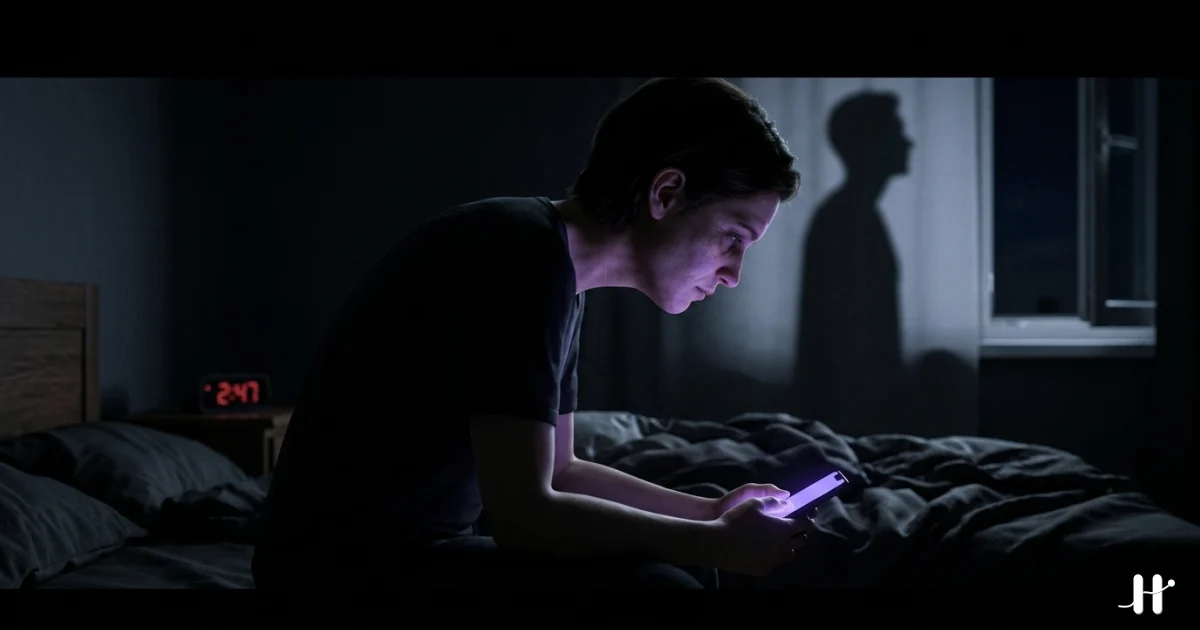
In February 2026, the American Academy of Sleep Medicine released a national poll on what bedtime screen use is doing to American sleep. The numbers are not subtle.
Across all adults, 38% say using their phone or tablet to view news and current events before bed makes their sleep slightly or significantly worse. Among adults aged 18 to 24, that number jumps to 46%. Adults 25 to 34 sit at 43%. The 35 to 44 cohort lands at 39%. Even adults 45 to 54 report 38%. The pattern holds across age groups, and it matches what sleep researchers have watched in lab settings for over a decade. The phone is winning a bedtime contest with the body.
This post pulls together what we actually know: where the consensus is strong, where it is still contested, and what reverses the damage. Every figure here is sourced. None of it asks you to take our word for anything.
The 2026 baseline
The AASM poll surveyed 2,007 US adults, with fieldwork run by Atomik Research from June 5 to 13, 2025 (AASM released the results in February 2026). Beyond the headline 38% number, the breakdown reveals the real story:
| Age group | % reporting worse sleep from phone use |
|---|---|
| 18 to 24 | 46% |
| 25 to 34 | 43% |
| 35 to 44 | 39% |
| 45 to 54 | 38% |
| 55 to 64 | 31% |
| 65+ | 22% |
The age gradient is consistent with sleep medicine literature. Younger adults sleep worse from phone use because they use phones more at bedtime, because their content diet skews more emotionally activating (TikTok, Instagram Reels, X), and because their sleep architecture is more sensitive to circadian disruption during late adolescence and early adulthood.
The earlier large-scale baseline is a 2014 systematic review by Hale and Guan in Sleep Medicine Reviews, which examined 67 studies on screen time and sleep in school-aged children and adolescents. They found that 90% of studies showed an adverse association between screen time and sleep outcomes. The 2026 AASM poll is, in essence, a 12-year update on a question that has had a clear answer the whole time. The phone is now the dominant screen, and the effect has scaled with adoption.
Mechanism 1: Blue light and melatonin
The mechanism most people have heard of is also the most measurable. Light in the 460 to 480 nanometre range (the spectrum smartphones, tablets, and most LED screens emit heavily) suppresses pineal melatonin secretion. Melatonin is the hormone that signals "it is time to sleep" to the rest of the body's circadian system. Suppress it for long enough in the evening and sleep onset latency (the time it takes to fall asleep) lengthens by 30 to 90 minutes in lab studies.
The threshold most cited in sleep research is two hours of pre-sleep screen exposure. Past two hours of evening phone or tablet use, melatonin suppression is measurable in saliva or blood samples. Below two hours, the effect is smaller and harder to isolate from confounding variables.
This is the part Apple's Night Shift, iOS True Tone, and similar features were meant to address. They reduce the blue-spectrum component of the screen's emission. The studies on whether they actually preserve melatonin are mixed. A 2021 BYU study found Night Shift produced no measurable improvement in sleep quality versus a non-shifted screen. The light is one input. The screen as a whole, including its content, is the larger one.
Mechanism 2: Emotional arousal and cortisol
Doomscrolling content is engineered to capture attention, and attention-capturing content is, definitionally, emotionally activating. News content is overwhelmingly negative. Social media content induces social comparison, FOMO, or low-grade anxiety. Even neutral content (cooking videos, dance clips) elevates dopamine in ways that delay the cortisol drop that normally accompanies sleep onset.
The relevant biology is the cortisol awakening curve. Cortisol should peak roughly 30 minutes after waking and decline through the day to its lowest point around bedtime. Emotional content keeps cortisol elevated past the point it should have fallen, which competes with the parasympathetic shift the body needs to begin sleep. This is sometimes described as the "wired tired" state: physiological exhaustion combined with neural overstimulation. The body wants to sleep. The brain is still in daytime mode.
This is why a 30-minute pre-bed scroll can be worse than a 90-minute pre-bed reading session, even though the screen exposure is shorter. What drives the sleep cost is the content profile, not just the screen time.
Mechanism 3: Sleep procrastination
There is a behavioural pattern researchers have named bedtime procrastination, and a sub-pattern called revenge bedtime procrastination. The first refers to delaying sleep despite no external requirement to stay awake. The second refers to people who feel they had no time for themselves during the day and use late-night phone time to claim that time back, even though it costs them sleep they need for the next day.
A 2014 study by Kroese et al. in Frontiers in Psychology documented that bedtime procrastination is a strong predictor of insufficient sleep, and that it is more common among people with low self-regulation scores. The phone is the modal vehicle for the behaviour. There is something to do, on the phone, that is more immediately rewarding than sleeping. The phone wins the choice. The next day pays for it.
This mechanism is purely behavioural. It does not require blue light, does not require emotional arousal, does not require any specific content type. It only requires the phone to be available in the bedroom and the user to be tired enough to want stimulation but not tired enough to fall asleep without help. That window opens for most people around 10 PM and closes around 1 AM.
Mechanism 4: Behavioural conditioning
Repeated phone use in bed creates a learned association: the bed is for the phone, not for sleep. Sleep medicine has known about this association for decades. The original treatment protocol for insomnia (stimulus control therapy, developed by Bootzin in 1972) is built on the opposite principle: the bed should be associated only with sleep and sex. Reading in bed, watching TV in bed, working in bed, scrolling in bed. All of these weaken the bed-equals-sleep association and prolong sleep onset latency.
Reviews of stimulus control therapy continue to show medium-to-large effect sizes for insomnia treatment when patients move screens out of the bedroom. The mechanism is conditioning, not biology. The body has learned that being in the bed does not necessarily mean falling asleep, so it stops releasing the cascade of physiological signals (lower body temperature, parasympathetic dominance, melatonin) it should release upon entering the bedroom.
Mechanism 5: Notification fragmentation
The fifth mechanism is the easiest to fix and the most often ignored. Notifications during sleep wake the brain partially, even if you do not consciously remember waking. Sleep architecture cycles through four stages plus REM, and arousals during deep sleep stages cost more than arousals during light stages. A buzzing phone next to the bed produces a measurable reduction in deep sleep duration over a full night, even when the user reports they "slept fine."
Sleep medicine guidance broadly recommends Do Not Disturb mode at minimum, and ideally physical removal of the phone from the bedroom. The same principle applies to adults. The notification you do not see is the one your brain is not partially processing.
The downstream costs
Sleep loss accumulates as a debt that compounds. Missing one night of recommended sleep produces a measurable next-day decrement in cognition, mood, and metabolic regulation. Missing seven nights in a row produces effects on cardiovascular function and immune response. Missing months of partial sleep produces a documented increase in risk for the conditions sleep researchers have studied longest:
- Cardiovascular: increased risk of hypertension, atrial fibrillation, and stroke (Walker, 2017)
- Metabolic: insulin resistance, weight gain, and increased risk of type 2 diabetes (Spiegel et al., 1999, replicated repeatedly since)
- Cognitive: reduced working memory, attention, and emotional regulation (Killgore, 2010)
- Mental health: insomnia is one of the strongest known predictors of subsequent depression (Baglioni et al., 2011)
- Long-term: chronic sleep deprivation is associated with elevated risk of dementia in midlife and beyond (Sabia et al., 2021, Nature Communications)
None of these are caused by phone use specifically. They are caused by the cumulative sleep loss that phone-driven sleep procrastination produces. The phone is upstream of the deficit. The deficit is upstream of the disease.
What actually works
The research on improving sleep when phone use is the primary disruptor is unusually consistent. Five interventions have the strongest evidence:
- Charge the phone in another room. This is the single intervention with the largest effect size in behavioural sleep medicine. It works because it removes the choice rather than relying on the user to make the right one each night.
- Set a phone bedtime that is earlier than your sleep bedtime. Aim for 60 to 90 minutes of phone-free time before sleep onset. This gives the cortisol curve time to fall, the melatonin curve time to rise, and the brain time to disengage from the active processing state the screen induced.
- Use Do Not Disturb or Sleep Focus aggressively. If the phone must stay in the room, every notification suppressed is a partial arousal prevented.
- Replace the scroll session with a different default. Reading a paper book, journaling, or doing a basic stretch routine all work in the role the phone has been playing. Substitution beats prohibition; the brain wants the wind-down input, just not from a screen.
- Use a structural blocker if willpower has failed twice. If you have committed to phone-free wind-downs and broken the commitment more than twice, willpower-only solutions are not going to work. Apps like Habit Doom lock the apps you tend to scroll until your morning habits are completed the next day, which means Instagram and TikTok are simply not available between 10 PM and your morning workout. The bypass option is not there to use.
The first three cost nothing. The fourth costs a paperback. The fifth is the floor for people whose sleep has been wrecked for months and who have already exhausted the other four. None of them ask you to give up the phone entirely. All of them ask you to give up the phone in the bedroom, in the last 90 minutes of the day. That is the part of the day that decides how tomorrow feels.
Frequently Asked Questions
Keep Reading
Try Habit Doom
Lock your distracting apps. Complete your habits. Earn your screen time. It takes 30 seconds to set up.
Download Free