


Best Habit Tracker for ADHD iPhone (2026)

 X
X LinkedIn
ADHD changes how habit trackers work. The standard advice for habit formation (start small, be consistent, track your progress) assumes a baseline of executive function that ADHD users have less reliable access to. So trackers built for the average user tend to fail ADHD users in specific, predictable ways. And the apps that do work for ADHD users tend to share design choices that ADHD researchers actually recommend.
This guide reviews five iPhone habit trackers in 2026 that work for ADHD users. The picks emphasize three properties: real forcing functions for low-motivation days, dopamine-aligned reward mechanics, and reduced cognitive overhead. None of the apps below are explicitly marketed for ADHD, but all of them survive ADHD failure modes better than the average tracker.
Why most habit trackers fail ADHD users
The standard streak-tracker model has three structural problems for ADHD users.
Streak anxiety hits harder. ADHD users tend to experience all-or-nothing thinking more acutely. A 47-day Streaks chain resetting on a missed day feels like a verdict, not data. The cost of restarting from zero is amplified, which accelerates abandonment compared to neurotypical users.
Interface density competes with executive function. Many trackers (Done, Productive, even Habitica) present dense information on the home screen. For ADHD users whose working memory is already taxed, the interface itself becomes a cost. Opening a busy tracker can feel like another task rather than a quick check-in.
Motivation fluctuates more. ADHD reward sensitivity is well documented. Dr. Russell Barkley's ADHD research shows that ADHD users respond more strongly to immediate rewards and less reliably to delayed ones. Pure trackers depend on the user maintaining motivation across the 66 days that habit research says automaticity requires. ADHD users' motivation does not last 66 days at consistent levels without external scaffolding.
Apps that succeed for ADHD users address at least one of these problems. The best ones address all three.
Quick comparison: 5 ADHD-friendly habit trackers (2026)
| App | ADHD Strength | Mechanism | Cognitive Load | Price |
|---|---|---|---|---|
| Habit Doom | Real forcing function | iOS app blocks tied to habits | Low | Free + $4.99/mo |
| Habitica | High dopamine density | RPG gamification | High | Free + $4.99/mo |
| Way of Life | Lowest cognitive load | Calendar dot log | Lowest | Free + Premium from $4.99 |
| Streaks | Clean reward visual | Unbroken chain | Low | $5.99 one-time |
| TickTick | Combined task + habit | Task manager with habits | Medium | Free + $3.99/mo |
Each picks a different ADHD-friendly property. None of them are universally best. The right choice depends on which ADHD failure mode the specific user faces most often.
Detailed reviews
1. Habit Doom: Real forcing function
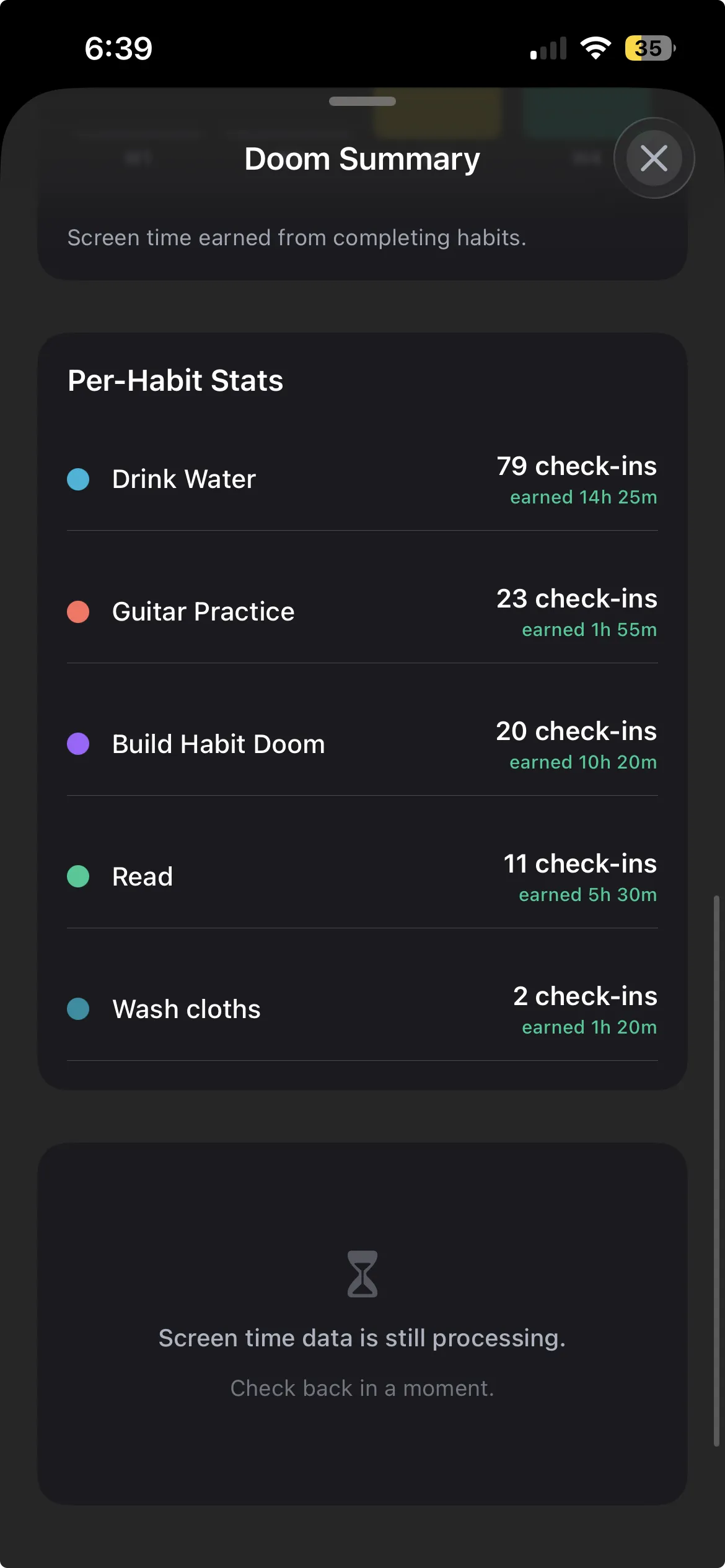
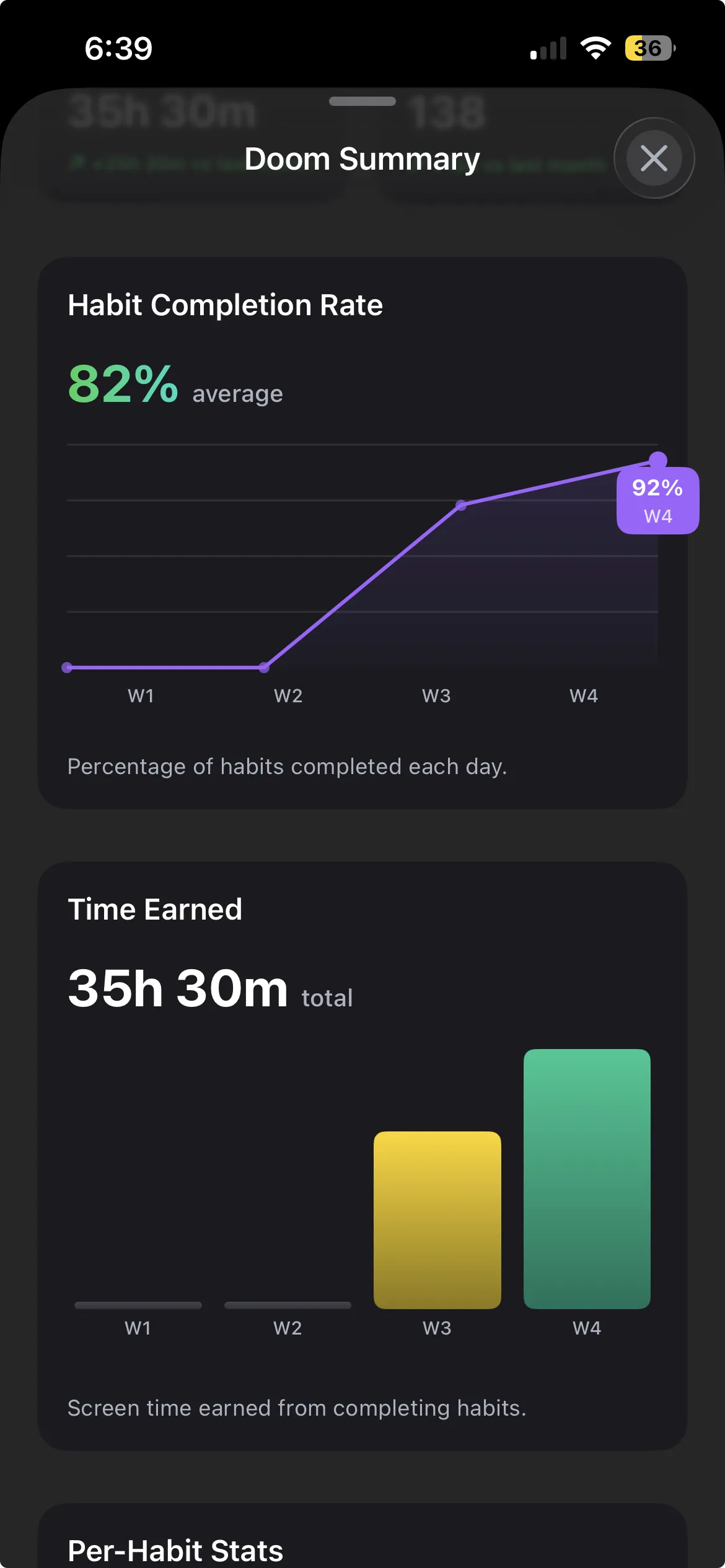
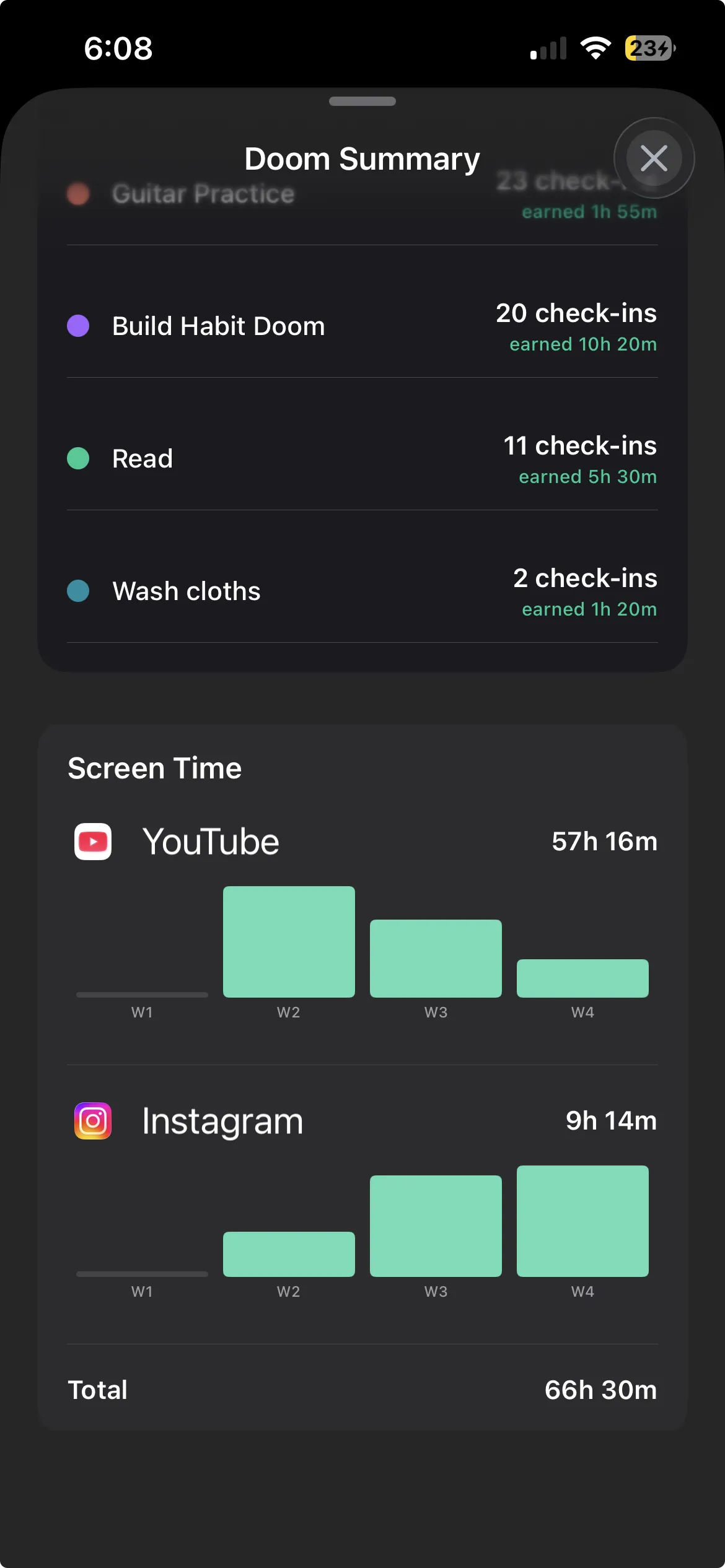
Habit Doom locks selected iOS apps at the ManagedSettings system level until daily habits are checked off. For ADHD users whose habit failure mode is attention defaulting to the phone, the lock removes the moment-of-weakness decision that ADHD often loses. The user does not have to choose discipline at 9 PM when Instagram is calling. The choice was made earlier, at habit setup. The system enforces it.
This addresses the dominant ADHD-relevant scenario. Someone with ADHD who wants to read more, exercise more, or journal more usually loses those habits to the phone. Pure trackers ask you to redirect attention through willpower. Habit Doom redirects it through structural blocking. And the dopamine pop of finishing the habit and unlocking the phone matches ADHD reward sensitivity better than pure-tracker approaches do.
The interface is among the lowest cognitive load in the category. Three screens: habits, locked apps, settings. No RPG, no coaching, no analytics. ADHD users who get overwhelmed by feature-heavy trackers find Habit Doom restful. See how Habit Doom works for the mechanic.
For ADHD, the strength is that real iOS-level forcing function, and the trade-off is that you have to define daily habits before it can do anything. It is free, with premium at $4.99/month or $29.99 lifetime.
2. Habitica: High dopamine density
Habitica's RPG mechanics produce more frequent micro-rewards than any other tracker. Each habit completion earns experience and gold. Skipped habits cost HP. Party members complete quests together. For ADHD users who respond to gamification, the frequent reward feedback aligns with dopamine seeking better than pure trackers.
The community is the underrated feature. Habitica parties function as accountability groups, which addresses the ADHD struggle with self-imposed deadlines. A user who would not work alone often works in a party. The social mechanic does what the streak counter cannot.
The trade-off is interface density. Habitica's dashboard is the busiest of the five, by a lot. For ADHD users prone to visual overwhelm, the constant HP, gold, party invites, and quest prompts can be counterproductive. It works strongly for ADHD users who enjoy games and fails for the ones who get overstimulated by them. There is no middle ground here.
The ADHD draw is gamification that maps onto dopamine seeking, offset by a busy interface that can overstimulate the users most prone to visual overwhelm. Habitica is free, with optional cosmetic IAPs.
3. Way of Life: Lowest cognitive load
Way of Life is the minimalist endpoint of habit trackers. Three habits maximum on the free tier, red green or yellow dots on a calendar, no streaks, no widgets, no game. For ADHD users who get overwhelmed by feature-heavy productivity apps, Way of Life is the most restful option.
The advantage for ADHD users is that opening the app does not feel like a task. The visual is the data. The data is the visual. There is nothing to manage beyond the three daily check-offs. For users whose executive function is preserved for the habit itself, this minimalism is genuinely useful.
The trade-off is the lack of stimulation. Way of Life can fade into the background and stay there. For ADHD users who need the app to push them, that minimalism just becomes invisibility. It works for ADHD users with strong intrinsic motivation and fails for those who need external scaffolding.
What ADHD users get here is the lowest cognitive overhead in the category, and what they give up is stimulation, so little that the app can quietly fade from the routine. It is free for 3 habits, with a roughly $5.99 unlock beyond that.
4. Streaks: Clean reward visual (with caveat)
Streaks delivers clear visual reward through the unbroken chain. The aesthetic is the strongest in the category. The Apple Watch complication is excellent. For ADHD users who respond to immediate visual feedback, the daily chain extension provides the dopamine pop that pure logging cannot.
The caveat is the streak-reset mechanic. ADHD users hit by streak anxiety more acutely than neurotypical users tend to abandon Streaks faster after a missed day. The same mechanic that produced reward for 47 days produces disproportionate cost on day 48. For ADHD users specifically, the all-or-nothing chain often shortens retention rather than extending it.
For ADHD users with strong follow-through on existing habits, Streaks is a beautiful logbook. For ADHD users still building habits, the streak-reset risk is real. Habit Doom's daily-reset model addresses the same need with less downside for ADHD-specific failure modes.
Streaks brings strong visual reward density, but the streak-reset mechanic amplifies the all-or-nothing thinking many ADHD users already fight. It is a one-time $5.99.
5. TickTick: Tasks plus habits
TickTick combines tasks and habits in a single tracker. For ADHD users who already use TickTick for task management, habits fold into the existing workflow without adding another app to remember.
The advantage for ADHD is reduced app switching. Many ADHD users struggle with managing multiple productivity apps. TickTick's combined experience is one home for both tasks and habits, which reduces the surface area where the system can fail.
The trade-off is that habits in TickTick feel like a secondary feature. The polish is on the task side. Users wanting habits-first design find Habit Doom, Streaks, or Habitica more focused. Users prioritizing simplicity in their app stack find TickTick efficient.
For ADHD, the value is folding tasks and habits into one place so there is less app switching, though habits stay a side feature next to the task tools. TickTick is free with limits, and premium is $3.99/month.
How to pick by ADHD failure mode
The decision matches the specific ADHD failure pattern.
- The user loses habits to the phone. Habit Doom. The forcing function is exactly what the failure mode requires.
- The user loses habits to low motivation on bad days. Habitica's RPG produces high reward density.
- The user gets overwhelmed by app interfaces. Way of Life or Habit Doom. Both are low cognitive load.
- The user has strong intrinsic motivation and wants clean visuals. Streaks, accepting the streak-reset risk.
- The user juggles multiple productivity apps. TickTick.
The 2026 ADHD-friendly tracker is the one whose forcing function or reward density compensates for the specific executive function the user is short on. For users whose phone is the obstacle (the most common ADHD-relevant scenario), Habit Doom is the only iPhone app in 2026 that combines low cognitive load with real iOS-level enforcement. For users whose obstacle is motivation, Habitica produces the highest reward density. For the broader ADHD app blocker survey see the best app blocker for ADHD breakdown.
Frequently Asked Questions
Keep Reading
Try Habit Doom
Lock your distracting apps. Complete your habits. Earn your screen time. It takes 30 seconds to set up.
Download Free