

The Atomic Habits App Test

 X
X LinkedIn
James Clear's Atomic Habits sold over 20 million copies by 2026 because the framework is simple, the prose is clean, and the underlying behavior science is correct. Clear distilled the academic work of B.F. Skinner, B.J. Fogg, Wendy Wood, and Charles Duhigg into four practical laws of behavior change. The book is the most-recommended habit-building reference on Reddit, in productivity newsletters, and across the self-improvement category.
The book does not recommend a specific habit tracker. Clear's framework is app-agnostic by design. The principles work with paper, with a wall calendar, with any iPhone app, or with no tracker at all. So the interesting question is not "which app did Clear endorse." It is "which app implements his framework most directly." This guide maps six iPhone habit trackers in 2026 to Clear's four laws and shows which app is the strongest fit for which law.
Clear's framework, in 90 seconds
Atomic Habits organizes behavior change around the Four Laws.
First Law: Make it obvious. Habits need a clear cue. The cue can be a time, a location, a preceding action, or an environmental trigger. Clear's advice is to make the cue impossible to miss. Place the running shoes by the door. Set the cue in a stable context.
Second Law: Make it attractive. Pair the habit with something pleasurable. Make the cue and craving emotionally compelling. This is where reward bundling, social accountability, and identity framing come in.
Third Law: Make it easy. Reduce friction for the desired behavior. Two-minute rule: make the entry point so small that motivation does not need to be high. Optimize the environment so the right behavior is the easy default.
Fourth Law: Make it satisfying. Habits stick when the reward is immediate. Long-term benefits do not motivate at the moment of action. The tracker, the visible chain, the small immediate reward is what reinforces the loop.
Clear also provides the inverse, which is often overlooked: to break a bad habit, make it invisible, unattractive, difficult, and unsatisfying. This is where environment design and app-blocking enter the framework directly. The inverse Third Law (make it difficult) is the structural fit for iPhone app blockers.
Quick comparison: 6 apps mapped to Clear's framework (2026)
| App | Obvious | Attractive | Easy | Satisfying | Inverse (Difficult) |
|---|---|---|---|---|---|
| Habit Doom | Moderate | Moderate | Strong | Strong | Strongest (iOS blocks) |
| Streaks | Strong | Moderate | Strong | Strongest (chain) | None |
| Habitica | Strong | Strongest (RPG) | Moderate | Strong | Weak (virtual HP) |
| Forest | Strong | Strongest (tree visual) | Strong | Strong | Weak (virtual penalty) |
| Way of Life | Strongest (calendar) | Weak | Strong | Moderate | None |
| Productive | Strongest (widgets) | Moderate | Strong | Strong | None |
Each app excels at one or two of Clear's laws. None covers all four equally. The right choice depends on which law the user's habit goal most needs.
Mapping each app to Clear's principles
Habit Doom: The inverse Third Law made literal
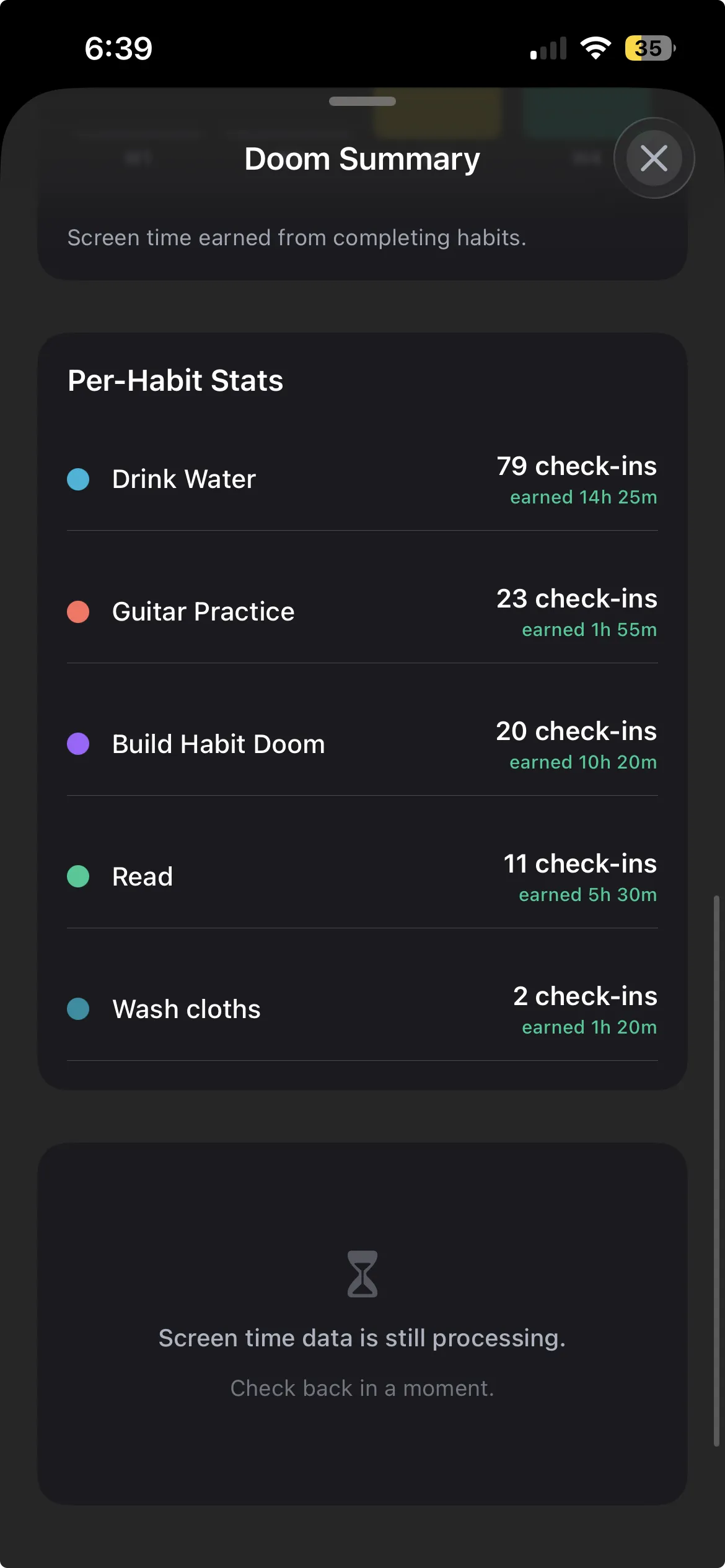
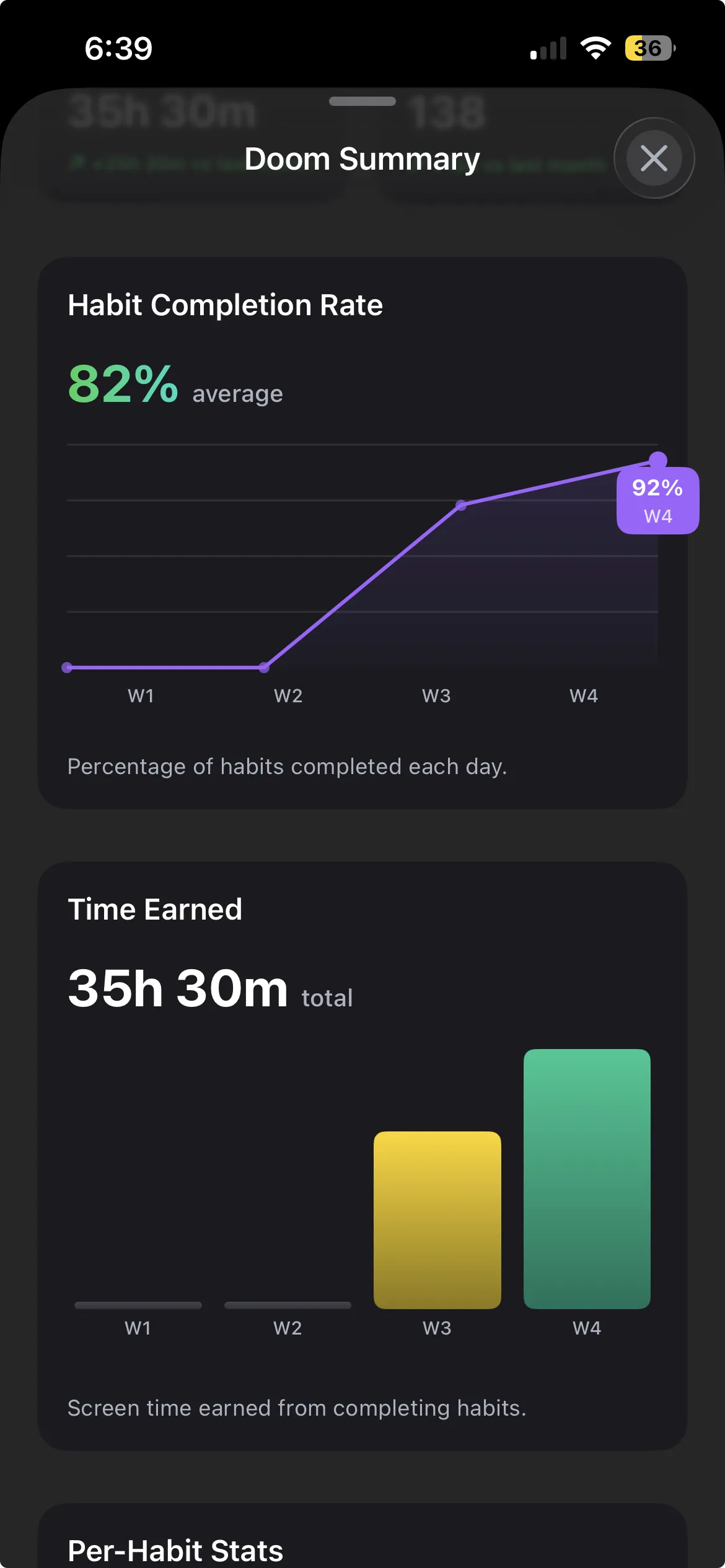
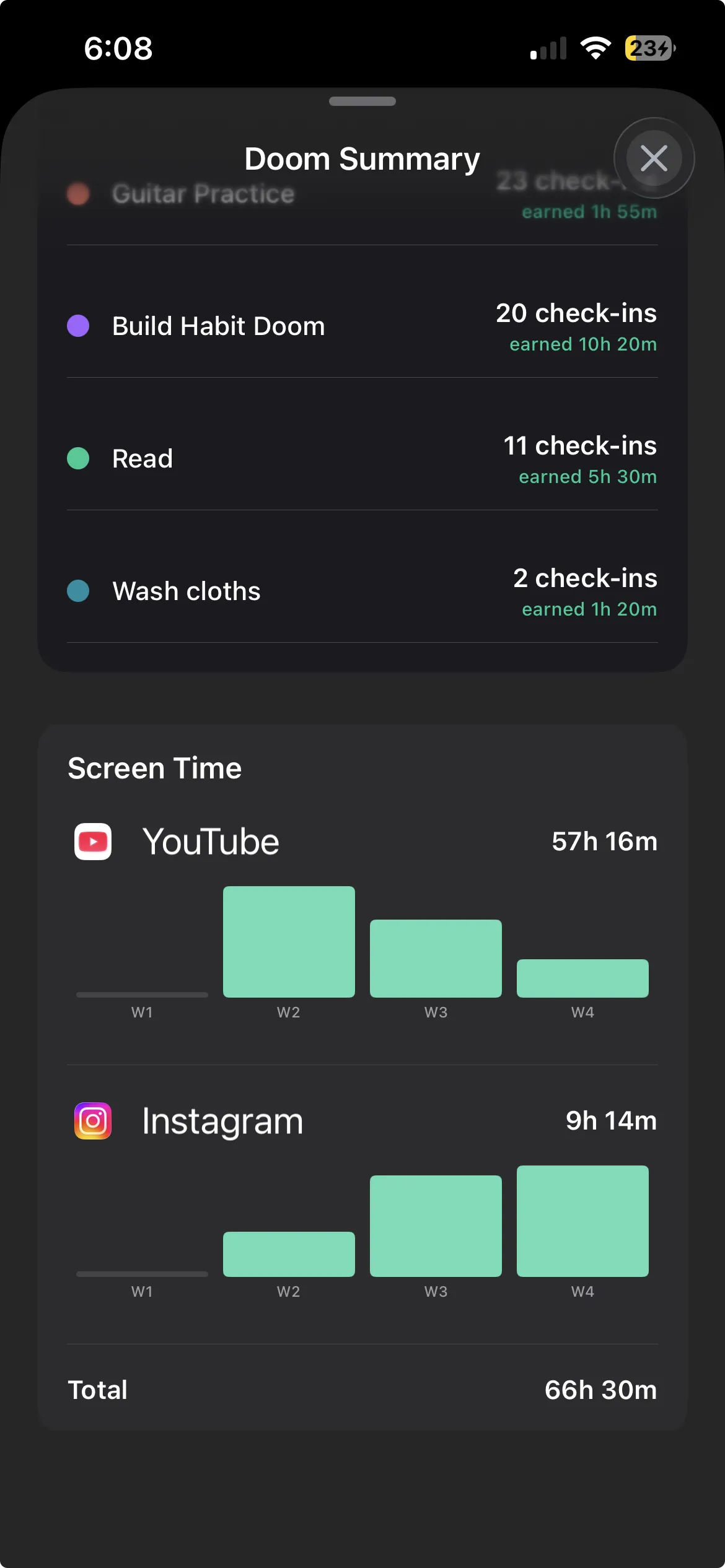
Habit Doom is the only app in the category that implements Clear's inverse Third Law (make it difficult) at the iOS system level. Selected apps stay locked at the ManagedSettings layer until daily habits are checked off. Opening Instagram during habit-formation hours is not just discouraged. It is not possible.
This aligns precisely with Clear's chapter on environment design. The argument is that willpower is finite, and the cleanest behavior change comes from engineering the environment so that bad habits become inconvenient. Habit Doom moves the environment design from the physical world into the iOS lock screen.
As of June 2026, a free feature called Anti-Cheat extends this to the check-off itself. Checking a habit can require a real-time photo that an AI model on the iPhone verifies against the habit in under half a second, with photos never leaving the device. This closes the gap Clear's Fourth Law warns about: a tracker is only satisfying if the completion is real, and an honor-system checkbox lets the user fake the reward. No other app in this comparison verifies that the habit actually happened. See the habit tracker you cannot cheat post.
For the positive laws, Habit Doom is solid but not best in class. Habits are reasonably obvious (the daily list, the morning alarm). Completion is satisfying (the unlock event ties immediate reward to habit completion). Habit Doom does not gamify or socialize, so the Second Law (make it attractive) is left to the user's intrinsic motivation.
For users whose primary obstacle is phone distraction, Habit Doom is the most Atomic-Habits-aligned app in the category because the inverse Third Law is exactly what their problem requires. See how Habit Doom works for the mechanic.
Streaks: Fourth Law specialist
Streaks is the most polished implementation of Clear's Fourth Law (make it satisfying). The unbroken visual chain delivers immediate visual reward for completed habits. The Apple Design Award is earned. For users motivated by the daily check-off, Streaks is genuinely best in class.
The limit is the Fourth Law's caveat in Clear's framework. Clear argues that the satisfaction has to survive imperfection. Streak resets violate this principle. A user who broke a 47-day chain feels the loss disproportionately, which Clear's framework would predict produces abandonment rather than continued behavior. For the broader pattern see streak anxiety.
If you already have discipline and treat the chain as decoration rather than fuel, Streaks fits Clear's framework nicely. Lean on the chain itself for your motivation, though, and you get exactly the failure mode the framework predicts.
Habitica: Second Law specialist
Habitica implements Clear's Second Law (make it attractive) more deeply than any other app. The RPG layer adds character progression, gold accumulation, party-based quests, and pet armor as motivational layers. For users who respond to gamification, Habitica produces sustained motivation by making the habit emotionally compelling in ways pure trackers cannot match.
The trade-off is that Habitica's enforcement (virtual HP damage) is weak. Your character takes damage. You might not even notice. The forcing function is real for engaged players and basically absent for anyone who does not buy into the game layer.
If your obstacle is "I do not find this rewarding," Habitica is the right Atomic-Habits-aligned tool. If it is "I get distracted by my phone instead," Habitica does nothing about the underlying environment.
Forest: Second and Fourth Law combined
Forest pairs Clear's Second Law (make it attractive) and Fourth Law (make it satisfying) through a single elegant visual. The growing tree is both pleasure during the focus session and accumulating satisfaction over time. The forest of completed sessions becomes a visual record of focused work.
Forest works best for focus sessions rather than daily habits, which limits its fit for the broader Atomic Habits framework. The cumulative forest is satisfying. The single dying tree from a failed session stings just enough to be motivating. If your habits map to focus sprints (Pomodoro-style work), Forest is the cleanest fit here.
For users with daily habits that do not map to focus sessions (read 10 pages, drink water, journal), Forest is the wrong shape. The mechanic is excellent for what it is. It just covers a narrower habit category.
Way of Life: First Law specialist
Way of Life's calendar log implements Clear's First Law (make it obvious) more directly than any other app. The red, green, or yellow dots make the user's pattern instantly visible. Reviewing a month or year of habits is unambiguous. The signal is the data itself.
For Clear's Second Law (attractive), Third Law (easy), and Fourth Law (satisfying), Way of Life is intentionally minimal. The aesthetic is closer to a paper journal than to a productivity app. Users wanting active motivation will not find it here.
For users following Clear's principle that awareness is the foundation, Way of Life is the most direct tool. The user sees the pattern. The pattern speaks for itself.
Productive: First Law via widgets
Productive uses iOS widgets and Lock Screen complications to implement Clear's First Law at the home screen level. Habits are visible without opening the app. The cue is the device itself, not a buried screen inside a productivity app.
Productive's widget design is among the best in the App Store. For users who interact with habits through widgets rather than dedicated app sessions, the constant visibility produces the cue-strength Clear's framework recommends. The aesthetic is modern and dark, which suits users who prefer interface density.
The trade-off is the subscription model and the absence of an enforcement layer. Productive tracks. Productive does not block, gamify, or socialize. For users whose problem is cue visibility, this is enough. For users with deeper obstacles, additional layers are needed.
How to pick by Clear's framework
The decision matches the user's primary obstacle to the law that addresses it.
- The obstacle is awareness. The user does not remember the habit exists. First Law: Way of Life or Productive.
- The obstacle is motivation. The user knows the habit but does not feel pulled toward it. Second Law: Habitica or Forest.
- The obstacle is starting. The habit is too large or has too much friction. Third Law: any tracker, paired with making the habit smaller. Habit Doom or Streaks for simple daily check-offs.
- The obstacle is sustaining. The user starts but stops. Fourth Law: Streaks for visual reward, or Habit Doom for the immediate unlock event.
- The obstacle is the phone competing with the habit. Inverse Third Law: Habit Doom is the only app that implements this at the iOS system level.
Most users have more than one obstacle. The honest framework is to start with the most pressing one and accept that the chosen app will not cover all of Clear's principles equally. The book is the framework. The app is the implementation. The user is the underlying behavior. The combination of all three produces the habit, regardless of which app does the tracking.
For deeper exploration of habit research see the deliberate practice breakdown and the habit tracker comparison.
Frequently Asked Questions
Keep Reading
Try Habit Doom
Lock your distracting apps. Complete your habits. Earn your screen time. It takes 30 seconds to set up.
Download Free