


Streak Anxiety: Habit Trackers That Forgive (2026)

 X
X LinkedIn
You have a 47-day Streaks chain and you miss a Tuesday. Wednesday morning the chain is back to zero. You look at the empty calendar and the cost of restarting feels bigger than the value of the habit itself. By Thursday the app is buried in a folder. By Sunday it is gone. That is streak anxiety, and it is the single most common reason people abandon habit trackers. It is also a direct consequence of the exact mechanic that made the tracker so engaging for the first 50 days.
This post covers five iPhone habit trackers in 2026 that handle missed days gently. The category is small but growing, as more researchers and designers notice that the all-or-nothing streak mechanic optimizes for engagement at the cost of retention.
What streak anxiety actually is
The Reddit pattern is consistent. A user on r/getdisciplined wrote about streak-based apps: "The streak apps were the worst, break the streak once and the whole system collapsed, and I'd come back angrier at myself than before." Another reply on the same thread: "The streak-and-shame thing is so real. I had the same experience where breaking a streak felt worse than never starting. Like cool, now I have guilt on top of the original problem."
The mechanic is structurally asymmetric. Building a chain feels good, and the reward scales with each new day, so the satisfaction at day 30 is higher than at day 5. Breaking the chain drops you back to zero, and the loss is total rather than proportional: a 47-day investment vanishes overnight. Loss aversion, well documented in behavioral economics, is roughly twice as motivating as an equivalent gain, and the streak mechanic ends up turning that against you.
The underlying habit research does not justify this design. Phillippa Lally's 2010 UCL study found a median 66 days to habit automaticity, with significant variance. A single missed day inside a 66-day window has no measurable impact on long-term habit formation. The all-or-nothing cost lives in the app, not in your actual progress.
Quick comparison: 5 habit trackers that handle missed days gently (2026)
| App | Missed Day Behavior | Underlying Mechanic | AI photo verification (Anti-Cheat) | Price |
|---|---|---|---|---|
| Habit Doom | Daily reset, no compound penalty | Habit completion unlocks apps | Yes (free) | Free + $4.99/mo |
| Habitica | RPG character takes HP, recovers | Gamified completion | No | Free + $4.99/mo |
| Way of Life | Calendar-style log, no chain | Red/green/yellow dot history | No | Free + Premium from $4.99 |
| Routinery | Routine completion, not streaks | Sequenced steps | No | Free + from ~$5.49/mo |
| Done | Per-habit counter, increments | Multiple completions per day | No | Free + $7.99/mo |
Each app handles the missed day differently, and none of them reduce accumulated progress to zero. Miss a Tuesday and you pick up on Wednesday with your long-term record still visible and intact.
Detailed reviews
1. Habit Doom: Daily reset, no compound penalty
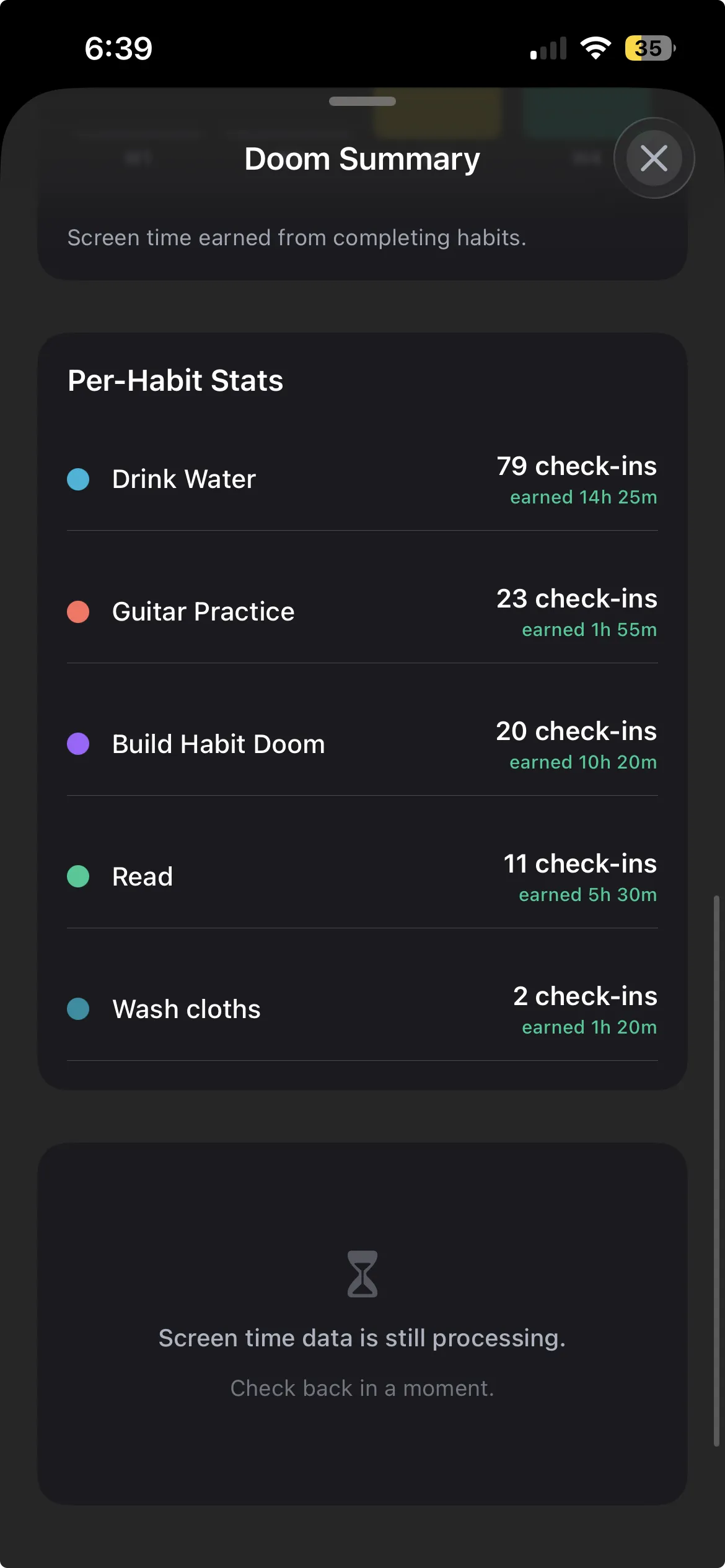
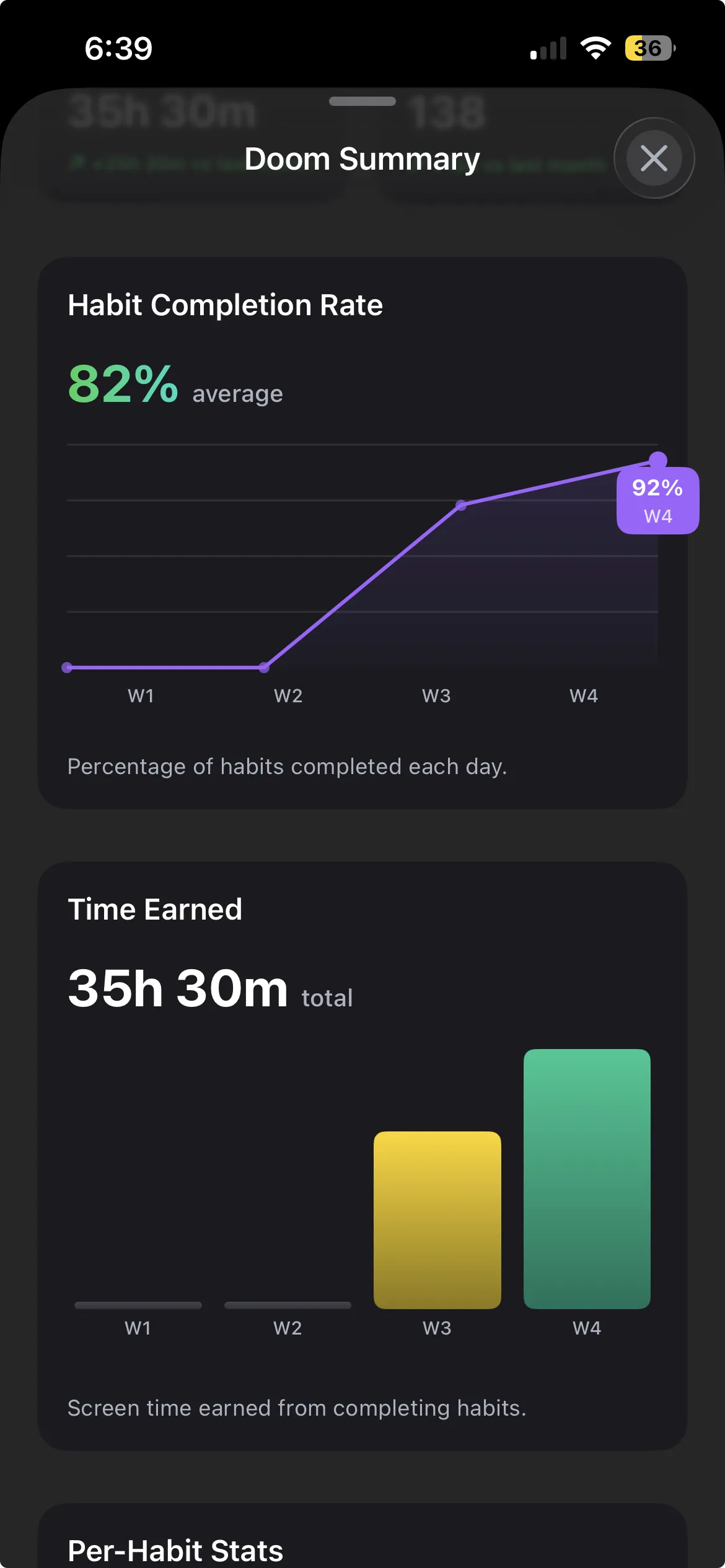
Habit Doom resets habits every day at midnight. A missed Tuesday has no bearing on Wednesday's list. You start fresh each morning. Long-term streak data is still logged and visible, but the missed day never compounds into a worse next day or a damaged record.
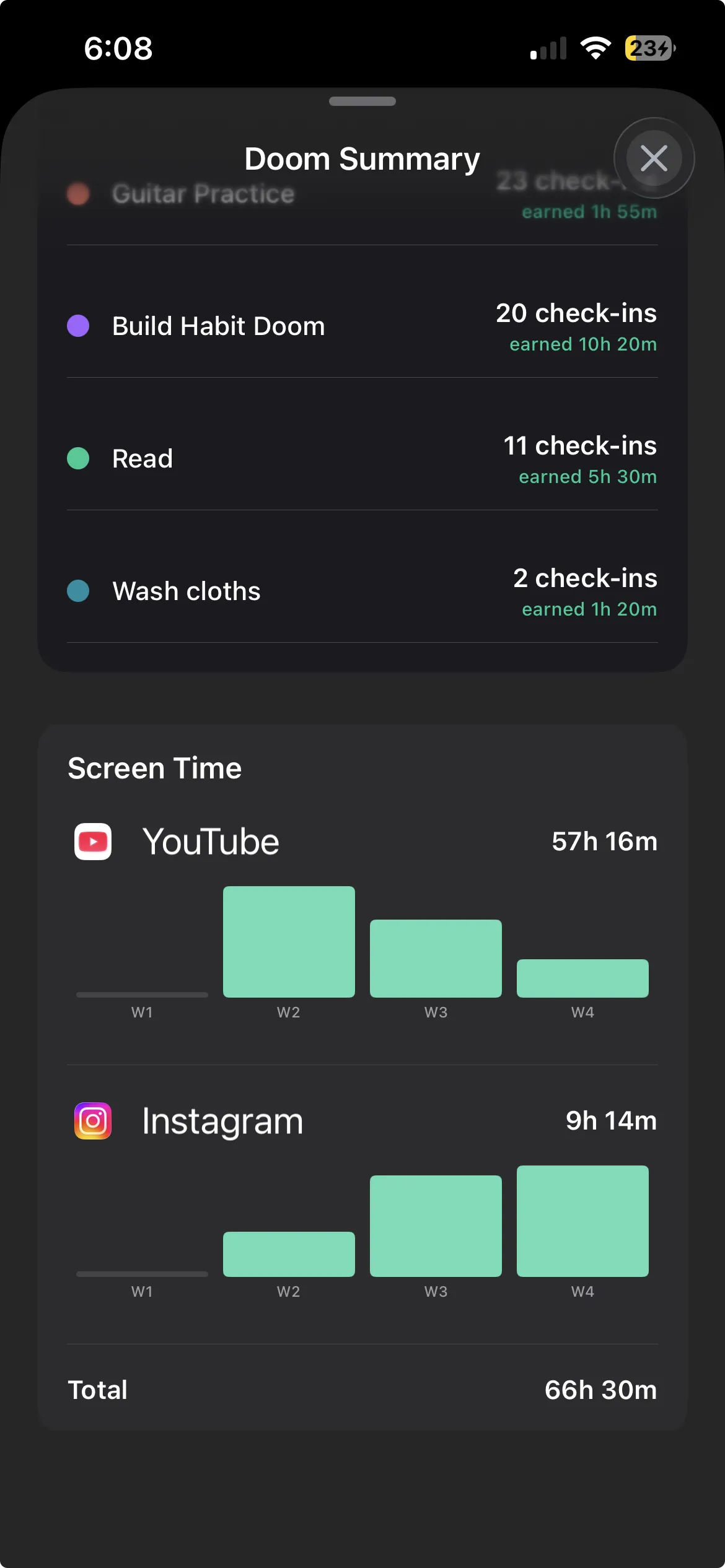
What makes that work is the forcing function. Habit Doom locks selected iOS apps until the day's habits are checked off. Miss yesterday's habits and you are not locked out any longer today; you get the same daily chance to check them off and unlock the apps. The lock pushes you toward the check-off without the streak-reset penalty. An optional free feature called Anti-Cheat makes the record itself trustworthy: checking off a habit opens the camera and an on-device AI model verifies a real-time photo matches the habit (usually in under half a second, with photos never leaving the phone), so a streak reflects days you actually did the thing rather than days you tapped a box. The habit tracker you cannot cheat post covers the verification.
If you specifically want a tracker that pairs with phone-blocking, Habit Doom is the most direct fit. See the how it works breakdown.
- Missed day handling: Reset daily. No compound penalty.
- Forcing function: iOS app blocks tied to habit completion.
- Price: Free, premium $4.99/month, $19.99/year, or $29.99 lifetime.
2. Habitica: RPG character takes HP, recovers
Habitica turns habits into an RPG character that levels up. Completing habits earns experience and gold. Skipping habits causes HP damage. The damage is real but bounded. The character does not die from a single miss. HP recovers over time and through completing other habits.
The gentle aspect is that the cost of missing a habit is virtual character damage rather than the loss of an accumulated visual asset. Users who respond to gamification find Habitica more sustainable than Streaks for this exact reason. The setback is recoverable.
The trade-off is interface density. Habitica is busier than minimalist trackers. Users who prefer aesthetics over RPG mechanics find it overwhelming.
- Missed day handling: Virtual HP damage, recoverable.
- Forcing function: RPG character progress.
- Price: Free, premium $4.99/month.
3. Way of Life: Calendar log without chains
Way of Life uses a journal-style calendar with red, green, or yellow dots for each habit-day. There is no streak counter. There is no chain visualization. The display is the historical record itself.
The aesthetic is the appeal. Look back over six months and you see a field of mostly green dots with the occasional red one. The missed days never erase the green ones. What matters is the pattern, not the longest unbroken run.
The limit is feature thinness. Way of Life is minimal by design. Users wanting widgets, HealthKit integration, or rich analytics will find it underbuilt. Users wanting a clean habit journal find it sufficient.
Missed days log as red or yellow, and there is no chain to break in the first place. No forcing function either; this is pure logging. It is free for 3 habits, with a roughly $5.99 one-time unlock after that.
4. Routinery: Routine completion, not streaks
Routinery organizes habits into sequenced routines. A morning routine might be brush teeth, stretch, journal, make coffee, and you move through it with timed prompts. The metric is whether the routine got completed, not whether a streak survived.
The gentle part is that the unit of tracking is the routine, not the individual habit. Skip the journaling step but do the rest and you still finish most of the routine. The all-or-nothing pressure never lands at the routine level.
The trade-off is rigidity. Routinery works if you like your day structured into pre-defined routines. If you prefer flexible daily habits without sequenced steps, it will feel constraining.
A missed day leaves the routine partially complete or skipped, with no chain to snap. There is no forcing function. It is free with limits, and premium runs $4.99/month.
5. Done: Per-habit counter that increments
Done tracks habits by counter instead of by streak. A "drink water" habit ticks up each time you drink; a "workout" habit ticks up each time you train. The metric is total completions, not consecutive days.
The advantage is that a missed day zeroes nothing. Your counter for the past month still reads 23 completions out of 30 possible. That is the real record, and a single skip does not turn it into a zero.
Done's interface is denser than most trackers because it supports power-user features (categories, multiple completions per day, custom intervals). If you track many habits on varied schedules, Done is the most flexible option here. If you just want a clean daily check-off, it is heavier than you need.
- Missed day handling: Counter unaffected. Tracks totals not streaks.
- Forcing function: None.
- Price: Free with limits, premium $7.99/month or $49.99/year.
How to leave Streaks without losing the benefits
The migration path that works for most people is to pair the new tracker with a forcing function. Streaks worked for the first 50 days because the chain itself was motivating. Take the chain away and the motivation has to come from somewhere else.
If your phone is the obstacle, Habit Doom's app blocks provide the forcing function. If you respond to gamification, Habitica's RPG mechanics fill the gap. If you just want a quiet log without any pressure, Way of Life holds up better than you would expect once the chain anxiety is gone.
The decision is not about finding the prettiest tracker. It is about finding the one whose missed-day behavior matches how you actually want to relate to your habits. Streak anxiety is a real cost, and choosing a tracker that does not impose it is one of the easier fixes to the broader habit system. For the wider habit tracker survey see the best habit tracker comparison and the research on why trackers stop working.
Frequently Asked Questions
Keep Reading
Try Habit Doom
Lock your distracting apps. Complete your habits. Earn your screen time. It takes 30 seconds to set up.
Download Free