


Why Most Habit Trackers Stop Working After Week 3 (2026)

 X
X LinkedIn
A habit tracker has the highest first-week retention rate of any productivity app category. The user installs Streaks on January 1, checks off four habits on January 1, four on January 2, four on January 3. The visual chain is satisfying. The widget looks great on the home screen. Week one is the honeymoon.
Week three is the funeral. The same user has missed a check-in. The streak is broken. The app is in a folder. By week four it is uninstalled. The user blames willpower. The actual culprit is structural. Tracking is not enforcement. Asking the user to maintain motivation for the 66 days that habit research says automaticity requires is asking too much.
This post is the research-backed breakdown of why most habit trackers fail at consistent retention, what the major behavior researchers actually found, and what to install instead.
The 66-day number
The most cited modern habit formation study is Phillippa Lally's 2010 paper at University College London. Lally and colleagues tracked 96 participants attempting to form daily habits across a 12-week period. Participants chose their own habit (drinking water at lunch, doing 50 sit-ups before breakfast, eating fruit with dinner) and logged daily whether they performed it and how automatic it felt.
The median time to reach automaticity, defined as the habit feeling effortless and consistent, was 66 days. The range was wide. Some habits formed in 18 days. Some took over 254 days. And the variable that predicted faster formation was not motivation, intelligence, or willpower. It was repetition under stable conditions. That is it.
The 66-day number replaced an earlier 21-day claim, which had been a casual estimate from plastic surgeon Maxwell Maltz's 1960 book Psycho-Cybernetics. Maltz observed that his patients took about 21 days to adjust to a new face after surgery. The 21-day number leaked into self-help literature and stuck. The actual research, conducted half a century later under controlled conditions, found that habit formation takes roughly three times that long for the median user.
This number is the structural problem for habit trackers. The mechanic works for users who hold motivation for 66 days. Most users do not. The dropout curve is steep between weeks two and four, which matches the cumulative failure point of a streak mechanic combined with fading novelty.
What B.J. Fogg actually says about habits
B.J. Fogg runs the Behavior Design Lab at Stanford. His Tiny Habits framework is the most influential behavior design system in current use. The framework's core equation is that Behavior happens when Motivation, Ability, and Prompt converge at the same moment.
The implication for habit trackers is direct. The tracker handles prompt (the reminder notification). The tracker handles partial motivation (the streak badge, the visual chain). The tracker does not handle ability. The user wanting to read more is asked to choose between reading and Instagram every evening. Ability is not increased. The tracker is silent on which choice the user makes.
Fogg's emphasis on starting absurdly small ("floss one tooth") is a way of engineering ability. Make the habit so small that motivation does not need to be high. Most habit trackers do not enforce this. The user creates habits like "read 30 minutes" or "exercise 60 minutes" on day one, hits resistance on day three, skips day seven, and abandons by day fourteen.
What Wendy Wood adds: context stability
Wendy Wood at USC studies habit automaticity from a different angle. Her research, summarized in Good Habits, Bad Habits, emphasizes that habits form fastest when the cue, context, and behavior are stable.
The implication is that habit trackers fail when they ask the user to perform the habit in shifting contexts. A morning workout that happens in the same room at the same time after the same prior cue (waking up, drinking water, putting on workout clothes) forms quickly. The same workout performed at variable times in variable rooms after variable cues forms slowly, or not at all.
Habit trackers can support context stability, with reminders, location-based prompts, and HealthKit integration. Most do not enforce it. The user is free to attempt the workout at 6 AM Monday, 4 PM Tuesday, and 9 AM Saturday. The variability defeats automaticity even when the daily check-off log looks perfect. The log says success. The habit never forms.
The streak anxiety problem
The streak mechanic is the most effective short-term engagement driver in habit-tracker design. It is also one of the most common reasons users abandon trackers permanently.
The mechanic works for the first 50 to 100 days. The unbroken chain becomes a psychological asset. The user does not want to break it. Many users report continuing habits they no longer enjoy purely to preserve the streak.
The breakdown happens on the first missed day. The streak resets to zero. Some users restart. Many users feel that the value they accumulated has vanished, and the cost-benefit of restarting from zero is worse than uninstalling the app entirely. This is sometimes called streak anxiety. Reddit threads on habit-tracker abandonment frequently surface this pattern. A user on r/getdisciplined wrote that streak-based apps were "the worst" because "break the streak once and the whole system collapsed."
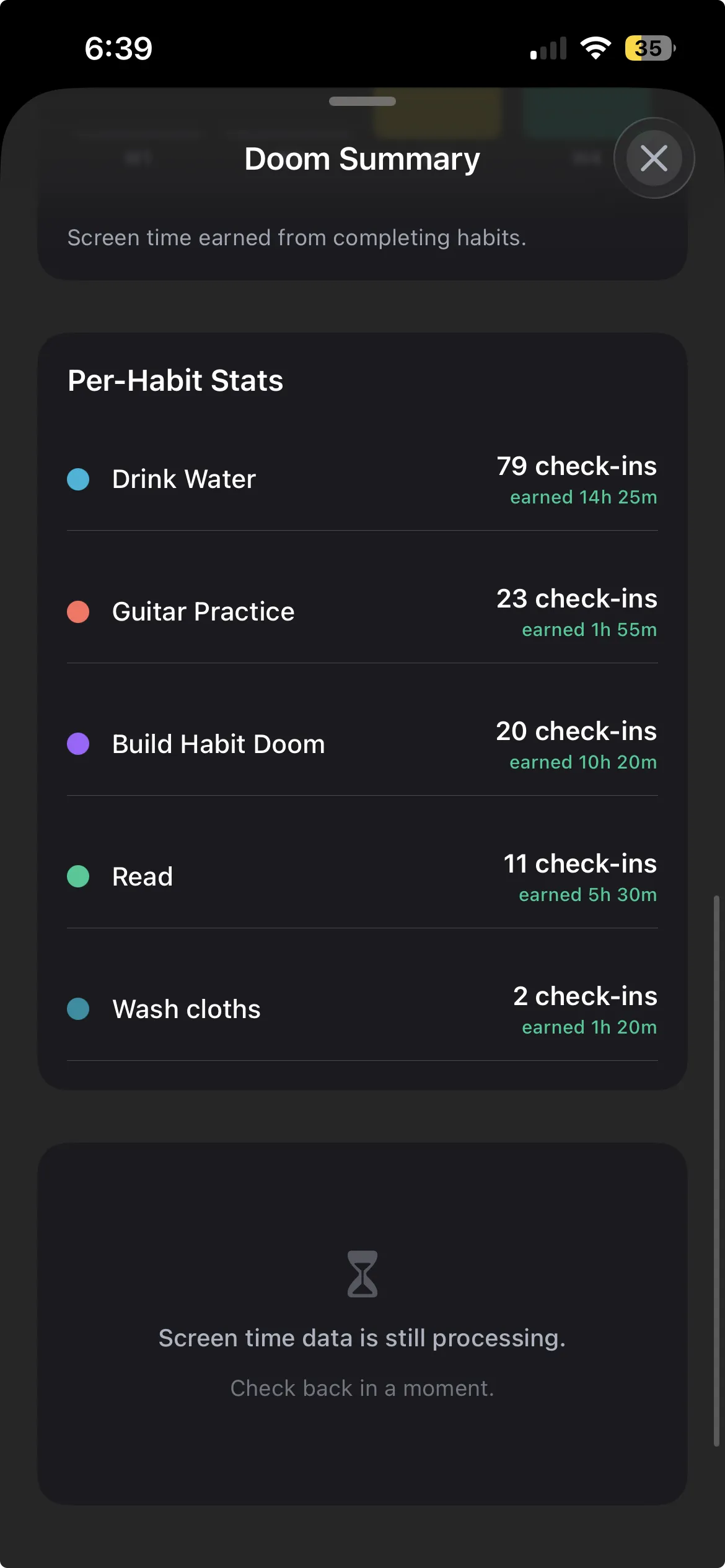
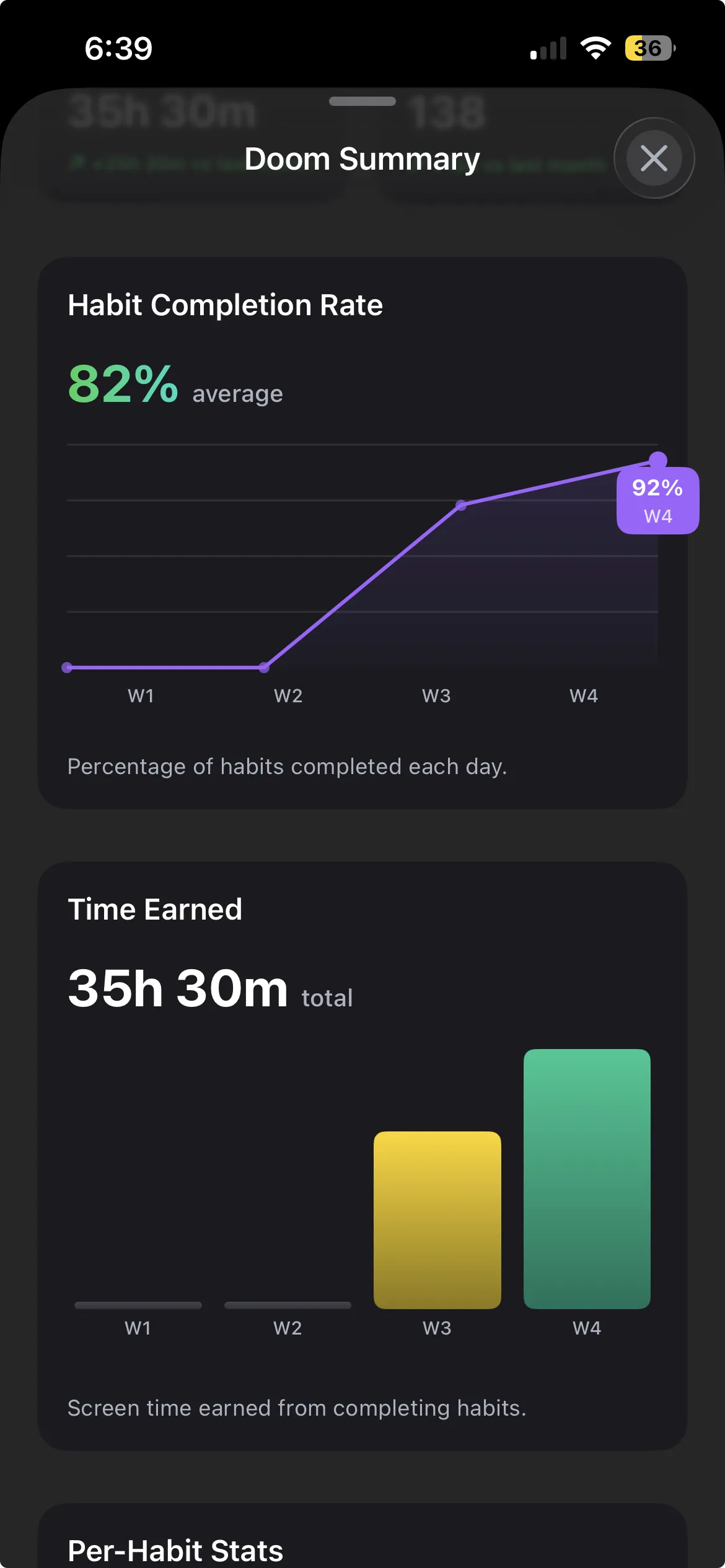
Trackers that handle missed days gently retain users longer. Habitica's RPG character takes HP damage and recovers. Habit Doom's habits reset daily, so a missed Tuesday does not compound into a worse Wednesday. Streaks, the Apple Design Award winner, uses the full streak-reset model and is the most aesthetically polished version of the mechanic that produces this exact abandonment.
What works: tracker plus forcing function
The habit trackers that retain users past week three pair the tracking layer with a forcing function. The forcing function makes skipping the habit expensive in a way the streak alone cannot.
Three categories of forcing function appear in the 2026 app landscape.
Virtual stakes. Habitica's character takes HP damage when habits are skipped. Forest's virtual tree dies if the user opens another app during a focus timer. The penalty is reputational and accumulates over time. For users who enjoy gamification, the virtual cost is meaningful. For users who do not, it fades quickly.
Social stakes. Flora's group focus sessions tie the user's focus to friends. Habitica parties function as accountability groups. Beeminder charges real money for missed habits. The social cost is the strongest forcing function for users with peer-driven motivation.
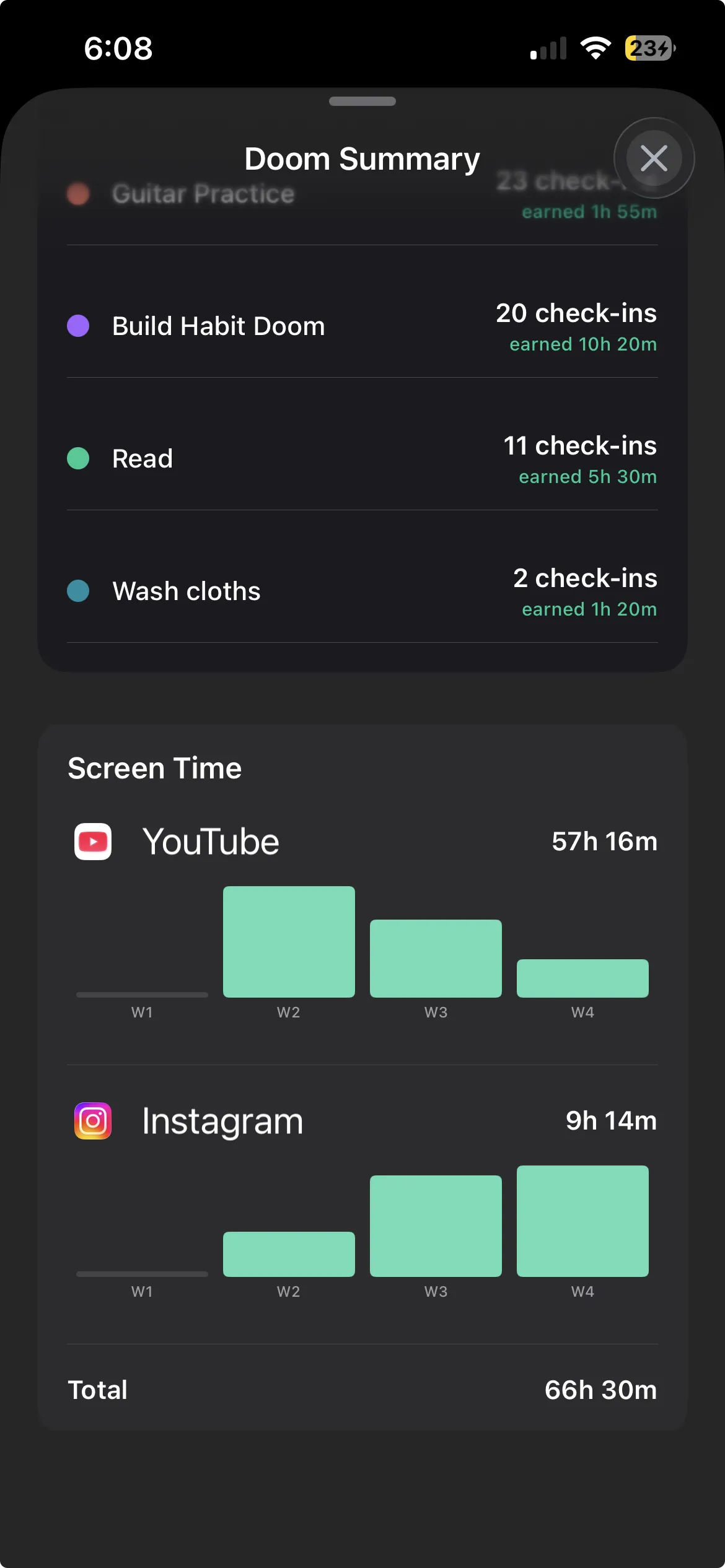
System stakes. Habit Doom locks selected iOS apps at the ManagedSettings layer until daily habits are checked off. The cost of skipping the habit is that Instagram, TikTok, YouTube, or whatever apps the user selected stay locked. This is the most direct forcing function for users whose habit failure mode is phone distraction. The mechanic is detailed in the habit tracker with app blocking breakdown.
The pattern across all three is the same. The tracker layer is necessary but not sufficient. The forcing function is what carries the user through the 66 days of repetition that habit research says automaticity requires.
The honest exception: tracking-only works for users with existing discipline
Pure habit trackers like Streaks and Way of Life are not bad apps. They are tools that match a specific user. For users with strong existing self-direction, the visual chain alone is enough. The user does not need the app to enforce anything. The app is a logbook.
This is a small minority of users. The larger group searching for a habit tracker is doing so because their existing self-direction has been insufficient. For those users, a tracking-only app is solving the wrong problem. The user does not need a better logbook. The user needs a forcing function.
How to pick
The decision tree.
- The user is logging habits that are already automatic and wants the satisfaction of a clean record. Streaks or Way of Life.
- The user enjoys games and responds to RPG mechanics. Habitica.
- The user works in focus sprints and wants reputational stakes. Forest.
- The user's habit failure mode is phone distraction. Habit Doom.
- The user needs serious accountability and is willing to pay. Beeminder or Flora.
The choice is not about the prettiest icon. It is about matching the failure mode. The tracker that survives past day 21 is the one whose forcing function aligns with what the user is actually fighting against.
The week 3 abandonment pattern is not a personal failure. It is a structural feature of pure tracking apps. The fix is not to try harder with the same tool. The fix is to install a tool that does the part the user cannot. For the broader habit tracker survey see the best habit tracker comparison. For the deliberate practice angle on what compounds when habits do hold see the daily habits compound breakdown.
Frequently Asked Questions
Keep Reading
Try Habit Doom
Lock your distracting apps. Complete your habits. Earn your screen time. It takes 30 seconds to set up.
Download Free