


Habitica Alternatives 2026: 5 Without the RPG Grind

 X
X LinkedIn
Habitica deserves its loyal community. The open-source RPG approach to habit tracking is genuinely unique. The party mechanic creates real accountability. The quest system maintains engagement past the point where pure trackers lose users. For users who respond to gamification, Habitica is the strongest fit in the App Store, and no alternative quite reproduces the depth of the RPG layer.
For users who do not engage with the game framing, though, Habitica is overbuilt. The interface is busier than competing trackers. The constant HP, gold, experience, and party references start to feel like ceremony that gets in the way of the actual tracking. By month two, plenty of users find themselves managing a character instead of building habits.
This guide reviews five Habitica alternatives for adults who want serious habit tracking without the RPG elements.
Best Habitica alternatives for adults (2026): Habit Doom (habit-locked app blocking with a free tier), Streaks (clean one-tap chains), Way of Life (journal-style color logging), Done (power-user tracking), and Productive (widget-driven routines). Each keeps the tracking and drops the RPG layer. Full comparison below.
Why adults outgrow Habitica
The structural mismatch: Habitica's mechanics are optimized for engagement, and engagement is not the same goal as habit formation. A user who checks Habitica four times a day to manage their character is engaging with the app. A user who builds the underlying habits is forming behavior. The two overlap, but they are not the same thing.
Adults who outgrow Habitica typically report one of three patterns.
The game stopped being fun. The novelty of leveling up faded. The new armor stopped feeling rewarding. The RPG layer became maintenance.
The interface became overwhelming. Habitica is denser than Streaks, Way of Life, or Habit Doom. For users who wanted a clean daily check-off, the dashboard's RPG references, party invites, and quest prompts add cognitive load.
The mechanic stopped enforcing. Virtual HP damage is real for users invested in the character. For users whose attention shifted elsewhere, the character takes damage and the user does not notice. The forcing function dissolves.
None of these patterns indicate Habitica failed at its design goal. They indicate the user's needs changed. The right move is a different tracker, not a heavier effort on the same one.
Quick comparison: 5 Habitica alternatives (2026)
| App | Mechanic | Interface | Enforcement | Photo verification | Price |
|---|---|---|---|---|---|
| Habit Doom | iOS app blocks tied to habits | Minimal | iOS ManagedSettings | Yes (free) | Free + $4.99/mo |
| Streaks | Visual chain, 12 habits max | Polished, simple | None | No | $5.99 one-time |
| Way of Life | Calendar dot log | Journal-style | None | No | Free + Premium from $4.99 |
| Done | Counter-based, multi-completion | Dense, power user | None | No | Free + $7.99/mo |
| Productive | Widget-driven tracking | Modern, dark | None | No | $2.99/week |
Habit Doom is the only one with a forcing function. The other four are pure trackers with different aesthetics and complexity levels.
How each alternative differs from Habitica
| App | How it differs from Habitica |
|---|---|
| Habit Doom | Replaces Habitica's virtual HP damage with real iOS-level app blocking. |
| Streaks | Keeps the daily check-off and drops the game entirely: just the visual chain. |
| Way of Life | The simplest option here, a red, green or yellow dot per habit per day, with no streak counter and no game. |
| Done | Unlimited habits, categories and detailed analytics, with none of the RPG mechanics. |
| Productive | Built around iOS widgets and Lock Screen complications rather than a game loop. |
Detailed reviews
1. Habit Doom: Real enforcement, no RPG
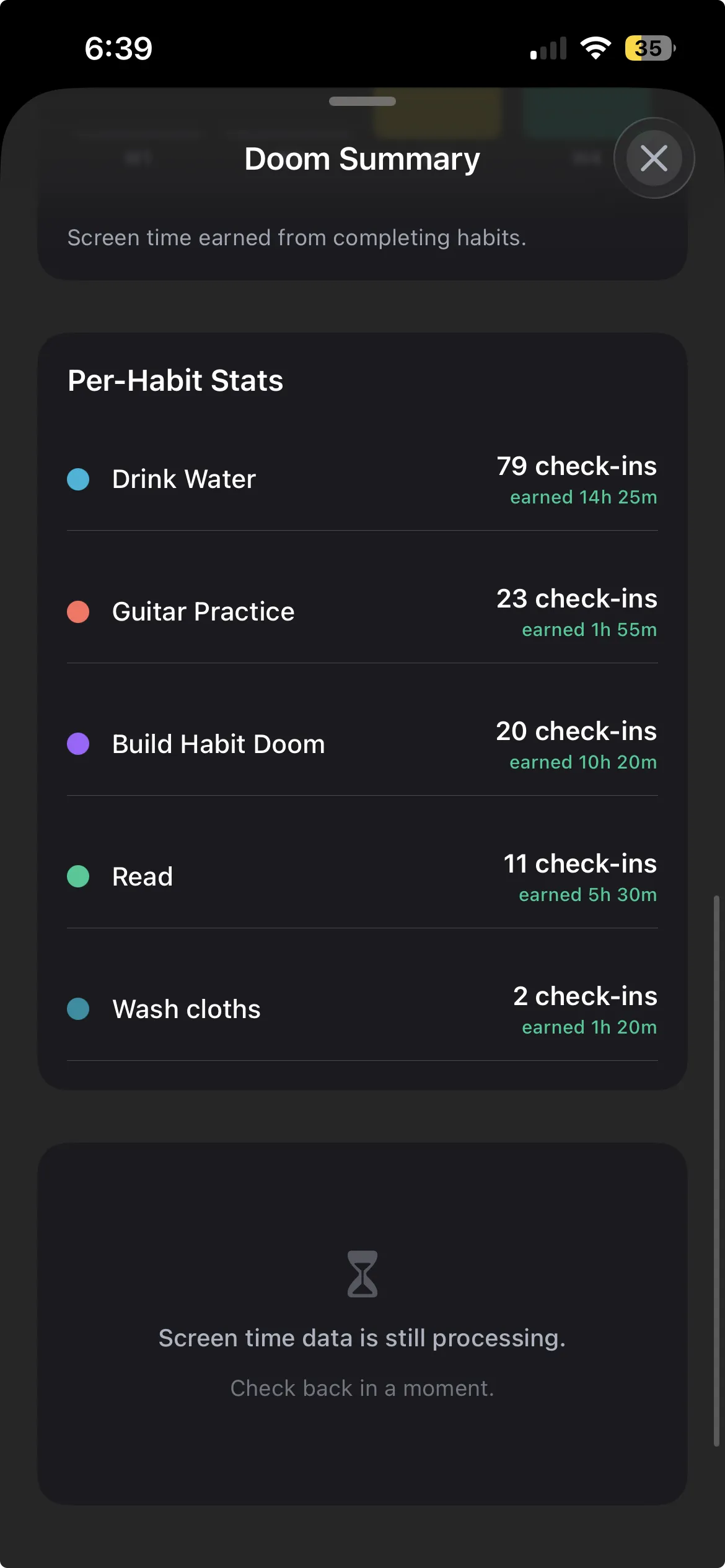
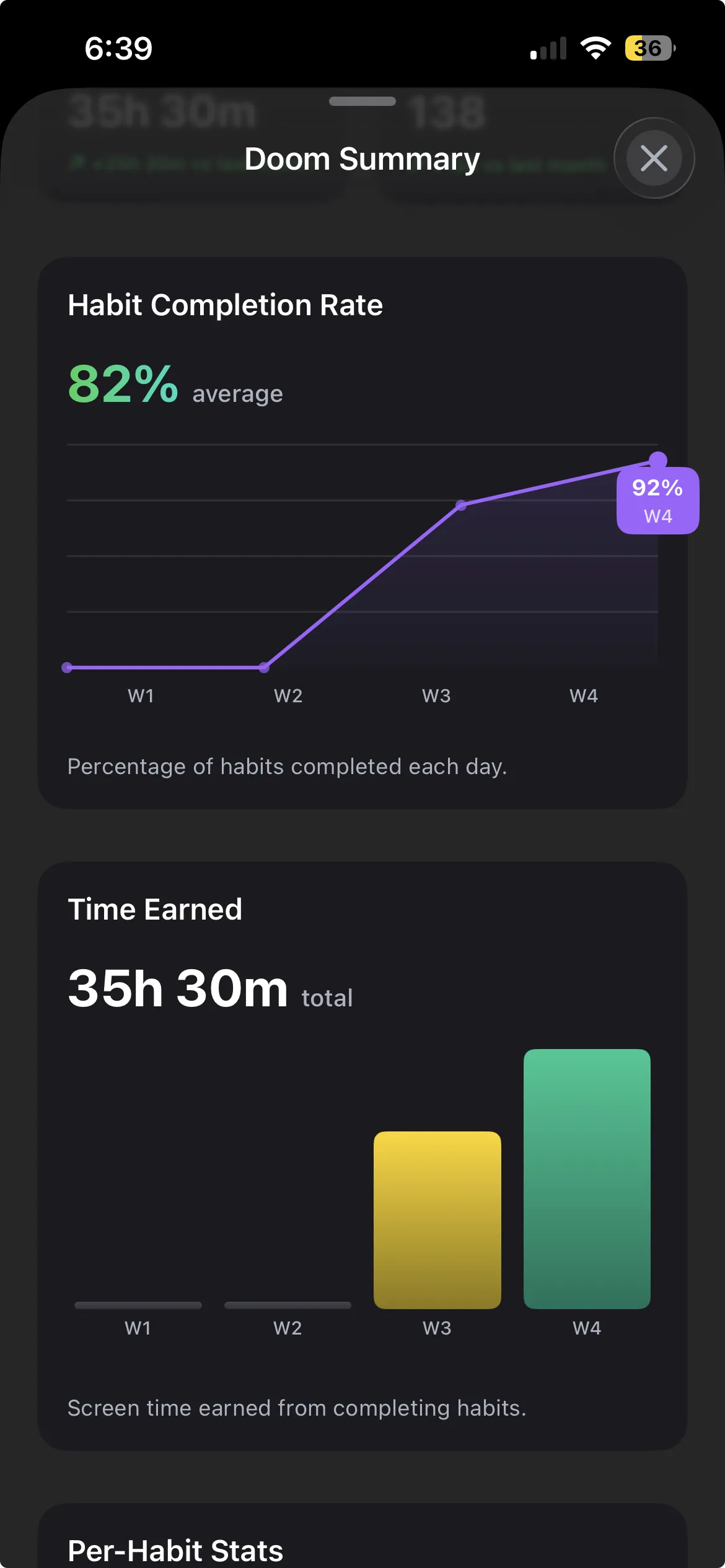
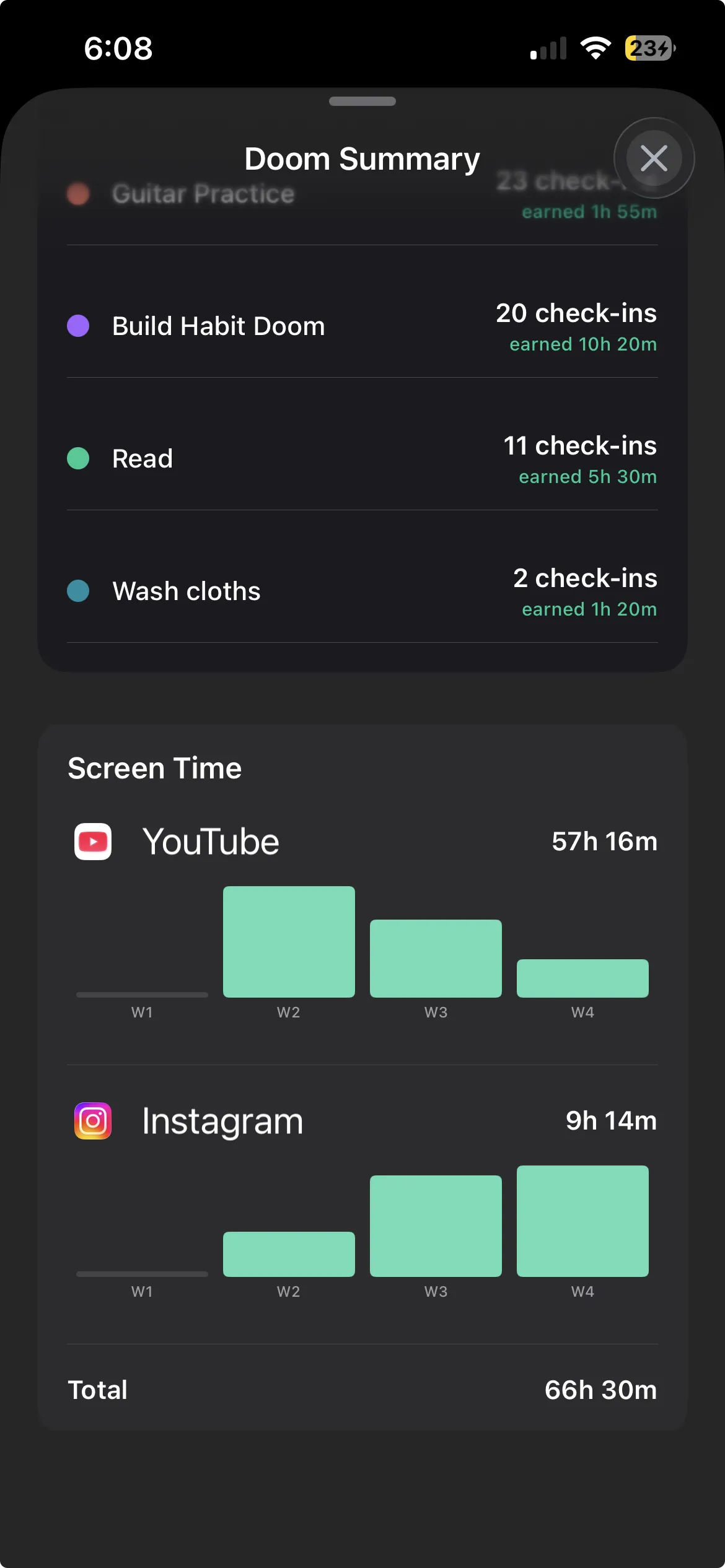
Habit Doom replaces Habitica's virtual HP damage with real iOS-level app blocking. Where Habitica's character takes damage when you skip a habit, Habit Doom keeps Instagram, TikTok, YouTube, and whatever else you select locked at the iOS ManagedSettings level. The penalty is not cosmetic, and you cannot tap through it.
For anyone who responded to Habitica's virtual forcing function but wanted it to bite in the real world, this is the most direct match. The shape is identical, skip the habit and pay a cost, except the cost moves from the game to the phone. There is no character to manage and no inventory to maintain: you define habits, pick apps to lock, and the system handles the rest.
The trade-off is the missing social layer. Habit Doom has no parties, quests, or community challenges, so anyone who stayed with Habitica specifically for that accountability will feel the absence. Anyone who was really there for the enforcement, and treated the social features as a bonus, gets a cleaner version of the core mechanic.
June 2026 added a verification layer called Anti-Cheat. Ticking a habit prompts a live photo, verified on the phone itself against what the habit claims to be, with nothing uploaded anywhere. Habitica, like the other trackers here, records completion on your word alone. For anyone whose virtual HP damage stopped enforcing once the character stopped feeling real, the photo check is a real-world version of the same forcing function. It is opt-in, free for everyone, and covered in the habit tracker you cannot cheat breakdown.
Against Habitica, it swaps virtual HP for real iOS-level enforcement, at the cost of any social or RPG layer. It is free, with premium at $4.99 a month, $19.99 a year with a 7-day free trial, or $29.99 lifetime.
2. Streaks: Clean visual chain
Streaks strips out the game and keeps the satisfying daily check-off. Its Apple Design Award visual chain is the whole motivator: no RPG, no damage, no party, just the chain. That suits the Habitica user who wanted the daily habit but never warmed to the game framing. The interface is dramatically cleaner, the widgets are among the best in the category, and the Apple Watch complication is solid.
The trade-off is the twelve-habit cap and the total absence of a forcing function. If you leaned on Habitica's HP damage for motivation, Streaks is easier to ignore. If you just wanted a beautiful logbook, it is far more sustainable than Habitica. It is a $5.99 one-time purchase.
3. Way of Life: Journal-style log
Way of Life is the simplest option on this list: a red, green, or yellow dot per habit per day, plotted on a calendar, with no streak counter, no chain, and no game. The display is the historical record itself. For a Habitica user who wanted a habit log they can review without any motivational machinery in the way, this is the minimalist endpoint, closer to a paper bullet journal than a productivity app.
Being intentionally light is also the trade-off. Anyone who wants widgets, HealthKit integration, or analytics will find it underbuilt, while anyone who wants a journal they can still read and understand in five years will find it enough. It is free for 3 habits, with a roughly $5.99 one-time unlock beyond that.
4. Done: Power-user tracking without RPG
Done gives you unlimited habits, categories, multiple completions per day, and detailed analytics, with none of the RPG mechanics. It is the closest fit for anyone who left Habitica wanting more power but less game. The interface is dense, which suits the job: Done assumes you know what you want and does not coach. Tracking 15 or 20 concurrent habits across fitness, finance, journaling, learning, social, and self-care is exactly where its flexibility scales, in a way Habitica's RPG layer tends to obscure.
Price is the catch. At $7.99 a month, Done's subscription is the most expensive here, and it does not enforce anything. If you want comparable flexibility for less, Habit Doom's free tier or Streaks' one-time price get you most of the way, accepting fewer power features in return. Done is free with limits, then $7.99 a month or $49.99 a year.
5. Productive: Widget-driven tracking
Productive builds its whole identity around iOS widgets and Lock Screen complications, and the widget design is among the best in the category. It is the strongest fit for a Habitica user who wanted to interact with habits through widgets rather than by opening the app. The interface is modern and dark, there is no RPG layer, and the mechanic is streak-based with reminders and smart sort. For a widget-driven user, the constant visual presence of habits on the home screen does the motivational work that Habitica's RPG mechanics did for game-driven users.
The trade-off is the subscription. At $2.99 a week it adds up quickly, though the yearly tier is more reasonable, and like the others here it offers no enforcement.
How to pick
The decision matrix.
- The user wanted Habitica's enforcement but in the real world. Habit Doom.
- The user wanted a clean check-off. Streaks.
- The user wanted a minimalist journal. Way of Life.
- The user wanted power features without games. Done.
- The user wanted widgets. Productive.
The Habitica user who outgrew the RPG mechanics is rarely looking for a simpler game. The user is looking for a tracker that respects the underlying habit goal without ceremonial overhead. For users whose habit failure mode is phone distraction (which describes most users who tracked phone-related habits on Habitica), Habit Doom's iOS-level enforcement is the natural step. For users whose Habitica use was largely aesthetic, Streaks or Way of Life carry the daily check-off without the game layer.
The honest framing: Habitica is excellent for some users and overbuilt for others. Outgrowing it is not a failure. It just means your needs evolved past the point where gamification was the right tool. For the broader habit tracker survey see the best habit tracker comparison.
Frequently Asked Questions
Keep Reading
Try Habit Doom
Lock your distracting apps. Complete your habits. Earn your screen time. It takes 30 seconds to set up.
Download Free