


Tech Neck: What the Evidence Actually Shows

 X
X LinkedIn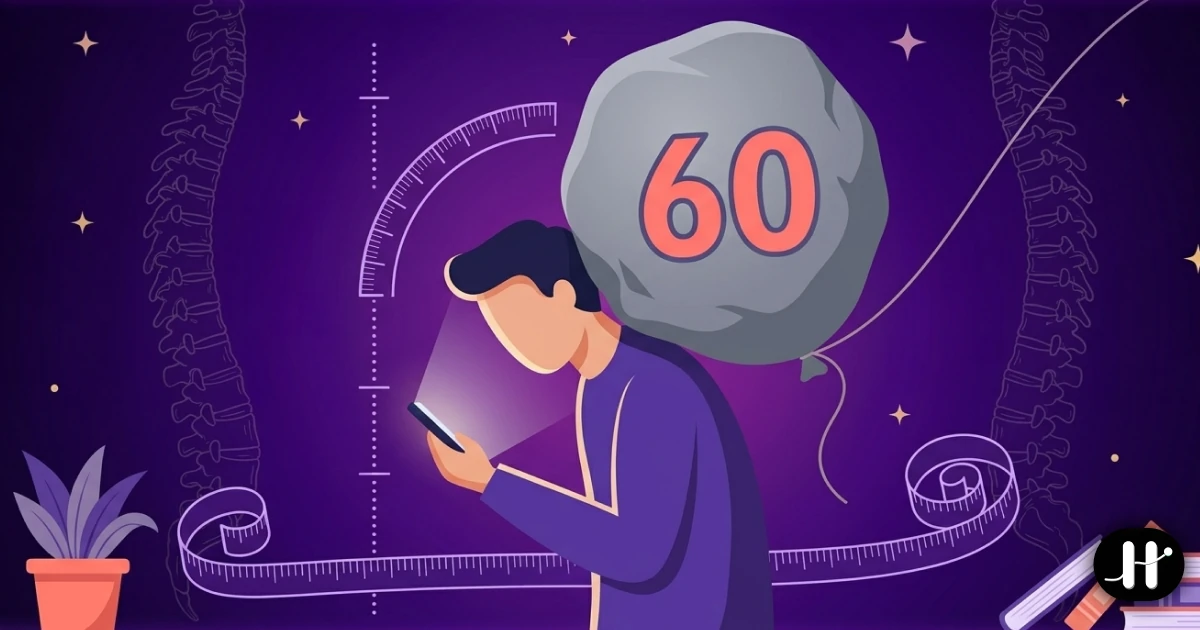
You have seen the claim. Tilt your head over your phone and your neck is suddenly carrying 60 pounds, the weight of a seven-year-old. It appears in news segments, physiotherapy blogs, and roughly every article about phone posture written in the last decade.
The number is real, in the sense that somebody calculated it and published it. What it means is a good deal shakier than how it gets used.
Where the number comes from
The figures trace to a single source: Kenneth Hansraj's 2014 paper in Surgical Technology International, Assessment of stresses in the cervical spine caused by posture and position of the head. It reports modelled load on the cervical spine at increasing forward tilt:
| Head position | Modelled load |
|---|---|
| Upright, neutral | 10 to 12 lbs |
| 15 degrees forward | about 27 lbs |
| 30 degrees forward | about 40 lbs |
| 45 degrees forward | about 49 lbs |
| 60 degrees forward | about 60 lbs |
Sixty degrees is roughly phone-reading position, which is where the seven-year-old comparison comes from.
Three reasons to hold that number loosely
It is a model, not a measurement. Nobody put load cells in anyone's neck. This is a computational simulation of forces, published in a journal that sits well outside the top tier of spine research. Simulations are useful, but they are a starting hypothesis, not an observation.
Sixty pounds is not a lot for a cervical spine. This is the part that rarely makes it into the coverage. Cadaver research on mechanical loading has recorded cervical spine tolerance in the region of 540 pounds, roughly nine times the modelled figure at 60 degrees, and living tissue adapts in ways cadaver tissue cannot. So even taking Hansraj's number at face value, it does not sit near a failure threshold. It describes a load your neck is built to handle.
The link to actual pain has largely not been found. This is the one that matters most. Studies looking specifically for an association between text-neck posture and neck pain have repeatedly come up empty. Work in young adults found that text neck, assessed both by self-perception and by physiotherapist rating, was associated with neither the presence nor the frequency of neck pain. The International Association for the Study of Pain has addressed this directly, and the broad conclusion in the pain research community is that posture is a much weaker predictor of pain than the popular narrative suggests.
That last point cuts against a lot of received wisdom, including the idea that there is one correct posture and that deviating from it accumulates damage.
So is neck pain from phones imaginary?
No, and this is where the honest version gets more useful than the scary version.
Plenty of people genuinely get neck stiffness, upper-back tightness, and tension headaches after long stretches on a phone or laptop. That experience is real. What the evidence suggests is that the culprit is less about the angle and more about staying in one position without moving, for a long time.
Sustained static loading fatigues muscles regardless of which position you hold. The muscles at the base of the skull work continuously to stabilise the head, and prolonged unbroken tension there is a recognised trigger for tension-type headaches. On that reading, a "perfect" posture held rigidly for two hours is not obviously better than a slouched one you shift out of every ten minutes.
Which reframes the problem in a way that is actually actionable. The variable you can move is not the geometry of your neck. It is how long you stay still.
What actually helps
Move and change position often. Alternate sitting, standing, and propping the phone at chest height. Variation beats holding any single position, including the recommended one.
Shorten the sessions rather than perfecting the pose. Nobody remembers to correct their posture mid-scroll, which is why "hold your phone higher" advice fails. What people can change is how long a session runs before something interrupts it. This is where an app blocker earns its place: Habit Doom locks distracting apps until you have done something else first, which naturally breaks up the forty-minute static stretches rather than relying on you to notice you have been still for half an hour.
Bring the screen up rather than dropping your head down. Still sensible, even with the load figures discounted. It costs nothing and reduces sustained muscle work.
Strengthen what opposes a forward head position. Chin tucks and upper-back or rear-deltoid work are the usual recommendations, and building capacity is better supported than chasing alignment.
Escalate real symptoms properly. Persistent or worsening pain, or anything with numbness, tingling or arm involvement, is a clinician's question rather than an article's.
The takeaway
Tech neck is a useful shorthand for a real experience and a poor description of a mechanism. The 60-pound figure is a model rather than a measurement, it sits well below what the cervical spine tolerates, and the research trying to connect phone posture to neck pain mostly has not.
None of which means your neck feels fine after two hours on your phone. It means the fix is probably about moving more and sitting still less, rather than about achieving a particular angle. If you want the wider picture on how much time is going into those sessions in the first place, Screen Time Statistics 2026 has the current figures.
Frequently Asked Questions
Keep Reading
Try Habit Doom
Lock your distracting apps. Complete your habits. Earn your screen time. It takes 30 seconds to set up.
Download Free