


What Is Doomscrolling? (And Why You Can't Just Stop)

 X
X LinkedIn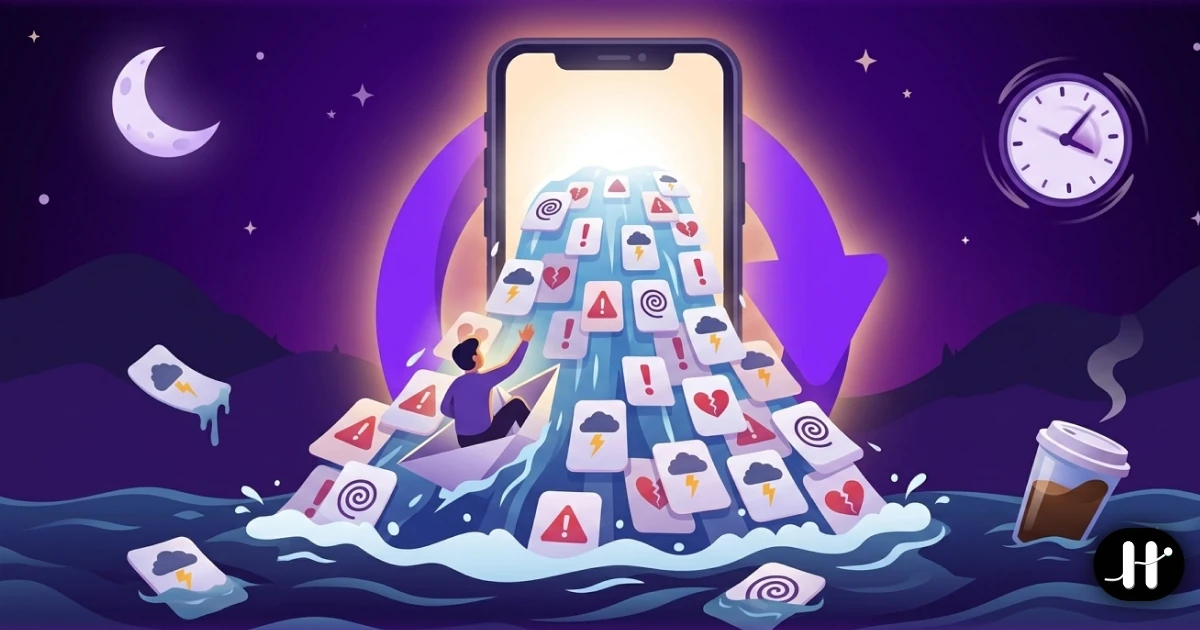
You told yourself you would check your phone for a minute. That was forty minutes ago. Somewhere between a headline about a natural disaster and a stranger's argument in the comments, your thumb kept moving on its own. You are not enjoying this. You know you should stop. You don't.
That is doomscrolling, and if it feels like more than a bad habit, that is because it is. This covers what the word means, where it came from, what is actually happening while it happens, and how to tell the difference between staying informed and being stuck.
So what is doomscrolling, exactly?
Doomscrolling is the habit of continuously scrolling through upsetting or anxiety-inducing content online, usually news or social media, well past the point where it is informing you of anything new. It usually comes with a nagging awareness that it is making you feel worse, and continuing anyway.
The dictionary definition
Merriam-Webster added it in September 2023, as one of 690 new entries in that update. The headword is the verb doomscroll: to spend excessive time online scrolling through news or other content that makes one feel sad, anxious, angry, and so on.
Small precision worth having, since most articles get it slightly wrong: the dictionary entry is the verb. The noun doomscrolling is what everyone actually says, but doomscroll is what got added.
Where the word came from
It appeared online around 2018 and spread fast in 2020, the first year most of the world was stuck at home trying to make sense of a situation that changed by the hour. Oxford Languages included it in their 2020 "Words of an Unprecedented Year" report, alongside lockdown and social distancing. Oxford declined to name a single Word of the Year that year on the grounds that no one word could carry it.
The behaviour did not start in 2020. The word caught up to something people were already doing. We simply had not named it.
Why it is not really a willpower problem
This is the part most articles skip, and the part that actually matters.
The mechanism has a name in behavioural psychology and it is older than the internet. B.F. Skinner's work on reinforcement schedules, set out in detail with Charles Ferster in Schedules of Reinforcement (1957), found that unpredictable rewards produce far more persistent, repetitive behaviour than reliable ones. Skinner called it a variable-ratio schedule. It is the mechanism behind slot machines.
Your feed runs on the same logic. You never know whether the next scroll brings something remarkable, something enraging, or nothing at all. That uncertainty is the engine, not a side effect. Most pulls return nothing, which is precisely what keeps you pulling.
Reward learning on social platforms has been modelled directly. Lindström and colleagues, writing in Nature Communications in 2021, analysed over a million posts from more than 4,000 users and found that behaviour on social media conforms to the principles of reward learning: people post more when likes are plentiful and less when they dry up. Worth being precise about what that study did and did not measure. It modelled posting behaviour rather than scrolling, so it is evidence that these platforms operate on reward-learning dynamics, not a direct measurement of what your thumb is doing. The slot-machine claim rests on Skinner, and it rests well.
Aza Raskin, who built infinite scroll, has said publicly that he regrets it, and has estimated the global cost at something like 200,000 human lifetimes lost to scrolling per day. That figure is his own back-of-envelope arithmetic rather than a study, and he has framed it differently in different interviews, so treat it as a designer's estimate of scale rather than a measurement. The underlying point stands regardless: he removed the stopping cue on purpose, and it worked.
So when you feel you should be able to just close the app, you can, technically. But you are working against a system built to make that hard. That is a different problem from laziness, and the mechanism is covered further in It's Not Willpower. Here's Why You Can't Stop Scrolling.
What the mental health research actually says
A 2024 scoping review in Mental Health and Digital Technologies, The influence of doomscrolling on mental health, gathered 17 empirical studies under PRISMA-ScR guidelines. It found consistent associations between doomscrolling and higher anxiety, depression and stress, and lower resilience.
One caveat the review itself raises, and which almost every article quoting it drops: the evidence base is predominantly cross-sectional. That means these things reliably occur together. It does not establish that doomscrolling causes the anxiety. Anxious people may simply doomscroll more, and the honest reading is that it probably runs in both directions.
Related work in Personality and Individual Differences (Beyond the Scroll, 2024) connects trait anxiety to doomscrolling through intolerance of uncertainty: the same discomfort with not knowing that makes you check the news is what keeps you scrolling past the point of it helping. More on the wider evidence in Phone Use and Mental Health: What the Research Says.
Doomscrolling, or just staying informed?
The two look identical from outside. Four honest questions:
Are you still learning anything? Three articles on one event from different angles is informed. The fortieth refresh is not.
Do you feel worse, rather than just better informed? Staying up to date can be sobering. Doomscrolling tends to leave you anxious, drained, or oddly numb.
Did you lose track of time? "Five minutes" becoming forty is the clearest tell there is.
Are you still going after the original reason is gone? You checked the headline. You know what happened. You are still scrolling.
Two or three of those and you are not staying informed. That is useful to know, because the fix is not caring less about the news. It is interrupting the mechanism.
What the pattern looks like over time
It rarely stays confined to one bad news cycle. Once the loop is established it generalises: first thing in the morning, last thing at night, and any lull in between. The nighttime version has its own mechanics, covered in How to Stop Doomscrolling at Night, and the morning version in How to Stop Doomscrolling in the Morning. For how much time this adds up to across a population, Screen Time Statistics 2026 has the current figures and Average Screen Time by Age breaks them down by generation.
What actually helps
Friction beats willpower, for the reason above: you are not fighting a preference, you are fighting a schedule of reinforcement that was designed to be hard to leave.
Apps like Habit Doom do not ask you to try harder. They lock the apps you doomscroll on until you have done something else first, which removes the decision rather than relying on you to make a good one at 11pm. If a do-not-disturb schedule already keeps you off your feeds, you do not need anything more elaborate. If it does not, the full breakdown is in How to Stop Doomscrolling: 7 Ways That ACTUALLY Work, and a list of replacement behaviours is in What to Do Instead of Doomscrolling.
Frequently Asked Questions
Keep Reading
Try Habit Doom
Lock your distracting apps. Complete your habits. Earn your screen time. It takes 30 seconds to set up.
Download Free