


What to Do Instead of Doomscrolling

 X
X LinkedIn
Why Replacement Beats Restriction
If you want the definition and the research picture first, What Is Doomscrolling? covers where the word came from and what the studies actually establish.
Most people try to stop doomscrolling through willpower and restriction. They delete apps, set screen time limits, tell themselves they are going to stop. And for a few days, it works. Then it doesn't. The apps get reinstalled. The limits get bypassed. The resolve crumbles at 10 PM on a Tuesday when you are tired and bored and your thumb navigates to the App Store on autopilot.
This happens because habits are not eliminated in a vacuum. They are replaced. Neuroscience 101: every habit follows a loop of cue, routine, and reward. The cue triggers the behavior, the routine is the behavior itself, and the reward is what your brain gets out of it. Remove only the routine and you leave the cue and the craving completely intact. Your brain still fires the same signal. It still wants the same payoff. It just has nowhere to send that energy.
When you delete Instagram without replacing the behavior, your brain still receives the cue (boredom, stress, a transition moment between tasks) and still craves the reward (dopamine, novelty, a sense of connection). With no replacement available, the craving does not go away. It intensifies. It nags at you until the path of least resistance wins, and you reinstall the app and scroll for two hours straight.
This is why the restriction-binge cycle is so common. Three days of iron willpower, then a two-hour scrolling binge that leaves you worse off than before you started. The shame compounds. You start to believe you simply lack discipline, that something is wrong with you. But the problem was never discipline. It was strategy.
The solution is surprisingly straightforward: identify what scrolling actually gives you (stimulation, escape, social connection, entertainment, emotional regulation) and find healthier activities that deliver similar rewards through different means. This is the core principle of habit replacement: you do not eliminate a bad habit so much as swap it out. The old cue remains. The reward stays the same. But the routine in the middle changes to something that leaves you feeling better, not worse.
"You do not rise to the level of your goals. You fall to the level of your systems."
James Clear, Atomic Habits
The five habits below were chosen specifically because each one satisfies one or more of the core psychological needs that doomscrolling fills, but without the regret, the anxiety, the time loss, and the hollow feeling that follows a long scroll session. These are not punishments. They are upgrades.
The 5 Best Habits to Replace Doomscrolling
Habit 1: Reading (10-15 Minutes)
What it replaces: the novelty-seeking and information-consumption drive.
Reading delivers new information and ideas, the same fundamental reward as scrolling, but in a format that strengthens your focus instead of fragmenting it. After 15 minutes of reading you feel sharper, more informed, slightly more interesting. After 15 minutes of scrolling you feel drained, scattered, and vaguely guilty. Both feed curiosity. Only one leaves you better off.
The difference comes down to attention structure. Scrolling trains your brain to process information in two-second bursts: glance, swipe, glance, swipe. Reading trains sustained attention, the ability to hold a single thread of thought for minutes at a time. This is the cognitive skill that doomscrolling erodes most aggressively, and reading is the most direct way to rebuild it.
You can take this further by blocking YouTube until you read, making the video app your reward for finishing your daily reading. How to start: keep a book or e-reader on your nightstand, your desk, or wherever you most often reach for your phone. When the urge to scroll hits, pick up the book instead. Even two pages counts. You are not training for a reading marathon. You are training your brain to reach for a book instead of a feed.
The compound effect: at just 10 minutes per day, you will finish roughly 15 to 20 books per year. That is the difference between "I don't really read" and "well-read," achieved with minimal daily effort. Over five years, that is 75 to 100 books. The knowledge compounds in ways that scrolling never will.
If you have not read in years, start with something easy and genuinely interesting. A thriller, a memoir, a topic you are already curious about. Do not start with dense nonfiction, or you will bounce back to TikTok by page three. The goal right now is not intellectual growth. It is building the habit of reaching for a book. The growth follows on its own.
Habit 2: Journaling (5-10 Minutes)
What it replaces: the emotional processing and self-expression component.
Part of why we scroll is to process emotions. We look for content that validates how we feel, that articulates what we are going through, that makes us feel less alone in our experience. This is a legitimate psychological need. The problem is that scrolling meets it passively and incompletely. You consume someone else's articulation of feelings that approximate yours but never quite match. Journaling does this work more effectively by forcing you to articulate your actual thoughts and feelings in your own words.
The science backs this up. Expressive writing has been shown to reduce anxiety, improve mood, and even strengthen immune function. A well-known University of Texas study found that journaling about stressful experiences for just 15 minutes a day over four consecutive days led to measurable improvements in mental health. Participants reported lower stress, fewer intrusive thoughts, and better emotional regulation. Scrolling through someone else's hot takes about stress does not produce these outcomes. Writing about your own stress does.
How to start: open a notes app or a physical notebook. Write whatever comes to mind for five minutes. No structure needed. Stream of consciousness is perfectly fine. You are not writing for an audience. You are writing for your own brain.
Prompts for when you are stuck: "Right now I feel..." or "Today I'm looking forward to..." or "Something I've been avoiding thinking about is..." These are not meant to produce polished entries. They are meant to get words moving when the blank page feels intimidating.
The key advantage of journaling is that it is a creation habit. Scrolling is a consumption habit. Switching even a few minutes per day from consumption to creation fundamentally changes your relationship with your own mind. You go from passively absorbing other people's thoughts to actively generating your own. That shift has ripple effects that extend far beyond the five minutes you spend writing.
Habit 3: Movement (5-20 Minutes)
What it replaces: the stimulation and energy-regulation function.
Physical movement triggers endorphin release, improves mood, and provides the stimulation your brain craves, but through your body rather than a screen. After a 10-minute walk, you feel energized, clear-headed, and physically present. After 10 minutes of scrolling, you feel lethargic, foggy, and disconnected from your body. Both activities respond to the same cue (restlessness, low energy, need for stimulation). Only one leaves you feeling genuinely better.
This does not mean going to the gym. A walk around the block, 10 pushups, a five-minute stretch, dancing to one song in your kitchen. It all counts. The bar is intentionally low, because the goal is not fitness. It is replacing a sedentary dopamine loop with a physical one. Get fitter in the process and that is a bonus.
If you want a structured way to make exercise non-negotiable, try blocking Instagram until you exercise. It turns your social media into a reward for moving your body. There is a specific reason why movement beats scrolling so effectively: when you are sedentary and scrolling, your body is in a low-energy state that actually increases your craving for more stimulation. You are understimulated physically, so your brain compensates by seeking stimulation digitally. Movement breaks this cycle by changing your physical state directly. Once your body is active, the digital craving drops noticeably. Many people who struggle with doomscrolling find that the urge simply evaporates after even two minutes of physical activity.
How to start: when you feel the scroll urge, stand up and move for just two minutes. Walk to the kitchen, do five pushups, stretch your shoulders. The urge usually passes once your body is active. You do not need to commit to a workout. You just need to stand up.
Habit 4: Learning Something Specific (10-15 Minutes)
What it replaces: the curiosity and novelty-seeking drive.
Doomscrolling gives you random, fragmented information. A cooking video here, a political take there, a science fact, a meme, a news headline. Your curiosity feels engaged in the moment, but nothing accumulates. You cannot point to anything you learned after an hour of scrolling. Deliberate learning gives you structured, cumulative knowledge that builds on itself over time. Both activities satisfy curiosity. Only one leaves you feeling accomplished at the end.
The options are broad: language learning with Duolingo or a similar app (10 minutes per day), learning an instrument (15 minutes of practice), coding (one tutorial lesson), drawing (one sketch), cooking (one new recipe per week). The specific skill matters less than the commitment to structured, progressive learning rather than random consumption.
The compound effect: 15 minutes of deliberate practice daily adds up to roughly 91 hours per year. Redirect the time you currently spend scrolling into learning and, over a single year, that is a meaningful block of sustained practice: enough to make real progress toward becoming conversational in a new language, competent on a musical instrument, or proficient in a creative skill.
How to start: pick one thing you have been wanting to learn. Just one. Put the learning app or tool in the spot where your social media apps used to live on your home screen. When the scroll urge hits, open that instead. The muscle memory of reaching for that screen position stays the same, but the outcome changes completely. This is what app management strategies look like in practice: restructuring your digital environment so the default action serves you.
Habit 5: Connecting with a Real Person (5-10 Minutes)
What it replaces: the social connection and belonging need.
Scrolling gives you an illusion of social connection. Parasocial relationships with creators. Comment section debates with strangers. Seeing what friends posted three hours ago. It feels social, but it lacks the core ingredient that makes social interaction psychologically nourishing: reciprocity. You are observing other people's lives rather than participating in a mutual exchange. The loneliness persists, and often deepens, even as you consume more social content.
A five-minute text conversation or phone call with a real friend delivers what scrolling promises but never actually provides. A Harvard study spanning more than 80 years (the longest-running study on happiness ever conducted) consistently found that the quality of close relationships is the single strongest predictor of both happiness and physical health. Not wealth, not career success, not social media followers. Real, reciprocal relationships. Social media engagement does not substitute for this. It cannot.
How to start: when you feel the scroll urge, text one friend instead. Not a meme, an actual message. "Hey, how's your week going?" or "Thinking of you, hope things are good." You will be surprised how often a real conversation follows. People are hungry for genuine connection in a world of algorithmic feeds, and a simple text can spark a meaningful exchange that leaves both of you feeling better.
The bonus is compounding: real conversations improve your mood and strengthen relationships, while scrolling does neither. Every time you choose to text a friend instead of opening Instagram, you are investing in something that pays dividends for years. Every time you choose to scroll, you are consuming something that evaporates the moment you put the phone down.
How to Make New Habits Actually Stick
Knowing the right replacement habits is necessary but not sufficient. The graveyard of good intentions is full of people who knew exactly what they should do and still could not make themselves do it consistently. The gap between knowing and doing is where most habit-change attempts die. Here is how to bridge it.
Habit stacking: pair the new habit with a specific, existing cue. Not "I'll read more" but "When I sit down at my desk in the morning, I will read for 10 minutes before opening any app." The specificity matters enormously. Vague intentions produce vague results. Anchoring the new habit to a concrete moment in your existing routine gives your brain a clear trigger point. Research on implementation intentions shows that people who specify when and where they will perform a new habit are two to three times more likely to follow through.
Start tiny: two minutes of reading beats zero minutes of a planned 30-minute session. The biggest mistake people make with new habits is setting the bar too high, which turns the habit into a negotiation every day. Should I really read for 30 minutes? I don't have time. Maybe tomorrow. The habit never gains traction. When the bar is absurdly low (read one page, write one sentence, do one pushup), there is nothing to negotiate. You just do it. And once you start, you often continue beyond the minimum. The rule of thumb from habit research: never miss twice in a row. One missed day is a blip. Two missed days is the start of a new pattern.
Track it: use a simple checklist, a habit tracker, or an app to mark completion daily. Visual streak tracking is remarkably motivating. There is something about seeing an unbroken chain of checkmarks that makes you reluctant to break it. Jerry Seinfeld's famous "don't break the chain" method works precisely because it leverages this psychological pull. The longer the streak, the more it costs you emotionally to break it.
Remove friction for new habits: put the book on your pillow. Put the journal on your desk with a pen on top. Lay out workout clothes the night before. Every second of friction between you and the desired behavior is an opportunity for the old habit to win. Design your environment so the right action is the easiest action.
Add friction for old habits: move social apps to the last page of your phone. Delete them from your home screen entirely. Enable app blocking. Or use a tool that locks them until your new habits are done. The more friction between you and the unwanted behavior, the less willpower you need to resist it. This is where environment design meets technology, and it is far more effective than relying on motivation alone. The comparison between different app-blocking approaches is worth understanding if you are serious about this.
The accountability gap: most habit trackers have no real consequences for skipping. You can uncheck a habit and nothing happens. The streak resets, you feel a twinge of guilt, and life continues. This is fine for people with strong intrinsic motivation, but for chronic doomscrollers fighting a dopamine-optimized algorithm, a twinge of guilt is not enough. Tools with enforcement, where skipping your habits means your distracting apps stay locked, close this gap by making the consequences of skipping immediate and tangible rather than abstract and emotional.
Where a Blocker Fits
Everything above works. Reading, journaling, movement, learning, connecting are all genuinely effective replacements. But each one runs into the same wall: the moment of choice. Every time the scroll urge hits, you have to pick the replacement over the app, and you are choosing against something engineered to make the app the easier option.
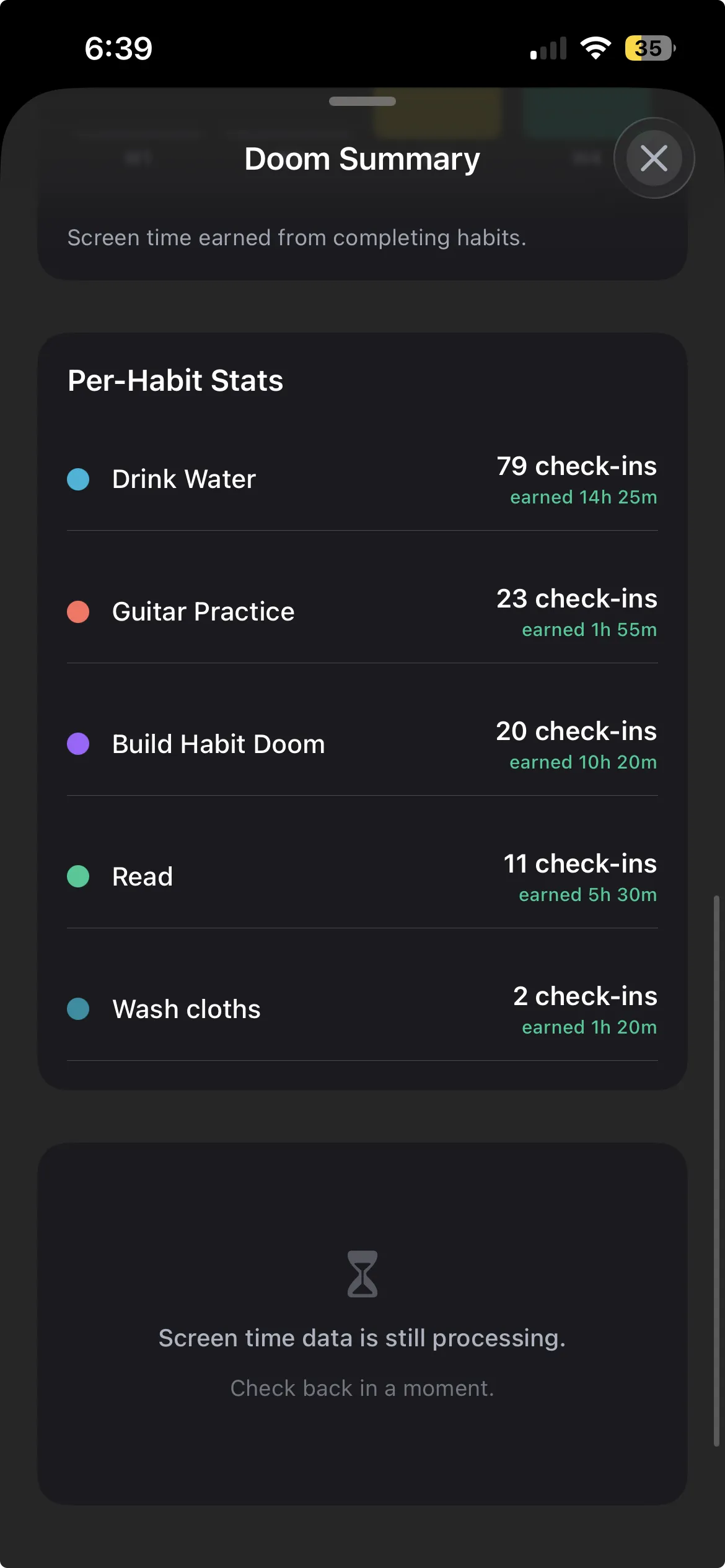
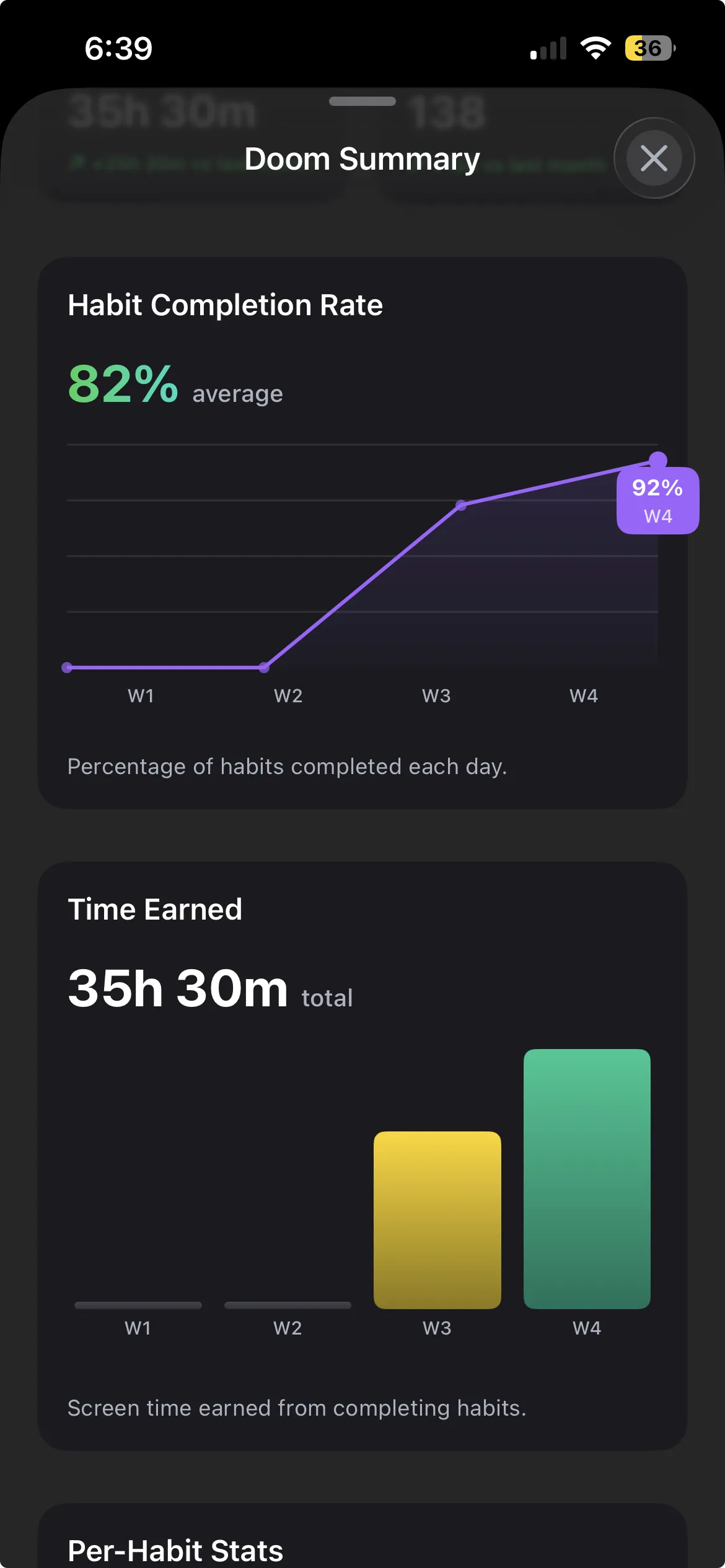
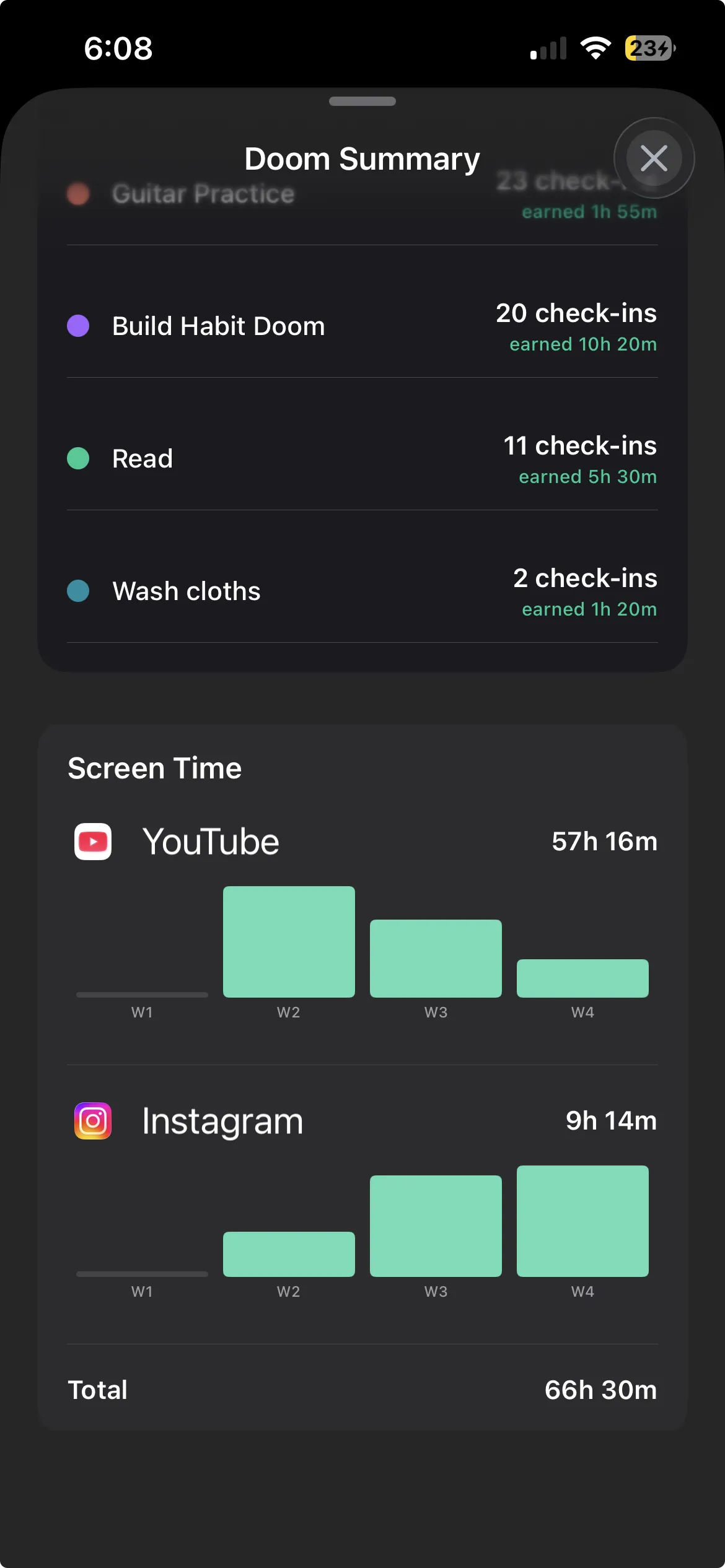
That is the gap app blocking closes. Tools like Habit Doom lock your distracting apps until your replacement habits are checked off, so the decision gets made once, up front, instead of every time you are tired and bored. It turns "I should read instead of scrolling" into "the apps open after I read." You still do the habits. You just stop leaning on end-of-day willpower to start them. If you want the mechanics, here is how Habit Doom works, and how it compares to Opal and One Sec.
The goal is not to never use your phone again. The goal is to use it on your terms, after you have invested in yourself, not before.
None of this is restriction for its own sake. It is restructuring the day so the things that matter happen first, and the scroll is what is left over instead of what eats the evening. If you want to see that play out over a longer stretch, read about what happened when I blocked social media for 30 days.
Frequently Asked Questions
Keep Reading
Try Habit Doom
Lock your distracting apps. Complete your habits. Earn your screen time. It takes 30 seconds to set up.
Download Free