


How to Stop Doomscrolling in the Morning

 X
X LinkedIn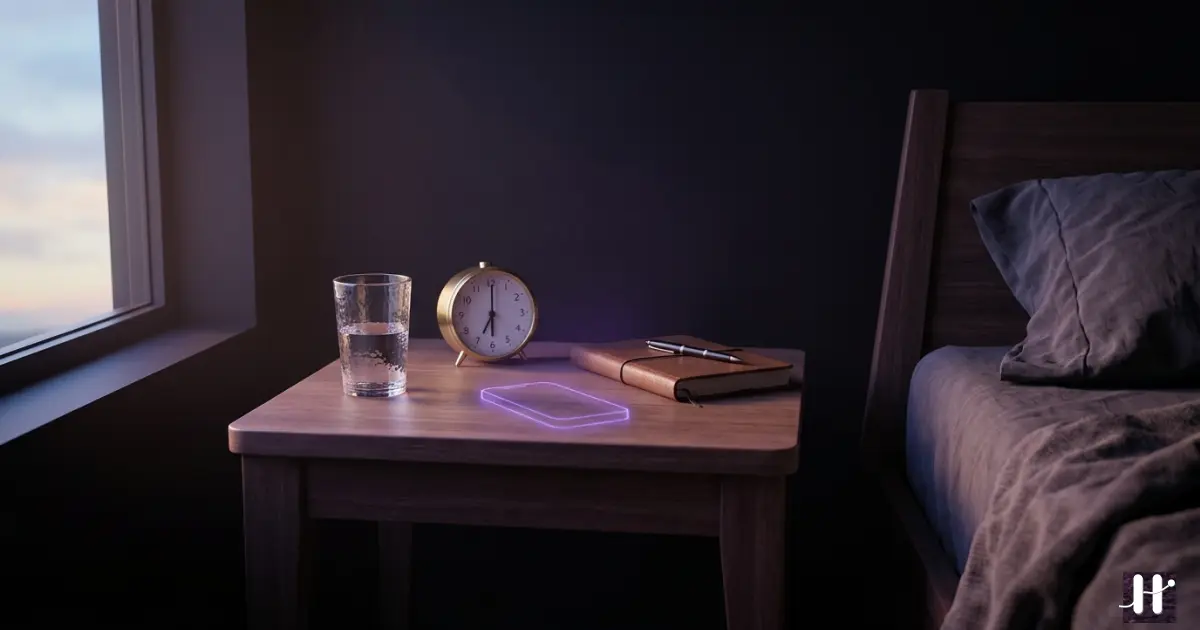
The first 3 minutes decide your day
You know the pattern. Your alarm goes off. Your hand reaches for your phone to silence it. And before your eyes have fully adjusted to the light, you are already scrolling.
It starts with checking the time. Then a notification catches your eye. You open Instagram "just to see." Twenty minutes later you are still in bed, thumbing through Reels, reading comments under posts from people you do not know, absorbing other people's opinions and anxieties before you have formed a single thought of your own. Every morning, same script.
By the time you get out of bed, your brain has already been hijacked. You are starting the day in reactive mode, responding to what other people posted, what the news decided was important, what the algorithm chose for you. Your mental state for the next several hours was set by an algorithm, not by you.
This is not a willpower problem. It is an environment problem. And it has a fix.
Why mornings are your most vulnerable time
Your brain in the first 30 minutes after waking is in a unique neurological state. Cortisol levels surge in what researchers call the cortisol awakening response (CAR). This natural spike is supposed to help you transition from sleep to alertness.
When you flood this vulnerable brain state with social media, you hijack the CAR. Instead of cortisol helping you wake up and focus, it gets channeled into processing negative news, social comparison, and the low-grade anxiety that scrolling produces. Research from the University of British Columbia found that people who checked their phones within the first 30 minutes of waking reported higher stress levels throughout the entire day compared to those who waited.
Your morning brain is also in a theta-to-alpha wave transition. This is a state associated with creativity, reflection, and intention-setting. Scrolling social media immediately shifts your brain into beta waves, the state associated with processing external stimuli. You skip the creative, reflective window entirely and go straight to consuming.
The morning is not just another time of day to avoid your phone. It is neurologically the worst time to be on it.
6 strategies that actually work
1. Move your phone out of reach
This is the single most effective change you can make. It is also the simplest.
Charge your phone in another room, or at minimum, across the bedroom where you cannot reach it from bed. When your alarm goes off, you have to physically stand up to silence it. Once you are standing, the gravitational pull of the bed weakens and the scroll-in-bed habit breaks.
If you are thinking "but I use my phone as my alarm," that is the point. Buy a cheap alarm clock. A $10 alarm clock from Amazon eliminates the excuse to have your phone on your nightstand. That $10 will be the highest-ROI purchase you make this year.
2. Replace the habit, do not remove it
Your brain reaches for the phone because it wants stimulation after the low-input state of sleep. Remove the phone without replacing that stimulation and the craving does not go anywhere. It nags at you until you give in.
Replace the scroll with something that delivers a similar type of light stimulation:
- Water. A glass of water is physical stimulation that wakes up your body. Keep one on your nightstand where your phone used to be.
- Stretch. Two minutes of stretching gives your body the movement signal it craves after hours of stillness.
- Write. A notebook next to your bed with a single prompt: "What is the one thing I want to get done today?" Writing activates your brain without handing control to an algorithm.
The replacement does not need to be impressive or Instagram-worthy. It just needs to exist. Any activity between waking up and touching your phone breaks the automatic loop.
3. Lock your apps until morning habits are done
If moving your phone out of reach feels too extreme, or if you genuinely need your phone nearby for calls, the next best option is to make the distracting apps inaccessible.
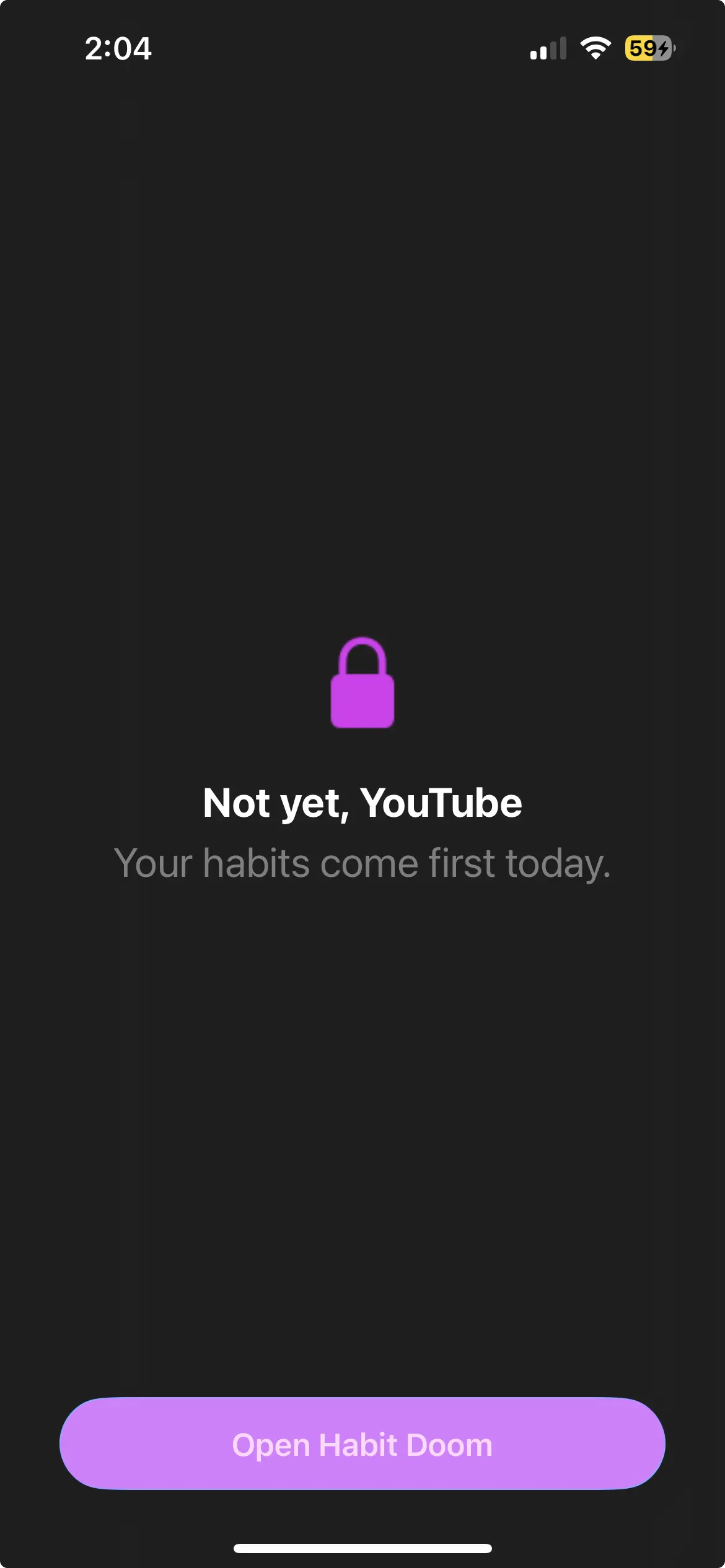
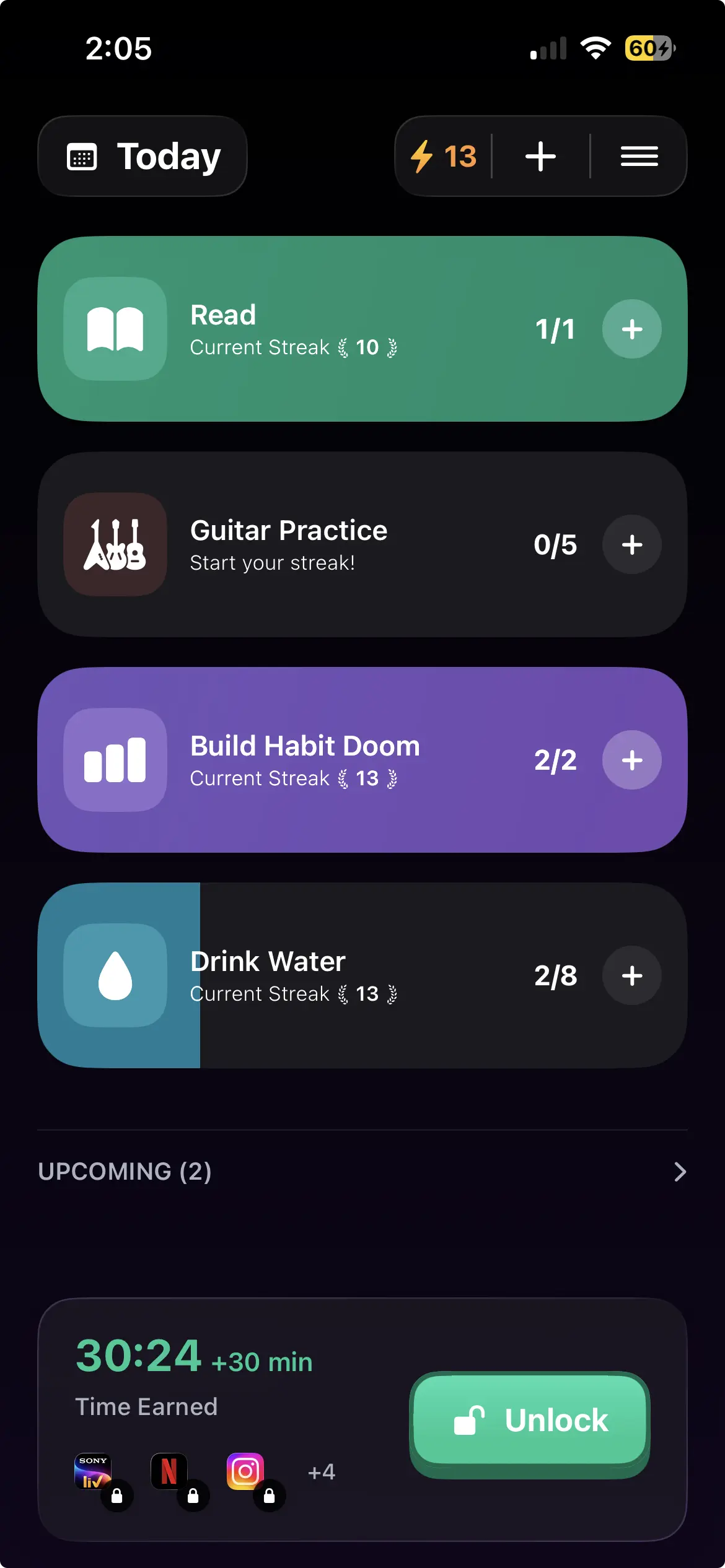
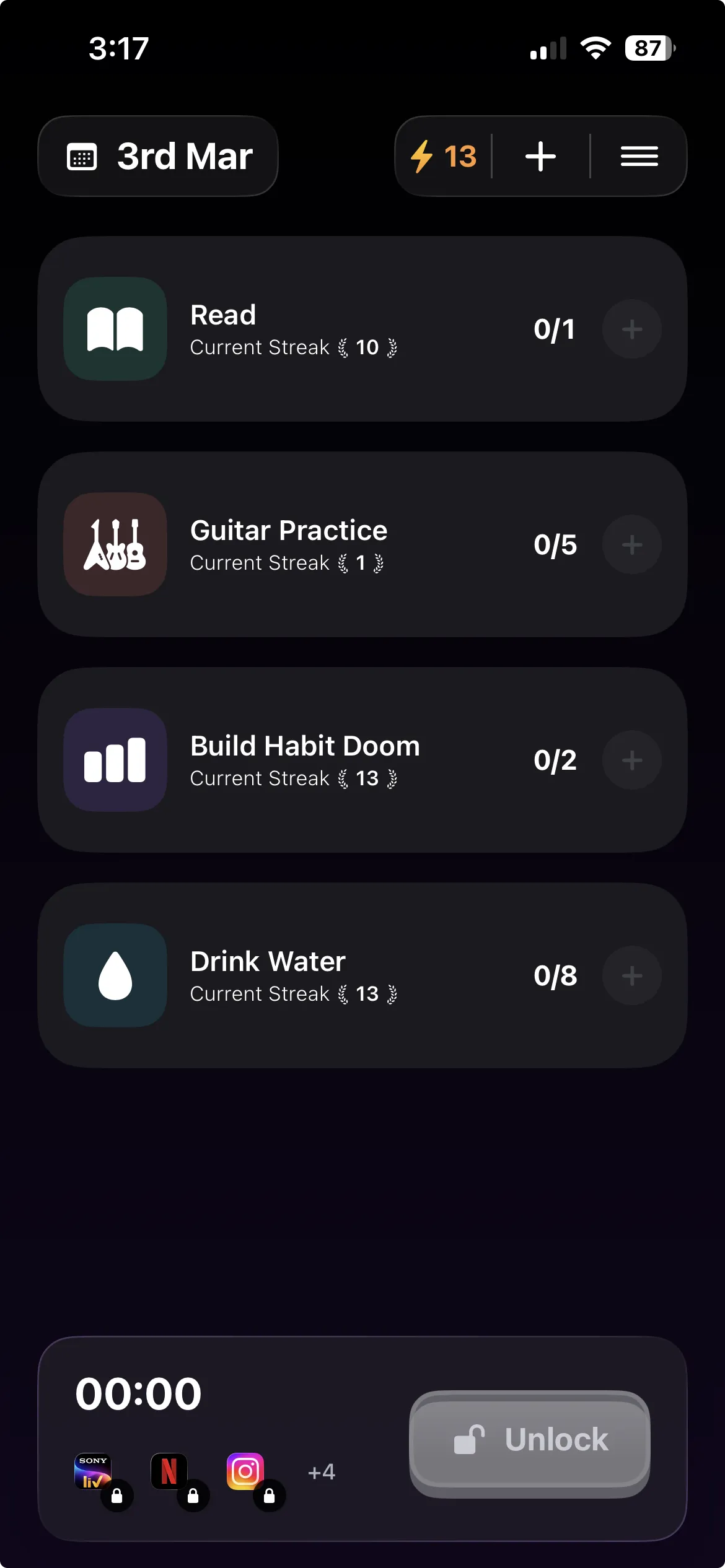
App blockers like Habit Doom lock your social media, news, and entertainment apps by default every morning. They unlock only after you complete your habits (exercise, journal, plan your day, whatever you choose). Your phone is still there. Calls still work. Messages still come through. But Instagram, TikTok, YouTube, and Reddit are locked behind a wall of completed habits.
This approach works because it does not require willpower. You do not have to resist opening Instagram. You literally cannot open it until your habits are done. The decision is already made for you.
4. The 30-minute rule
If app blocking feels like too much, start with a simple rule: no phone for the first 30 minutes after waking.
Set a timer when you wake up. For 30 minutes, your phone stays face-down or in another room. Do whatever you want during those 30 minutes. You do not need a perfect morning routine. Just exist without your phone for half an hour.
Why 30 minutes specifically? That is roughly the duration of the cortisol awakening response. By waiting 30 minutes, you allow your stress hormones to normalize naturally before introducing the stimulation of social media. You start your day from a baseline of calm rather than a baseline of reactivity.
If 30 minutes is too much on day one, start with 10. The number matters less than the consistency. Ten phone-free minutes every morning for a month will change more than one perfect morning followed by nothing.
5. Redesign your bedroom environment
Your bedroom environment either supports or undermines your morning habits. Small physical changes make the scroll-free morning the path of least resistance:
- Phone charger in another room. Already covered, but worth repeating because it is that effective.
- Alarm clock on the nightstand. Replaces the phone's alarm function.
- Water glass or book where your phone used to be. When your hand reaches for something in the morning (and it will), it grabs water or a book instead of a screen.
- No TV in the bedroom. If you do not scroll on your phone, do not replace it with scrolling on a bigger screen.
The principle is simple: make the unhealthy option harder and the healthy option easier. You do not need to be more disciplined. You need a better environment.
6. Track one number
Track how many minutes pass between waking up and first touching your phone. Write it down every morning. That is it.
You are not trying to hit a target. You are just measuring. What gets measured gets managed, and the simple act of writing down "4 minutes" today and "4 minutes" tomorrow creates a natural motivation to see that number go up without anyone telling you to.
If you use Screen Time on your iPhone, check your "First Pickup" time. It tells you exactly when you first used your phone each day. Watch that time drift later and later as you build the habit.
What your morning could look like
This is not about building a perfect morning routine. It is about inserting a buffer between sleep and the algorithm.
Wake up. Drink water. Stretch or walk to the bathroom. Maybe write one sentence about your day. Maybe do nothing for a few minutes and just exist in the quiet.
Then, after 15 or 30 minutes, pick up your phone. Check your messages. Open Instagram if you want to. But by then, your brain has already settled into a calm, intentional state. The scroll does not hijack your mood because your mood was already set by you, not by the algorithm.
The mornings where you scroll first feel different from the mornings where you do not. You already know this. You have had both kinds of mornings. The phone-free ones are not magical. They are just calmer. Clearer. You start the day feeling like you chose what to think about instead of having it chosen for you.
That is worth protecting.
Frequently Asked Questions
Keep Reading
Try Habit Doom
Lock your distracting apps. Complete your habits. Earn your screen time. It takes 30 seconds to set up.
Download Free