


How Long Does It Take to Form a Habit? (2026 Research)

 X
X LinkedIn
The most-cited number in habit-formation discussion is 21 days. It is wrong. It comes from a 1960 plastic surgery memoir and has no controlled-study support at all. The actual research, run half a century later under proper conditions, found a median of 66 days, with a range from 18 to 254. The 21-day claim survives because it makes good copy. The 66-day reality matters because it decides whether you expect success after three weeks or after ten.
This post is the research-backed answer to how long it takes to form a habit, why the 21-day myth persisted, and what the actual variables that predict formation speed are.
The 21-day myth, traced back
The 21-day number traces to Maxwell Maltz, a plastic surgeon practicing in the mid-twentieth century. Maltz wrote a 1960 book called Psycho-Cybernetics that combined surgical observations with motivational philosophy. Among the observations was that his patients took approximately 21 days to adjust to a new appearance after facial surgery. The amputee patients took roughly the same period to stop feeling phantom limbs.
Maltz wrote that "it requires a minimum of about 21 days for an old mental image to dissolve and a new one to jell." The claim was an informal observation about adjustment to bodily change, not a controlled study of habit formation. Maltz was not measuring habits at all.
Self-help authors in the 1970s and 1980s reached for the 21-day claim because it was concrete, encouraging, and easy to remember. The surgical context quietly dropped out. The number became "21 days to form a habit", which is neither what Maltz wrote nor what his observations supported. By the 2000s it had hardened into received wisdom in productivity culture without anyone ever testing it.
The 2010 study that replaced it
Phillippa Lally and colleagues at University College London ran the first proper controlled study of habit-formation timing in 2010. The methodology was straightforward. Ninety-six participants chose a daily habit they wanted to build (drinking water at lunch, eating fruit with dinner, doing 50 sit-ups before breakfast). They logged daily whether they performed the habit and rated how automatic it felt.
The researchers measured automaticity using the Self-Report Habit Index, a validated psychological scale. They tracked each participant for 12 weeks. The data showed that the time to reach the automaticity asymptote varied widely across habits and participants.
The headline finding: the median time to automaticity was 66 days. The range was 18 days at the fast end to 254 days at the slow end. The number depended on the habit, the participant, and the conditions, with one variable predicting more than the others.
What actually predicts speed
The Lally study isolated three variables that predicted habit formation speed.
Repetition under stable conditions. The variable Wendy Wood at USC has built her career around. Habits form fastest when the cue, context, and behavior are stable. A morning workout that happens in the same room at the same time after the same prior cue (wake up, drink water, put on workout clothes) forms quickly. The same workout performed at variable times in variable rooms after variable cues forms slowly or not at all.
Habit size. Smaller habits formed faster than larger ones in the Lally data. This finding aligns with B.J. Fogg's Tiny Habits work at Stanford. Fogg argues for the two-minute rule: make the habit so small that motivation does not need to be high. The two-minute starting point produces the fastest path to automaticity. The user can extend the habit's duration after the cue chain is locked.
Friction. Habits with lower friction formed faster. A habit that requires changing rooms, fetching equipment, or making decisions takes longer to automate than a habit that flows from the existing environment. Environment design (where the equipment lives, what the user sees first, what alternatives are visible) is the lever for friction.
Notice what is missing. None of the three primary predictors are motivation, willpower, or intelligence. Those show up constantly in everyday talk about habits because they feel salient. The data finds them weaker than the structural factors above.
The implications for habit trackers
The 66-day median has direct consequences for habit tracker design and use.
The first 21 days are not the test. A user who has not seen automaticity by day 21 has not failed. Day 21 is at the early end of the formation window, well short of the median. Trackers that reset progress at day 22 because the user missed once are punishing normal habit-formation behavior.
Missed days are within the normal pattern. Lally's study found that one or two missed days had no significant effect on the trajectory. The 66-day median already assumes some missed days. The user who misses a Tuesday and feels they have failed has misunderstood the underlying process. The user is on day 23 of formation, not day 1.
Trackers should support stable contexts. Apps that prompt habits at the same time, in the same context, with the same cue, support faster formation. Apps that allow arbitrary timing without anchoring to stable cues produce slower formation regardless of how often the user checks the box.
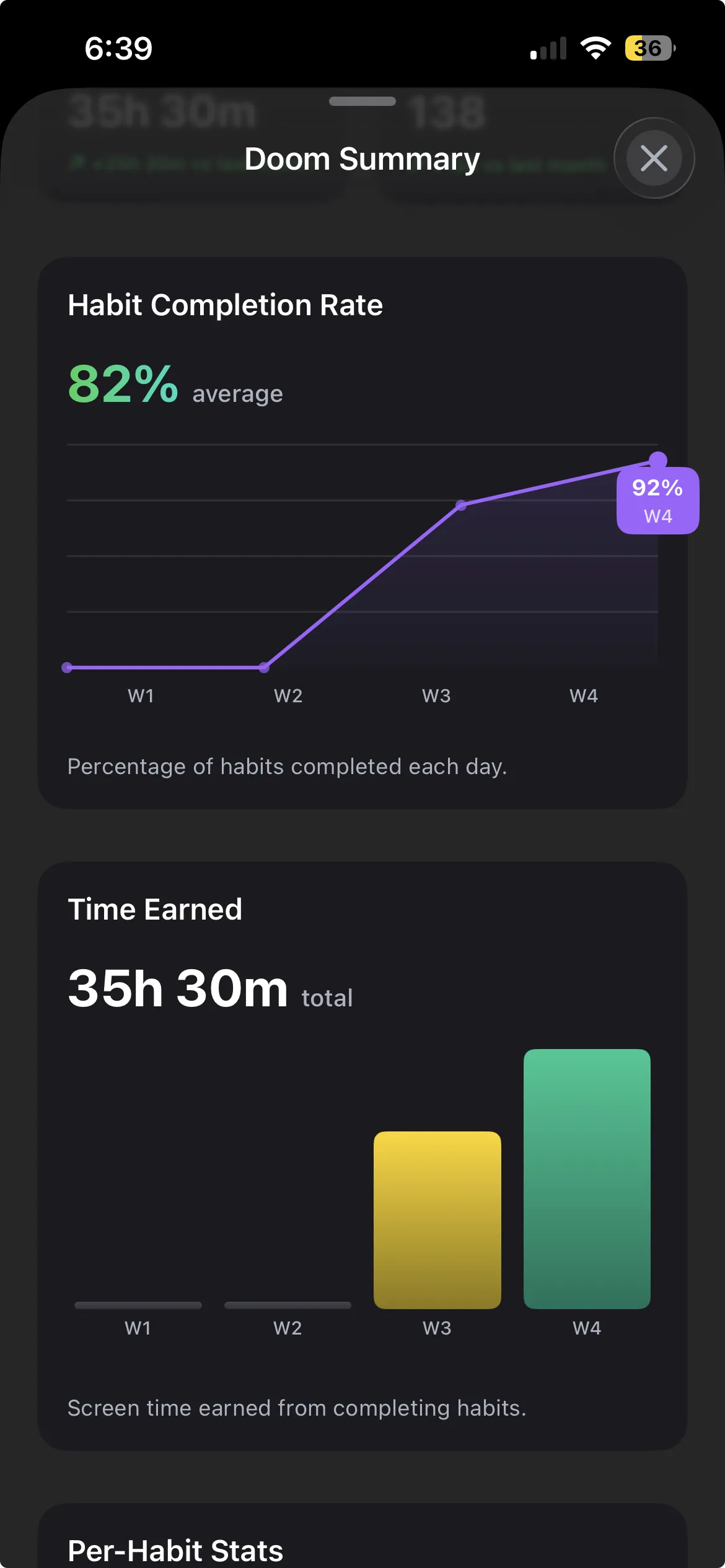
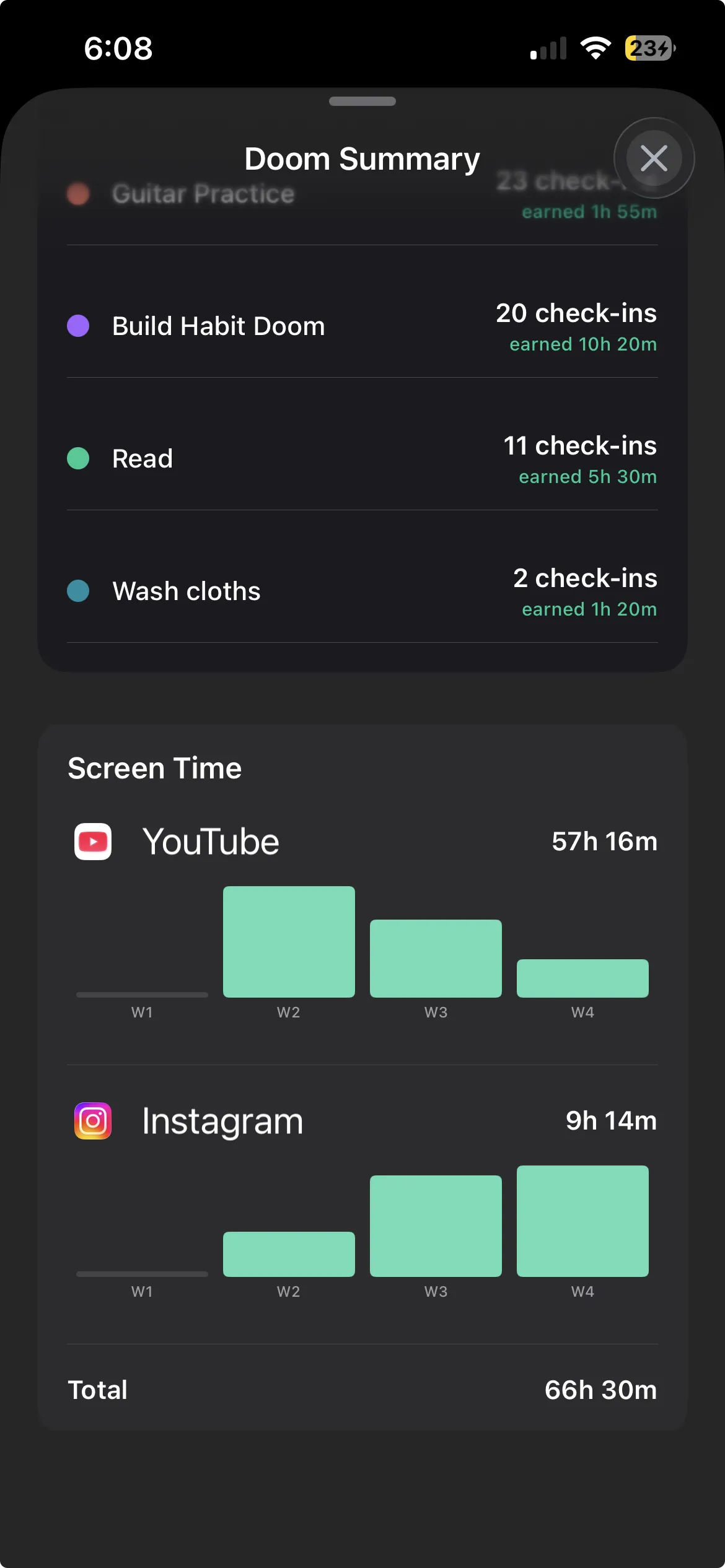
The 66 days is not motivation territory. Asking anyone to hold motivation steady for 66 days is asking too much. The pattern that works: use the tracker as a forcing function for the first 30 days, then let the habit's own cue chain carry the remaining 36. Trackers that enforce something (Habit Doom's app blocks, Habitica's RPG damage, Beeminder's cash penalty) cover the motivation gap. Trackers that only log lean on motivation the user does not reliably have.

What the variance means practically
The most-overlooked Lally finding is the variance. The range of 18 days to 254 days is wide. The user attempting a habit does not know in advance whether their habit will land at the fast end of the range or the slow end.
This has two practical implications.
Set timelines generously. A user planning to "be running daily by April" based on a January 1 start is using the median. About half of habits take longer than the median. The user is at significant risk of declaring failure at the median point when they are still on the normal formation trajectory. A more honest plan is to assume the habit might take 90 days and structure expectations accordingly.
Adjust based on the specific habit. Drinking water at lunch is at the fast end. Daily 60-minute exercise is at the slow end. The size, complexity, and disruption of the habit matter. Simple, small, low-friction habits form fastest. Complex, large, high-friction habits take longer. The user planning a habit can estimate where it falls in the variance range by judging size and friction.
How to use this data
The honest framework for the user starting a new habit.
Plan for 66 days, hope for 30. Set the realistic expectation. The user who plans for 30 days has built in failure at day 32. The user who plans for 66 days has slack for normal variance.
Pick a stable context. Same time, same place, same cue. The fastest formations in Lally's data clustered around stable contexts. The user can engineer this directly.
Make the habit small initially. Two minutes maximum for the first three weeks. Expand only after the cue chain is locked. Fogg's two-minute rule, supported by Lally's habit-size finding.
Use a tracker with a forcing function. Pure trackers ask the user to maintain motivation across 66 days. The math does not work. Trackers that enforce something (Habit Doom's app blocks, Habitica's HP, social accountability) cover the gap. The forcing function is what carries the user through the period where motivation alone is insufficient.
Do not panic about missed days. One or two missed days are part of the normal trajectory. The user who misses Tuesday and continues Wednesday is still forming the habit. The user who quits the tracker because of the missed Tuesday has chosen a worse outcome than the data required.
The 66-day number is more honest than the 21-day myth, and more useful than it first appears. The framework is clear. The expectations are set. You can build the habit on realistic estimates and structural support, instead of chasing a number that was wrong from the start. For the broader habit research see the deliberate practice breakdown and the tracker failure analysis.
Frequently Asked Questions
Keep Reading
Try Habit Doom
Lock your distracting apps. Complete your habits. Earn your screen time. It takes 30 seconds to set up.
Download Free