


Marshmallow Test: Why You Can't Put Your Phone Down

 X
X LinkedIn
In 1972, a psychologist named Walter Mischel sat a child down at a table, placed a marshmallow in front of them, and said: you can eat this one now, or wait 15 minutes and I will give you two.
That experiment, the Stanford marshmallow test, became one of the most famous studies in psychology. Not because of the marshmallow. Because of what happened to those kids over the next 40 years.
And what happened was strange.
The children who waited went on to score higher on their SATs. Some later research pointed to lower BMIs and better stress management. Other claims about relationships and careers are more loosely documented. The ones who grabbed the marshmallow immediately? On average, they seemed to struggle more: with school, with impulse control. For decades.
One test. 15 minutes. And it predicted the trajectory of their lives.
I came across this study through a lecture by Professor Jiang on the YouTube channel PredictiveHistory, a breakdown of delayed gratification, growth mindset, and deliberate practice. It hit me in a way I was not expecting. Because I realized something uncomfortable: every time I open TikTok instead of doing my habits, I am failing the marshmallow test. And I am failing it dozens of times a day.
The Ability That Predicts Success
Mischel's research did not just show a cute experiment with kids and candy. It revealed a fundamental truth about human performance: the ability to delay gratification is one of the strongest predictors of long-term success.
Here is what the follow-up studies found. The children who waited for the second marshmallow, tracked over decades:
- Scored an average of 210 points higher on the SAT
- Some later evidence pointed to a lower likelihood of obesity as adults
- Appeared to handle stress better
The strongest, most replicated finding here is the SAT gap. Other proposed links, such as substance abuse, income, and job satisfaction, are weaker and more loosely documented, so treat them as suggestive rather than settled.
This was not about intelligence. It was not about talent or privilege. It was about one skill: choosing a larger reward later over a smaller reward now. The kids who could sit with discomfort for 15 minutes had an advantage that compounded over their entire lives.
To be fair to the science, a larger 2018 replication by Watts, Duncan, and Quan found the raw correlation was real but only about half the size of the original. And once you add controls for a child's family background and early cognitive ability, the association shrinks much further, by roughly two-thirds, and becomes small and largely non-significant. In other words, the marshmallow was never destiny, and willpower at age four does not lock in your future. That is good news, not bad: it means the skill is shaped by environment, which is exactly what you can change as an adult.
Mischel called it the ability to resist "hot" impulses in favor of "cool" long-term thinking. The marshmallow was the hot stimulus: immediately appealing, right there, within reach. The second marshmallow was the cool reward: better, but requiring patience.
Now think about what is sitting in your pocket right now.
Your Phone Is an Anti-Marshmallow Machine
Here is the thing Mischel could not have predicted in 1972: we now carry a device engineered to destroy our ability to delay gratification.
Social media apps are designed by teams of behavioral psychologists and data scientists whose entire job is to make you choose the marshmallow. Every feature exists to deliver instant dopamine:
- Infinite scroll: no natural stopping point, no moment of reflection, just one more hit
- Pull-to-refresh: the exact same mechanic as a slot machine. Variable reward, unpredictable dopamine
- Notifications: interrupting your "cool" long-term thinking with "hot" impulses, dozens of times a day
- Autoplay: removing even the tiny friction of choosing the next video. The app chooses for you
- Like counts: instant social validation. The fastest marshmallow you can eat
Every one of these features trains you to prefer the immediate reward. And every time you give in, every scroll, every refresh, every "just one more video," you are strengthening the neural pathways that choose now over later.
The average person checks their phone 186 times per day. That is 186 micro-marshmallow tests. And most of us fail nearly all of them. Not because we are weak. The test is rigged. Doomscrolling is not a personal failing. It is the intended behavior of a system designed to exploit the exact vulnerability Mischel identified 50 years ago.
The marshmallow test kids had it easy. They had to resist one marshmallow for 15 minutes. We have to resist an infinite stream of perfectly-targeted dopamine hits, 24 hours a day, in our pockets, for the rest of our lives.
What the Successful Kids Actually Did
Here is the detail most people miss about Mischel's experiment: the kids who waited were not just born with more willpower. They used strategies.
Mischel watched what the successful children actually did. They covered the marshmallow with a napkin so they could not see it. They turned their backs to the table. Some sang songs, kicked the table legs, or found other ways to distract themselves. A few reframed the marshmallow entirely, imagining it as a cloud rather than food.
None of these strategies involved raw discipline. Every one of them involved changing the environment or changing their relationship to the temptation. The kids did not out-willpower the marshmallow. They made it easier to wait by restructuring the situation.
Mischel's later research confirmed this insight: delayed gratification is not a fixed personality trait. It is a learnable skill that depends heavily on environmental design. You can train it. You can build systems that make it easier. And crucially, you can erode it if your environment constantly rewards impulsivity.
This is where things clicked for me. If the successful kids hid the marshmallow, what would it look like to hide the phone?
I Built a Marshmallow Test Machine
That is essentially what Habit Doom is. A daily marshmallow test, built into your phone.
Here is how it works: you choose the apps that distract you most (TikTok, Instagram, YouTube, your marshmallows) and you choose the habits you want to build (reading, exercise, guitar practice, your second marshmallow). Habit Doom locks the distracting apps at the operating system level using Apple's Screen Time API. The only way to unlock them is to complete your habits first.
Every morning, you wake up to a choice: grab the marshmallow (try to open Instagram) or wait (do your habits and earn it). The lock is real. You cannot bypass it by force-quitting or restarting your phone. Just like the kids in Mischel's study, the temptation is visible but inaccessible. The apps are right there on your home screen with little padlock icons. You can see them. You just cannot have them yet.
And just like those kids covering the marshmallow with a napkin, Habit Doom restructures your environment so the right choice becomes the easier one. You do not need willpower. You need a system that makes the immediate reward contingent on the productive behavior.
The delayed gratification is built into the architecture.
What Happened When I Started Using It
I want to be honest about this part, because I think the data tells a more interesting story than I expected.
When I started using Habit Doom daily, something shifted in how I structured my time. I noticed I was rushing to complete my habits (guitar practice, reading, building the app, even small things like washing clothes), not because I suddenly became disciplined, but because I wanted to unlock my apps.
The competitive part of my brain kicked in. How early could I finish everything? How much screen time could I earn? It became a game against myself.
And here is what happened: by the time I had worked through my habit list each day, it was 10:30 or 11:00 PM. I had practiced guitar. I had read. I had coded. I had done laundry. And the apps I was so desperate to unlock? I barely had energy or interest to use them. The "marshmallow" was still there, but after doing the work, I did not even want it that badly.
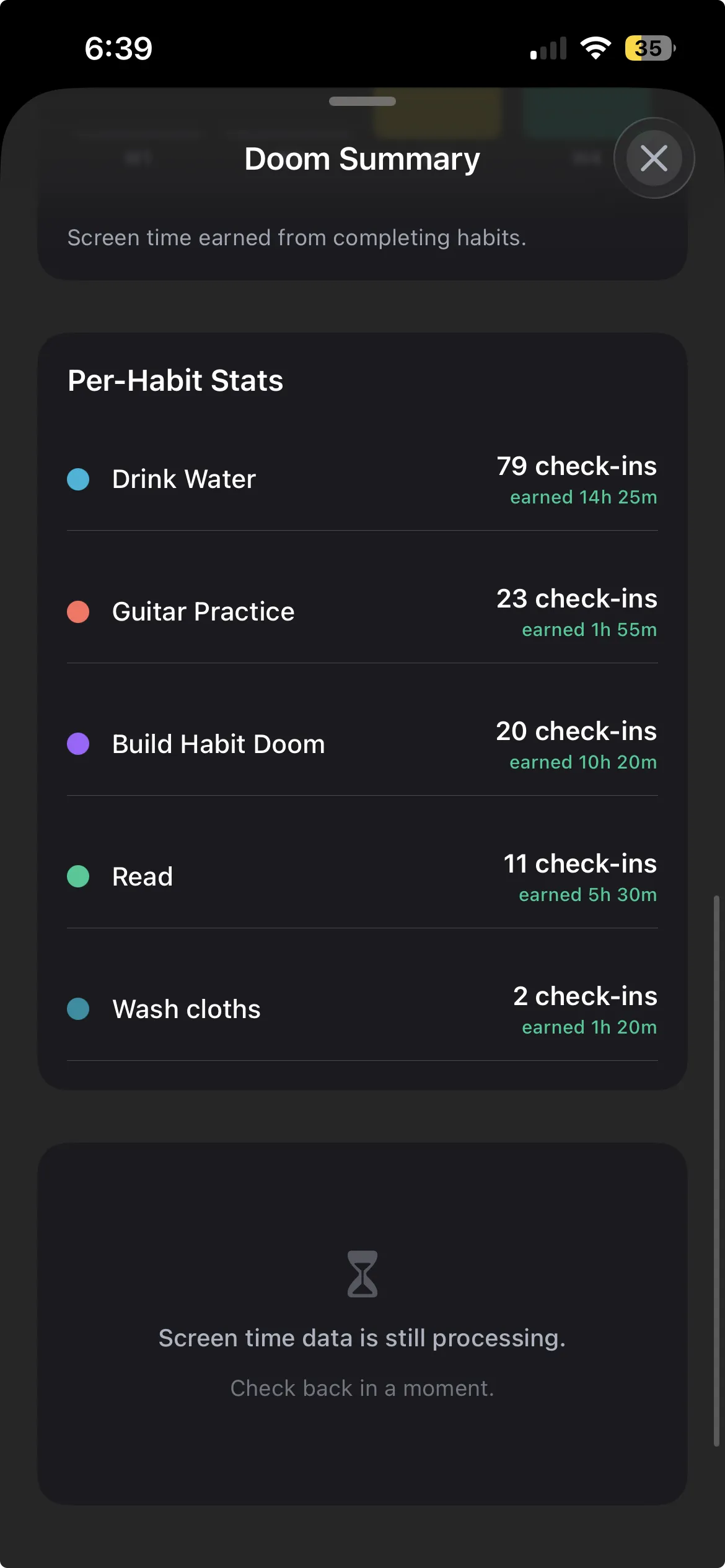
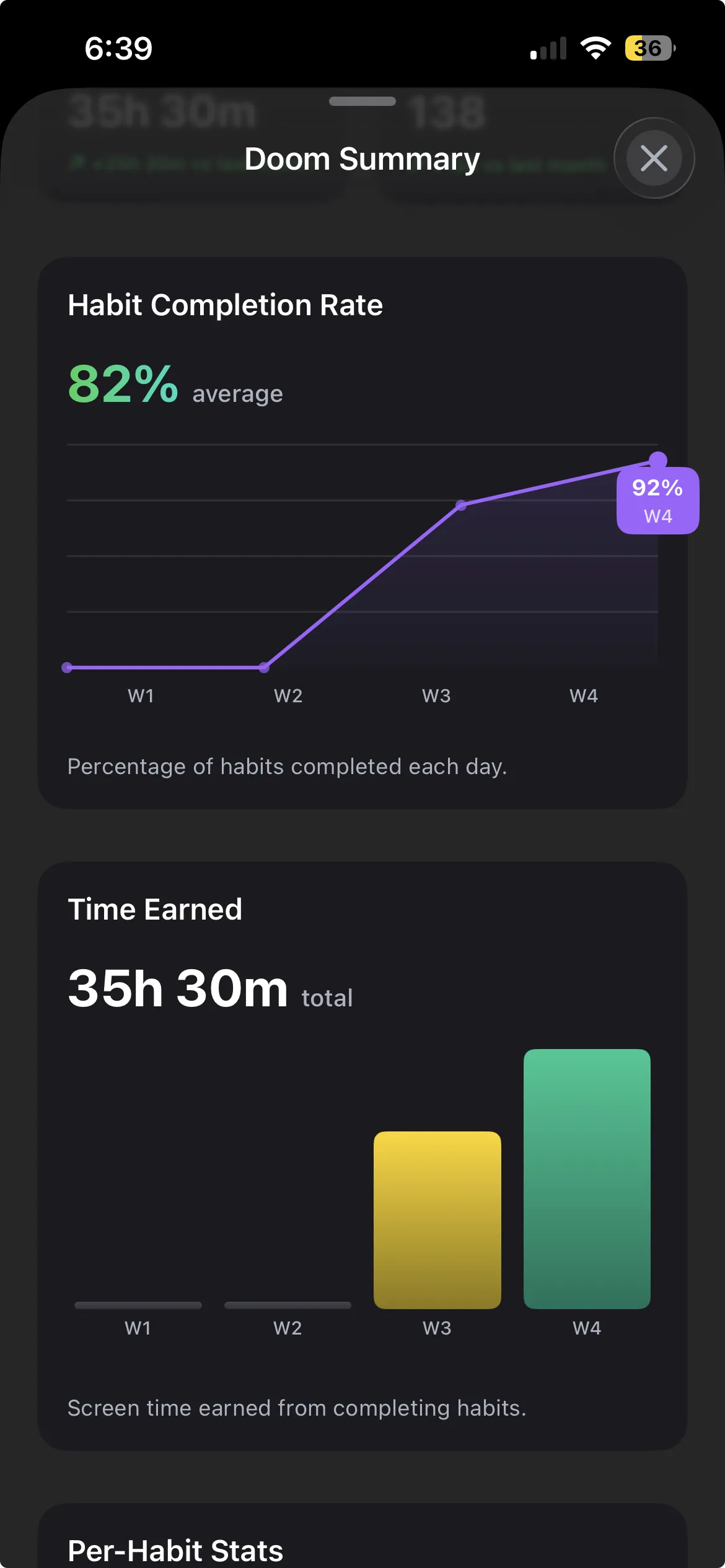
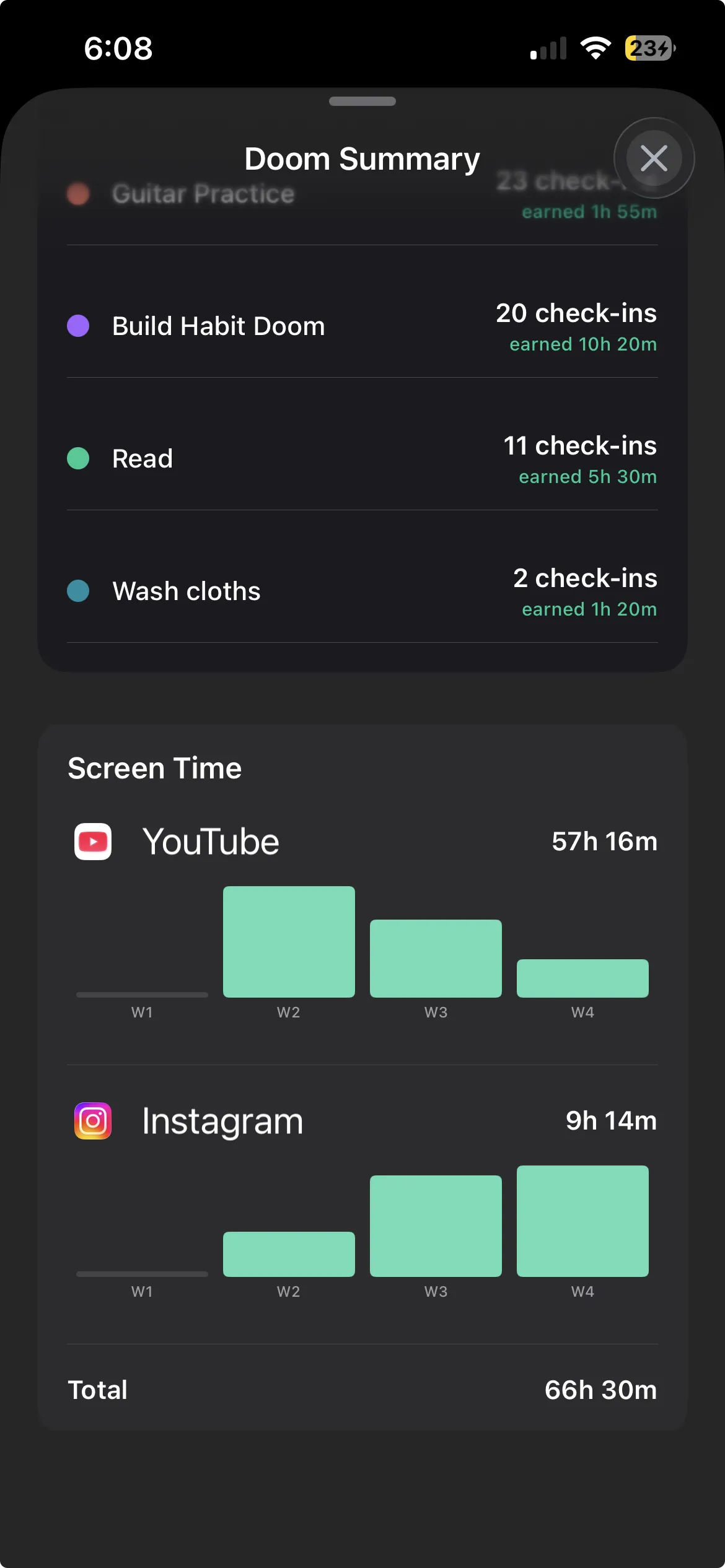
My YouTube consumption dropped visibly week over week. Not because I forced myself to stop watching. Not because I set a timer or deleted the app. I simply ran out of time after doing the things that actually mattered. The delayed gratification was not the sacrifice. It was the mechanism that made everything else happen.
Here is the part that surprised me most: I did not feel deprived. The old shame spiral (scroll, feel guilty, scroll more to escape the guilt) was gone. When I did open YouTube or Instagram after completing my habits, it felt earned. The exact same activity that used to make me feel terrible now felt like a legitimate reward. That psychological shift is what Mischel was really studying. It is not about never eating the marshmallow. It is about eating it on your terms, after you have done the work.
The Bigger Thesis: Why This Matters Beyond Screen Time
Mischel's marshmallow test was never just about marshmallows. And Habit Doom is never just about blocking TikTok or reducing Instagram time.
The deeper thesis is this: the apps many of us use for hours every day train us to choose the immediate reward over the long-term one. And the research points in a consistent direction: people who struggle to delay gratification tend to have a harder time with goals that pay off later, from careers to health to relationships.
The marshmallow test showed that this ability is a meaningful predictor of long-term outcomes. And the design of modern feeds steadily erodes it, one infinite scroll at a time.
But here is the optimistic part, and this is what Mischel's later work proved: delayed gratification is trainable. It is not a fixed trait you are born with. It is a muscle. The kids who covered the marshmallow were not genetically superior. They found a strategy. And if you can train the muscle, you can un-train the damage.
That is the real argument for tools like Habit Doom, or digital detox strategies, or even just putting your phone in another room while you work. Every time you choose the habit over the scroll, every time you sit with the discomfort of locked apps for 20 minutes while you read or exercise or practice guitar, you are running a rep. You are strengthening the exact muscle that Mischel proved determines how your life turns out.
One marshmallow test at a time.
Your Marshmallow Test Starts Tomorrow Morning
Tomorrow morning, you will wake up and reach for your phone. That is your marshmallow sitting on the table. You can grab it (open Instagram, check YouTube, scroll through TikTok) and the rest of your day will follow the same pattern it always has.
Or you can wait. Do the thing that matters first. Read for 20 minutes. Exercise. Practice a skill. Build a morning routine. And then unlock the apps, knowing you earned it.
Mischel's work suggests the skill of waiting is trainable, and you do not need to wait 15 minutes. You just need to do your habits first. Habit Doom is free on the App Store and takes about 30 seconds to set up.
Frequently Asked Questions
Keep Reading
Try Habit Doom
Lock your distracting apps. Complete your habits. Earn your screen time. It takes 30 seconds to set up.
Download Free