


Growth Mindset: 4 Failed Apps and Why I Didn't Quit

 X
X LinkedIn
Open my App Store Connect right now and you will see a graveyard.
UnManaged Tasks, a task management app. Still live. Zero traction. One Diary, a journaling app. Shipped it, nobody cared. Artizan App. I do not even remember what this one did. It says "Removed from App Store." That about sums it up.
Before Habit Doom, I had built close to a dozen web and mobile apps. Every single one followed the same pattern: exciting idea, burst of energy, weeks of building, launch into silence, slow death. Some never made it past the prototype. Some made it to the App Store and got zero downloads. Some had a brief spark (a few interested testers, a moment of validation), but I could never keep the fire alive.
I was, by every objective measure, a serial failure at shipping products.
This is a story about what changed. Not because I suddenly became more talented. Not because I had a breakthrough idea that was obviously better. But because I changed how I thought about failure itself. That shift, backed by decades of research from psychologist Carol Dweck, is the reason Habit Doom exists today.
This is Part 2 of a series on the science behind Habit Doom, inspired by Professor Jiang's lecture on the PredictiveHistory YouTube channel. Part 1 covers the Marshmallow Test and delayed gratification, and Part 3 covers deliberate practice.
The Research: Why Most People Quit
Beginning in the late 1970s, psychologist Carol Dweck (now at Stanford) ran a series of experiments that fundamentally changed how we understand achievement. She gave children a set of puzzles, easy ones at first, then progressively harder ones designed to be unsolvable.
What she observed was not about intelligence. It was about how the children responded to failure.
One group, when they hit the impossible puzzles, said things like: "I'm not smart enough." "I can't do this." They became frustrated, gave up quickly, and (here is the striking part) their performance on the easy puzzles dropped. Failure on the hard problems made them worse at problems they had already solved.
The other group responded differently. They said things like: "This is tricky, I need a new strategy." "I love a challenge." They leaned in. They tried different approaches. Some of them actually improved their performance even though the puzzles were designed to be unsolvable.
Dweck identified two distinct mindsets:
- Fixed mindset: "My abilities are set. Failure means I've hit my ceiling. If I have to try hard, it means I'm not naturally good at this."
- Growth mindset: "My abilities can be developed. Failure is information. Effort is the path to mastery."
The idea was later extended to students, athletes, and professionals. The broad pattern researchers described:
- Students with a growth mindset recovered from bad grades faster and, in some studies, ended up with higher GPAs
- Athletes who believed skill was trainable practiced more deliberately and improved faster
- Professionals with a growth mindset sought feedback instead of avoiding it
It is worth being honest about the evidence here. Growth mindset became hugely popular, but later reviews and replication attempts have found the real-world effects are debated and often small on average (for example Sisk et al. 2018, and Li and Bates 2019). Dweck originated the concept and the framing is genuinely useful, but the size of the gains is less settled than the early enthusiasm suggested.
The critical insight was this: mindset is not about positive thinking. It is about how you interpret failure. Fixed mindset treats failure as evidence of who you are. Growth mindset treats failure as evidence of what to try next.
My Fixed Mindset Years
I did not know about Dweck's research when I was shipping my first apps. But looking back, I was a textbook case of fixed mindset in action.
Here is what my inner monologue sounded like:
- After UnManaged Tasks got zero traction: "Maybe I'm just not good at product design. Real founders know what people want. I clearly don't."
- After Artizan App died: "I should stick to my day job. Building products is for people who have the instinct for it."
- After the fifth or sixth failure: "I've tried enough times. If I were going to succeed at this, it would have happened by now."
Every failure felt like a verdict. Not on the product, but on me. Each abandoned project reinforced the belief that I was not the kind of person who ships successful products. That I lacked something fundamental that real founders have.
And because I believed that, I acted accordingly. I stopped doing user research. I stopped iterating past the first version. I would build what I thought was good, ship it, and when nobody cared, I read it as confirmation that the problem was me, not the approach. Why iterate on something if the real issue is that you are not talented enough?
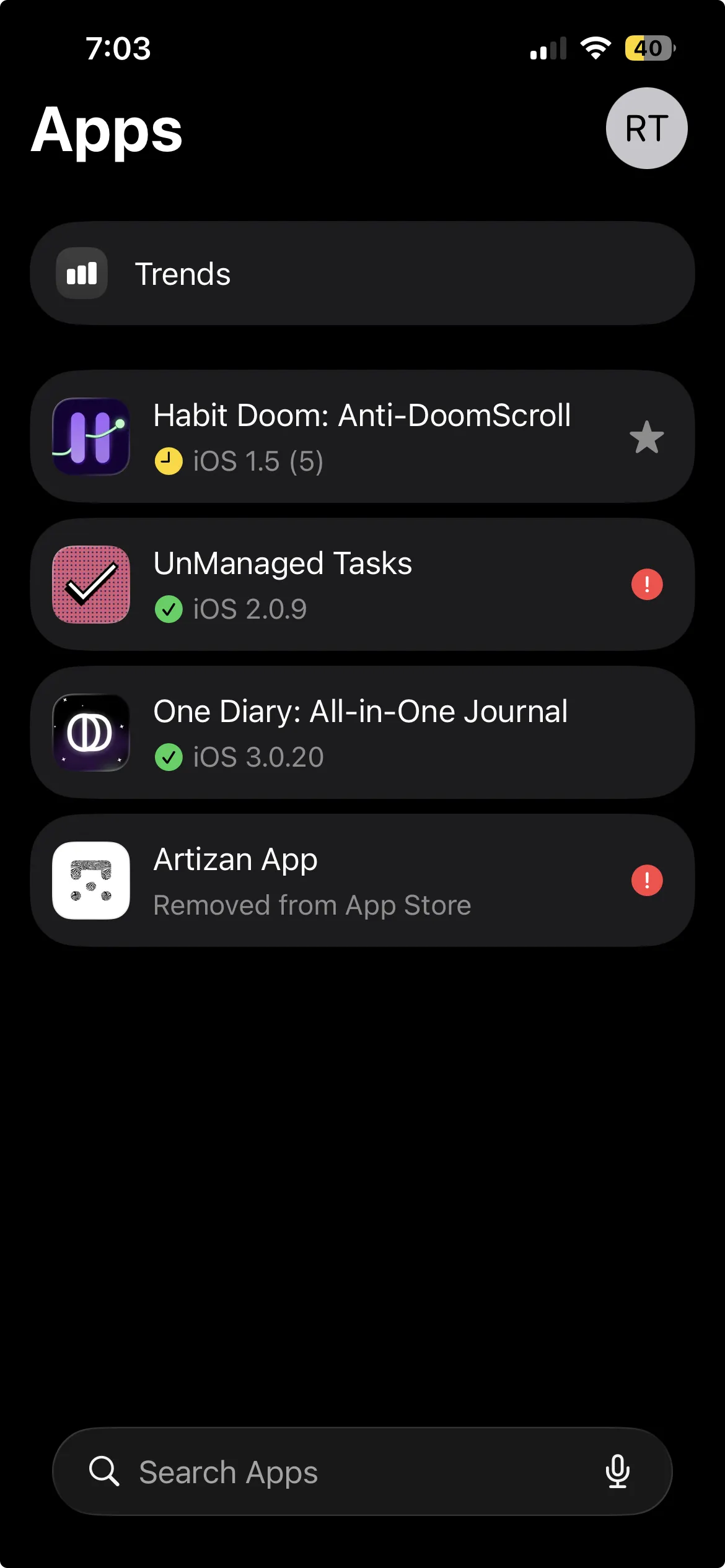
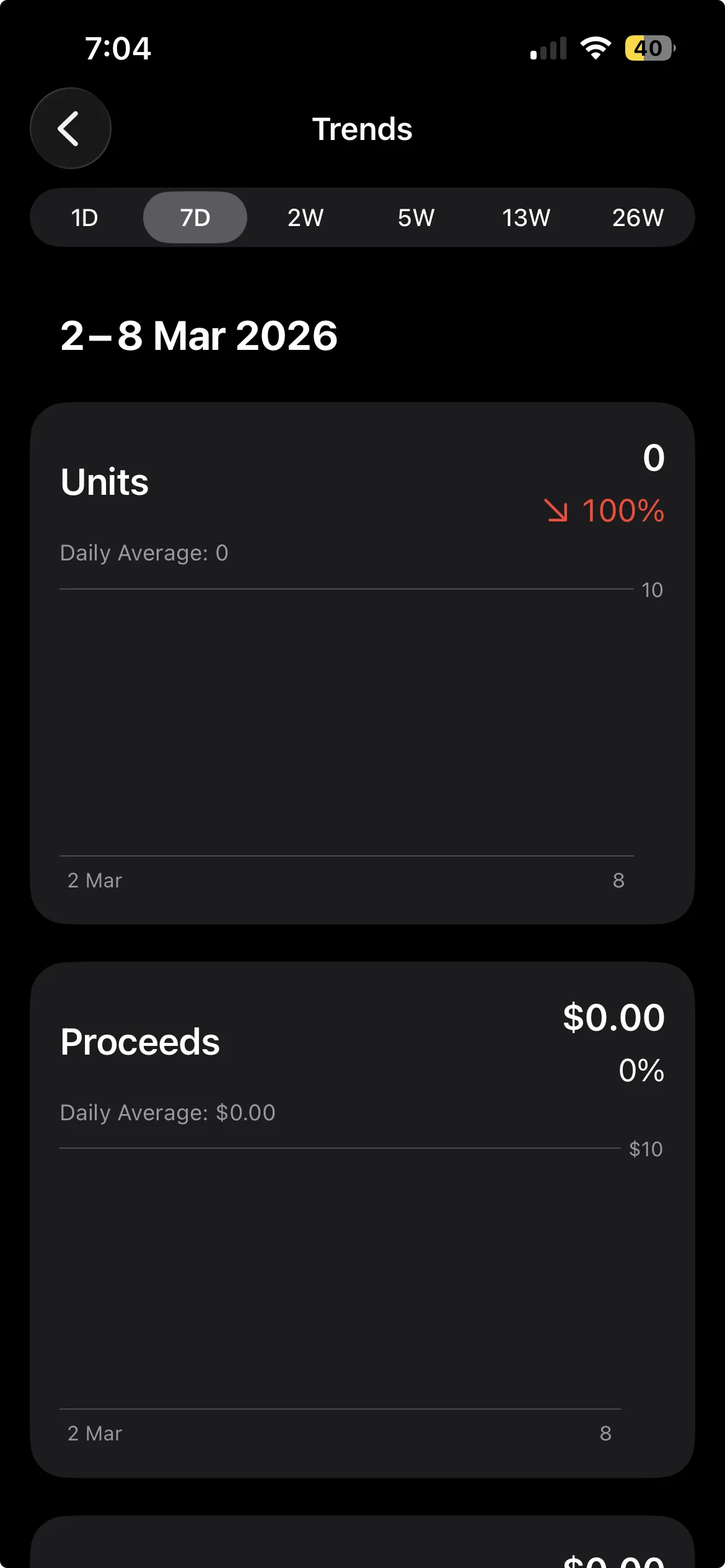
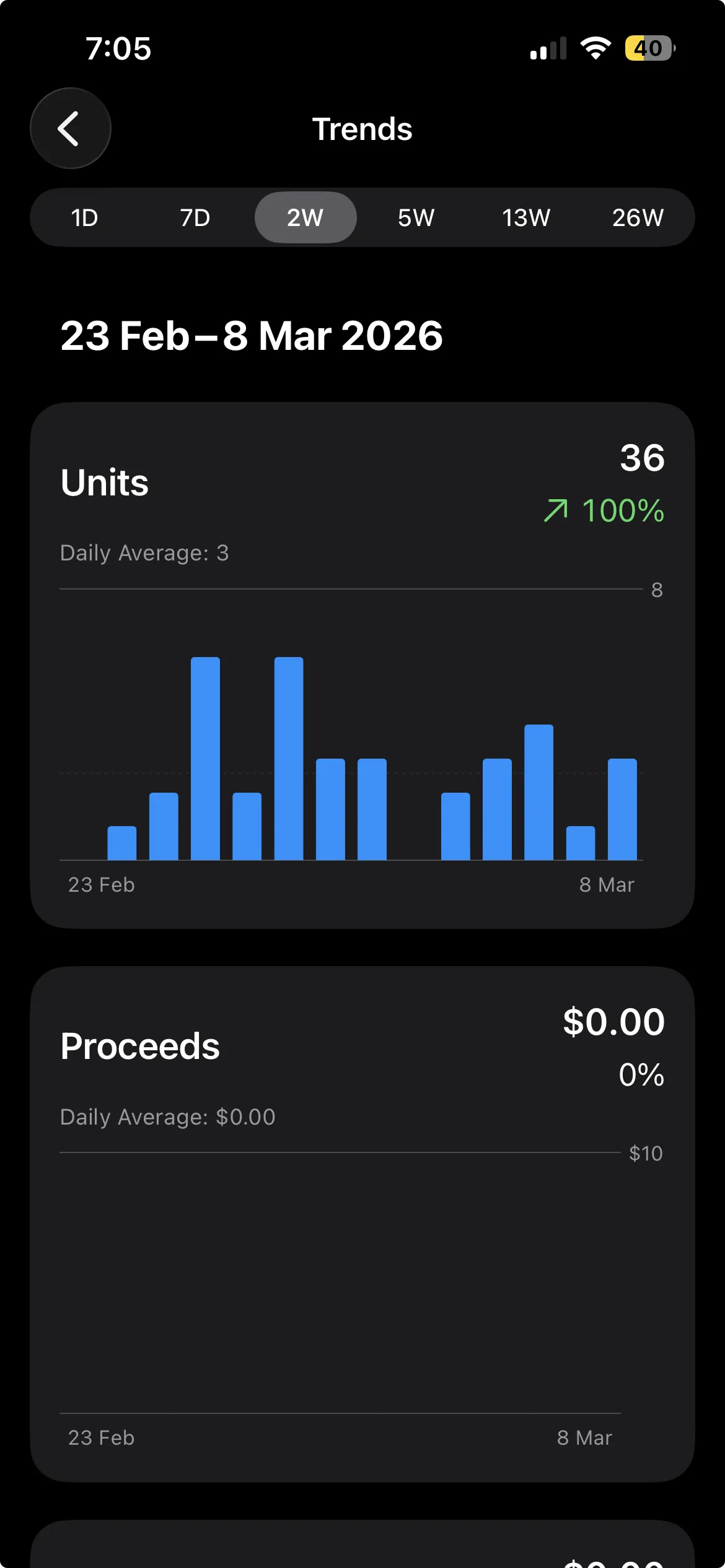
That screenshot is real. That is my actual App Store Connect. Zero units. Zero proceeds. "Removed from App Store." A graveyard of ideas I believed in and then abandoned because I interpreted silence as a final answer.
The Moment Everything Shifted
Habit Doom almost died the same way.
The first version of the app was, honestly, bad. Not technically broken (it worked). But the onboarding was confusing. The core concept, lock your apps until you do your habits, made perfect sense to me but was nearly incomprehensible to people seeing it for the first time.
I shared it with friends, family, anyone who would look at it. The feedback was brutal:
- "I don't understand what this does."
- "Why would I want to lock my own apps?"
- "I would never pay for this."
- "The onboarding lost me after the second screen."
They were right. Every single piece of feedback was valid. The app was not clear. The value proposition was not obvious. The onboarding assumed too much context.
Here is where the old me would have quit. In fact, I felt the pull. That familiar voice: "See? Another one. People don't want this. Move on to the next idea."
But something was different this time. I am not sure I can pinpoint exactly why. Maybe it was the accumulated frustration of too many abandoned projects, maybe I was just tired of the pattern. But instead of interpreting the feedback as "this idea is bad and you should stop," I heard it as "this execution needs work and you need to fix it."
That distinction, between "I failed" and "this approach failed," is exactly what Dweck's research describes. And it changed everything.
Iteration as a Mindset Practice
I threw out the entire onboarding and rebuilt it from scratch. Not a tweak. A complete rethink of how a new user encounters the app for the first time.
Then I tested it again. Different people this time, because the original testers already knew the concept and could not represent new users anymore. Fresh eyes. Honest reactions.
It was better. But not good enough. So I rebuilt it again.
And again.
I went through so many rounds of this that I literally exhausted my inner circle. Every friend, every family member, every colleague, every friend-of-a-friend. They had all seen the app at some point during testing. I even recruited my girlfriend as an unpaid market research department, which mostly meant she had to casually bring up "so how do you feel about your screen time?" to every friend she met for coffee. She was thrilled (or at least took enough pity on my distressed face to pretend she was). I had no one left within two degrees of separation who had not been a test user.
And that was actually the moment I knew I was ready. Not because the app was perfect (it was not). But because I had iterated so many times, with so many different people, incorporating so much real feedback, that the only way to continue improving was to show it to the world.
Here is what the growth mindset actually looks like in practice:
- Build something, knowing it will be imperfect.
- Show it to people, not to get validation, but to get data.
- Listen without defending. Their confusion is your product's problem, not their problem.
- Rebuild based on what you learned, not what you assumed.
- Repeat with new people, because previous testers cannot unsee what they have seen.
That loop is the entire game. And the only thing that makes it possible is believing that iteration leads somewhere, that you are not just rearranging deck chairs on a sinking ship, but actually building something better with each cycle.
Why Habits Are Growth Mindset Training
Here is the connection that Professor Jiang's lecture made click for me: daily habits are the most practical growth mindset training available.
Think about what happens when you commit to a daily habit:
Day 1: You are terrible at it. Your guitar playing sounds awful. Your writing is stiff. Your meditation lasts 90 seconds before your mind wanders.
Day 7: Slightly less terrible. You can almost play a chord change without pausing. Your writing flows a bit. You can sit for 3 minutes.
Day 30: You can hear the difference. Other people can hear the difference. The thing you were bad at is becoming the thing you do.
Every single day of that progression is a micro-dose of growth mindset. You are proving to yourself, with evidence you can see and hear and feel, that ability is not fixed. That effort produces results. That the person you were on Day 1 is not the person you have to be on Day 30.
This is not abstract psychology. It is literally what happens when you track your habits in an app and watch the numbers climb. Guitar practice went from 0 to 23 check-ins. My reading streak hit 11 days. My habit completion rate climbed to 82%. Every one of those numbers is concrete proof that I am not the same person I was a month ago.
And that proof compounds. The more evidence you accumulate that you can improve, the easier it becomes to face the next failure with a growth mindset instead of a fixed one. Because you have data. Not hope. Data.
The Part Nobody Talks About: Zero Downloads Is Not the End
I want to be transparent about where Habit Doom is right now, because I think the honest version of this story matters more than the polished version.
As I write this, Habit Doom has over 80 downloads in its first month. Revenue was at $0 for weeks because I spent that time fighting an App Store Connect bug that blocked my in-app purchases from being submitted. Update: All three IAPs are now live: Monthly ($4.99/mo), Yearly ($19.99/yr with 7-day trial), and Lifetime ($29.99).
Update (through May 2026): The arc kept going. Habit Doom is at 726 installs through May 2026, and May alone did 10,762 check-ins from 205 active users. D7 retention hit an all-time high of 26.5%. None of that is "made it" money, and that is not the point. The point is that the curve bends when you keep iterating instead of reading early silence as a verdict.
By every conventional startup metric, this is not a success story. It is a story in progress. I write blog posts at midnight after my day job. I test the app on strangers because I have used up everyone I know. I stare at download numbers that would make most people quit.
But here is what is different from every other project I have shipped: I am not interpreting the numbers as a verdict. Zero downloads this week does not mean the app is bad. It means nobody knows about it yet. Low engagement does not mean the concept fails. It means the onboarding might need another pass, or the messaging is not clear enough, or I have not found my audience yet.
Every one of those is a solvable problem. A growth mindset problem. Not a "you are not cut out for this" problem.
I have already iterated through more versions of this app than all my previous projects combined. I rebuilt the onboarding from scratch three times. I rewrote the App Store description. I redesigned the screenshots. I started this blog. Each iteration makes the product slightly better and my understanding slightly deeper.
Is this going to work? I genuinely do not know. But for the first time in a dozen projects, I am still here. Still iterating. Still showing up. And that, according to Dweck's research, is the only variable that actually matters.
How to Apply This to Your Own Habits
You do not need to build an app to benefit from growth mindset. You just need to change how you talk to yourself when things go wrong. Here is the practical framework:
Reframe the Identity Statement
| Fixed Mindset | Growth Mindset |
|---|---|
| "I'm not a morning person" | "I haven't found a morning routine that works for me yet" |
| "I can't focus for more than 10 minutes" | "My focus muscle needs training, so I'll start with 5 minutes" |
| "I always fail at habits" | "My previous systems didn't work. I need a different approach" |
| "I'm addicted to my phone" | "My environment makes it easy to scroll. I need to change the environment" |
The word "yet" is the most powerful word in the growth mindset vocabulary. "I can't do this yet" is a fundamentally different statement from "I can't do this." One is a status update. The other is a life sentence.
Build the Evidence Base
Start tracking something. Anything. The reason apps like Habit Doom work is not the lock mechanic (though that helps). It is the visible evidence of growth. When you can see your streak climbing, your check-ins accumulating, your completion rate rising, you are building an evidence base against the fixed mindset voice.
That voice says "you can't change." Your habit data says "you already have."
Expect the Dip and Plan for It
Every habit has a dip. The excitement of Day 1 fades. The streak breaks. You miss a day and the fixed mindset voice screams: "See? I told you. You always quit."
Plan for it in advance. Decide now what you will do when you miss a day. Not if, but when. The growth mindset response is not "I failed." It is "I missed one day. My 14-day streak becomes a 1-day streak. Time to build the next one."
Habit Doom's streak system is designed around this. When you break a streak, the counter resets, but your total check-ins and earned screen time stay. You can see that even with broken streaks, the overall trajectory is upward. That is growth mindset built into the data model.
Your Mindset Is a Habit Too
Carol Dweck's most important finding was not that growth mindset is better. It was that mindset itself is changeable. You are not born with a fixed or growth mindset. You practice one or the other, every day, through the stories you tell yourself about what your failures mean.
Every time you miss a habit and try again the next day, you are practicing growth mindset. Every time you look at a bad week and ask "what can I change?" instead of "what is wrong with me?", you are rewiring how your brain processes failure.
I shipped four failed apps before Habit Doom. Maybe Habit Doom will be the fifth failure. I genuinely do not know. But I know that I am no longer the person who interprets silence as a verdict. I am the person who interprets silence as "iterate and try again."
That shift, from fixed to growth, is not something I read in a book and suddenly believed. It is something I trained, one habit at a time, one iteration at a time, one rebuilt onboarding at a time.
You can train it too. Start with one habit. Track it. Watch the numbers. When the streak breaks (and it will), notice the voice that says "you always quit." Then open the app, check off the habit, and start a new streak.
That is growth mindset. Not as theory. As practice.
Start with one habit, track it, and let the numbers make the case that the fixed mindset voice never could.
Frequently Asked Questions
Keep Reading
Try Habit Doom
Lock your distracting apps. Complete your habits. Earn your screen time. It takes 30 seconds to set up.
Download Free