


How Many Times a Day Do You Check Your Phone?

 X
X LinkedIn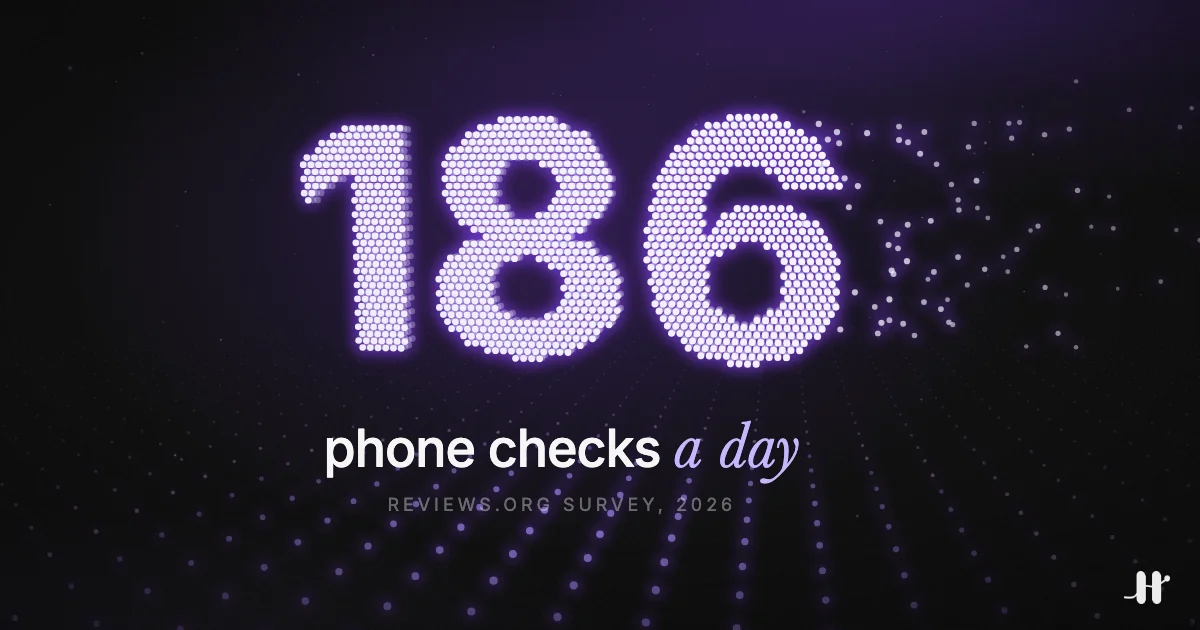
There is no single number for how many times a day people check their phones. There are several, and they disagree, and the disagreement is the interesting part. A self-reported survey will give you one figure. A passive tracker running on the actual device will give you a wildly different one. A study counting raw screen touches will give you a number so high it sounds made up.
This post collects the figures that get cited everywhere, attributes each one to its source and year, and explains why they diverge. Every number below links to the study it came from. If a number could not be traced to a primary source, it is not here.
The short answer, by source
Here is every credible phone-checking figure, with the measurement method and year attached, because the method is what explains the gap between them.
| Figure | What it measures | Source | Year |
|---|---|---|---|
| 186 checks/day | Self-reported checks, US adults | Reviews.org | 2026 |
| 205 checks/day | Self-reported checks, US adults | Reviews.org | 2025 |
| 144 checks/day | Self-reported checks, US adults | Reviews.org | 2023 |
| 352 checks/day | Self-reported checks, US adults | Asurion | 2022 |
| 96 checks/day | Self-reported checks, US adults | Asurion | 2019 |
| 58 pickups/day | Measured device pickups | RescueTime | 2019 |
| 2,617 touches/day | Measured screen touches | dscout | 2016 |
| 5,427 touches/day | Measured touches, heaviest 10% | dscout | 2016 |
| 237 notifications/day | Measured notifications, teens (median) | Common Sense Media | 2023 |
Read top to bottom, the table looks contradictory. It is not. It is three different questions being answered at once: how often do you think you check, how often does your phone actually wake up, and how often do you touch the glass at all.
How many times a day does the average person check their phone?
The most quoted figure comes from Reviews.org, which runs an annual cell-phone-use survey. In its 2026 report, the average American said they check their phone 186 times a day, which works out to roughly once every five minutes of waking time. That is down from the 205 times a day reported in the 2025 survey, which was itself a sharp jump from 144 times a day in 2023.
The 144 figure is the one that went viral and still circulates in headlines years later. It is real, but it is also the 2023 number. If you see "144 times a day" presented as current, it is two surveys out of date.
The same Reviews.org 2026 report adds context worth keeping. 84.6 percent of people check their phone within ten minutes of waking, 49.6 percent sleep next to their phone, and 45.8 percent describe themselves as addicted to it. The average self-reported daily screen time in that survey was 3 hours and 14 minutes.
Why Asurion's number is so much higher
Asurion's 2022 study of nearly 2,000 US adults found people check their phones 352 times a day, or about once every two minutes and forty-three seconds. That is almost double the Reviews.org figure for a roughly overlapping period.
The reason is the same study's own history. Asurion reported 96 checks per day in 2019, then 352 in 2022, a near-fourfold rise across the pandemic years. Different survey wording, different sample, different definition of a "check", and the number moves. That is the lesson of self-reported phone data: the figure depends heavily on how the question is asked.
What actually-measured data shows
Surveys ask people to estimate. Estimates are unreliable, almost always low. So the more honest measurements come from software that logs the phone itself.
RescueTime analyzed data from 11,000 of its mobile users in 2019 and found an average of 58 phone pickups per day, with 30 of those during working hours. Notice that this measured figure is lower than the self-reported survey numbers, not higher. RescueTime counts a discrete pickup, not the foggy "how often do you check" a survey respondent answers. Measured the same way, the loop is more contained than people fear, but still adds up: at about a minute and fifteen seconds per pickup, that is real time bleeding out of the day.
Then there is the number that broke everyone's brain. In 2016, research firm dscout tracked 94 users' every screen interaction for five days and found an average of 2,617 touches per day. The heaviest 10 percent of users hit 5,427 touches. A "touch" is any tap, swipe, or type, so this counts every individual interaction inside a session, not the session itself. It is a different unit from a check, which is why it is an order of magnitude larger. The dscout study also found participants dramatically underestimated their own use, with one person guessing 500 touches and actually hitting 5,000.
How many times do teenagers check their phones?
Teen figures come from device data, which makes them more trustworthy than adult self-report. Common Sense Media's 2023 study collected actual smartphone data from around 200 participants aged 11 to 17. The median teen received 237 notifications per day, and some received nearly 5,000 in a single day. About a quarter of those notifications arrived during the school day.
Pew Research Center's 2024 report found that 48 percent of US teens say they are online "almost constantly," roughly double the share from a decade earlier. In the same survey, 90 percent of teens use YouTube, about 60 percent use TikTok and Instagram, and 55 percent use Snapchat. "Almost constantly" is the phrase that matters: at that level, checking is not an event you could count. It is the baseline state.
So which number is right?
All of them, for what they measure.
- If you mean conscious self-reported checks, the current figure is 186 per day (Reviews.org, 2026), with recent years ranging from 144 to 352 depending on the survey.
- If you mean measured pickups from device software, it is closer to 58 per day (RescueTime, 2019).
- If you mean raw screen touches, it is 2,617 per day on average and 5,427 for heavy users (dscout, 2016).
The trend line across all of them points the same way. Asurion's fourfold jump from 2019 to 2022 and Reviews.org's climb from 144 to 205 before its small 2026 dip both describe a behavior that grew fast and then settled at a very high baseline. For a fuller picture of the screen-time side of this, the 2026 screen time statistics breakdown covers hours rather than counts.
The part the numbers do not say
Here is what no statistic on its own makes obvious: almost none of these checks are decisions.
A huge share of everyday behavior runs automatically, triggered by context cues rather than conscious choice. That is the central finding of decades of habit research from Wendy Wood and colleagues, summarized in their paper Habits in Everyday Life. A habit fires when a cue in the environment recurs: the same location, the same time, the same preceding action. Your phone is wired into more of those cues than anything else you own. Sit down, buzz, idle moment, awkward pause in conversation. Each is a trigger, and each trigger runs the same loop.
That is why the count is so high and why willpower barely dents it. You cannot consciously resist 186 separate urges a day. The pickup happens before the decision does. This is the mechanism explored in depth in why you keep picking up your phone and how to stop checking your phone unconsciously.
The implication is practical. If checking is a habit loop, the fix is not to muster more resistance at each cue. It is to change what happens when the loop fires.
Where Habit Doom fits
Habit Doom is built around exactly that mechanism. It is an iPhone and Android app that locks your chosen distraction apps, the Instagrams and TikToks and YouTubes that absorb most of those daily checks, until you complete your daily habits. The cue still fires. You still reach for the phone. But the app that the habit loop was reaching for is locked, so the automatic check resolves into nothing instead of a forty-minute scroll. The loop runs into a wall and, over time, fires less.
The core app is free: three habits, app blocking, custom alarms, streaks, and on-device Anti-Cheat photo verification, no payment required. Pro adds unlimited habits at $4.99/month, $19.99/year (with a 7-day free trial), or $29.99 lifetime. It is on iPhone and Android.
You will not get your daily check count down to zero. Nobody is at zero. But the difference between 186 automatic openings of a feed and a feed that stays locked until your habits are done is the difference between the phone running your day and you running it.
The bottom line
The average person checks their phone 186 times a day by the most recent self-report (Reviews.org, 2026), 58 times by measured device pickups (RescueTime, 2019), and touches the screen 2,617 times a day at the interaction level (dscout, 2016). Teens get a median of 237 notifications a day (Common Sense Media, 2023) and nearly half are online "almost constantly" (Pew, 2024).
Pick the number that matches your question. Then notice that the count is high because almost every one of those checks is a habit firing, not a choice being made. That is the part worth changing.
Frequently Asked Questions
Keep Reading
Try Habit Doom
Lock your distracting apps. Complete your habits. Earn your screen time. It takes 30 seconds to set up.
Download Free