


Why Do I Keep Picking Up My Phone? (Neuroscience + Fix)

 X
X LinkedIn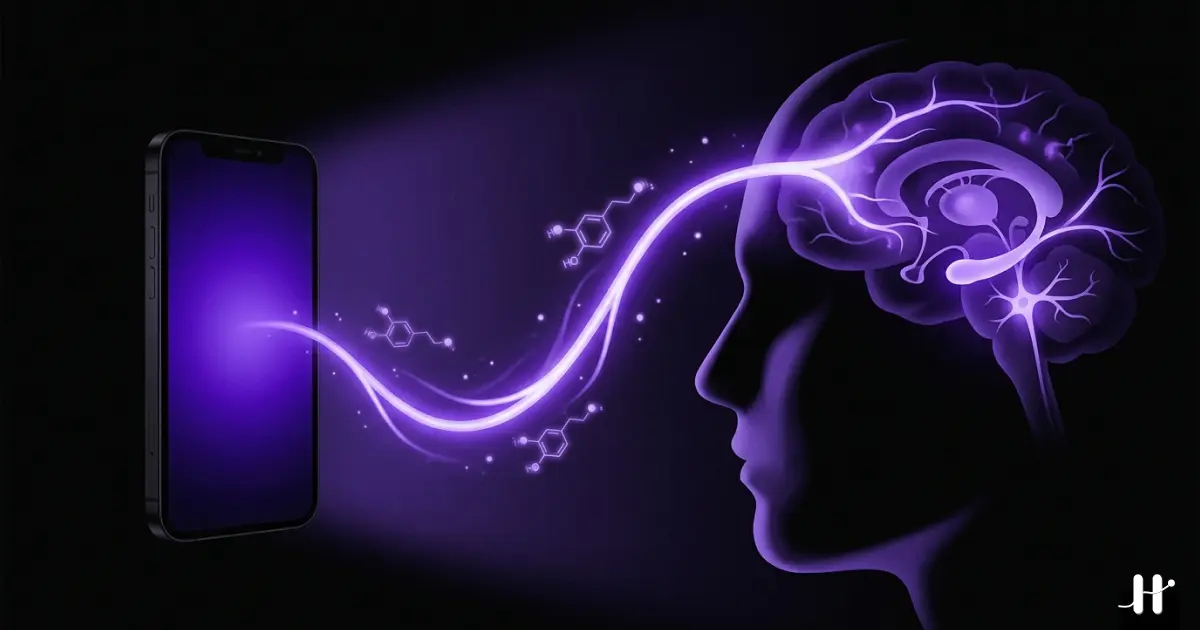
Why you keep picking up your phone: quick answer
You keep picking up your phone because the behavior has become an automatic dopamine-driven habit loop. The loop runs below conscious control: a faint cue (boredom, a task transition, half a second of waiting) triggers the pickup, and your brain receives a hit of dopamine from the anticipation of finding something rewarding in the feed, whether the feed actually delivers or not.
This loop has been studied extensively. BF Skinner's work on variable-ratio reinforcement in the 1950s showed that unpredictable rewards produce the most compulsive behavior, more compulsive than predictable rewards. Modern social media feeds were designed by engineers who understood this. Algorithmic feeds, infinite scroll, and pull-to-refresh are all variable-reward systems.
You cannot willpower your way out of this. You can starve the loop. Below: how the dopamine circuit works, why phantom vibrations happen, and the 5 fixes that consistently break the loop in 2 to 4 weeks.
The neuroscience of compulsive phone checking
Dopamine is about anticipation, not pleasure
The most persistent misconception about dopamine is that it is the brain's "pleasure chemical." It is not. Dopamine is the brain's anticipation chemical.
Wolfram Schultz's foundational work on dopamine neurons in primates showed that dopamine releases when an unexpected reward appears, and later releases in anticipation of expected rewards. The actual reward, once delivered, produces less dopamine than the anticipation did. This explains why scrolling Instagram for 20 minutes feels less satisfying than the moment right before you opened it.
For phone use, this means: the pickup itself releases dopamine. Opening Instagram releases dopamine. Pulling to refresh releases dopamine. The actual content you find may or may not be satisfying, but the loop self-reinforces because the dopamine arrived before the content did.
Variable rewards are the most reinforcing schedule
Skinner's variable-ratio reinforcement work in operant conditioning research showed that unpredictable rewards drive more compulsive behavior than predictable ones. A vending machine that delivers a snack every time you put in a dollar is less compulsive than a vending machine that randomly gives out free snacks 1 in 10 times.
Slot machines were the canonical example until smartphones. The pull-to-refresh gesture on social media is, behaviorally, identical to a slot machine lever. You do not know if this refresh will produce a great post, a mediocre one, or nothing. The uncertainty is the addictive ingredient.
Algorithmic feeds amplify this further. The next swipe might be the perfect video, the most insightful tweet, the message you have been waiting for. The next swipe might be nothing. Your brain treats this exactly the way it treats other variable-reward environments: with compulsion.
Phantom vibrations and the primed brain
A side effect of the highly trained phone-checking loop is phantom vibration syndrome: feeling your phone buzz when it has not. Student surveys have put the prevalence as high as around 90 percent, though broader populations tend to report lower rates.
This is not a mental health issue. It is a successful prediction by your brain. The brain learns that notifications produce a vibration sensation, and over time it begins generating that sensation pre-emptively when ambient inputs (clothing brushing your leg, muscle twitch, distant noise) match the expected pattern. Your nervous system is so well-tuned for notifications that it hallucinates them.
Phantom vibrations tend to fade as notification load drops, because the brain stops anticipating buzzes that no longer reliably arrive.
Why willpower does not break this loop
The classic advice, "just put your phone down," fails because it assumes willpower can interrupt a behavior willpower is not present for. The phone pickup happens before your conscious decision-making catches up.
There is a specific neuroscientific reason for this. Habit loops are stored in the basal ganglia, a deeper brain structure that operates without conscious involvement. Decisions live in the prefrontal cortex. When a well-trained habit loop fires, the basal ganglia complete the routine automatically, before the prefrontal cortex has even registered the situation. By the time you notice you are scrolling, the loop has already run several times. Willpower shows up late to a fight that is already over.
Stanford researcher BJ Fogg has studied this extensively in his Behavior Design Lab. His conclusion: trying to use willpower on automated behaviors is the most common reason behavior-change programs fail. The fix is not stronger willpower. The fix is changing the conditions the loop runs under so it stops getting reinforced.
That is the actual lever. Loops weaken when they stop delivering the dopamine they expect. Automatic behaviors fade once the reward that reinforced them stops arriving.
5 evidence-based fixes that break the loop
1. Make the reward unavailable
The cleanest intervention is also the most direct. When the loop fires and completes the pickup, the rewarding apps should not be there.
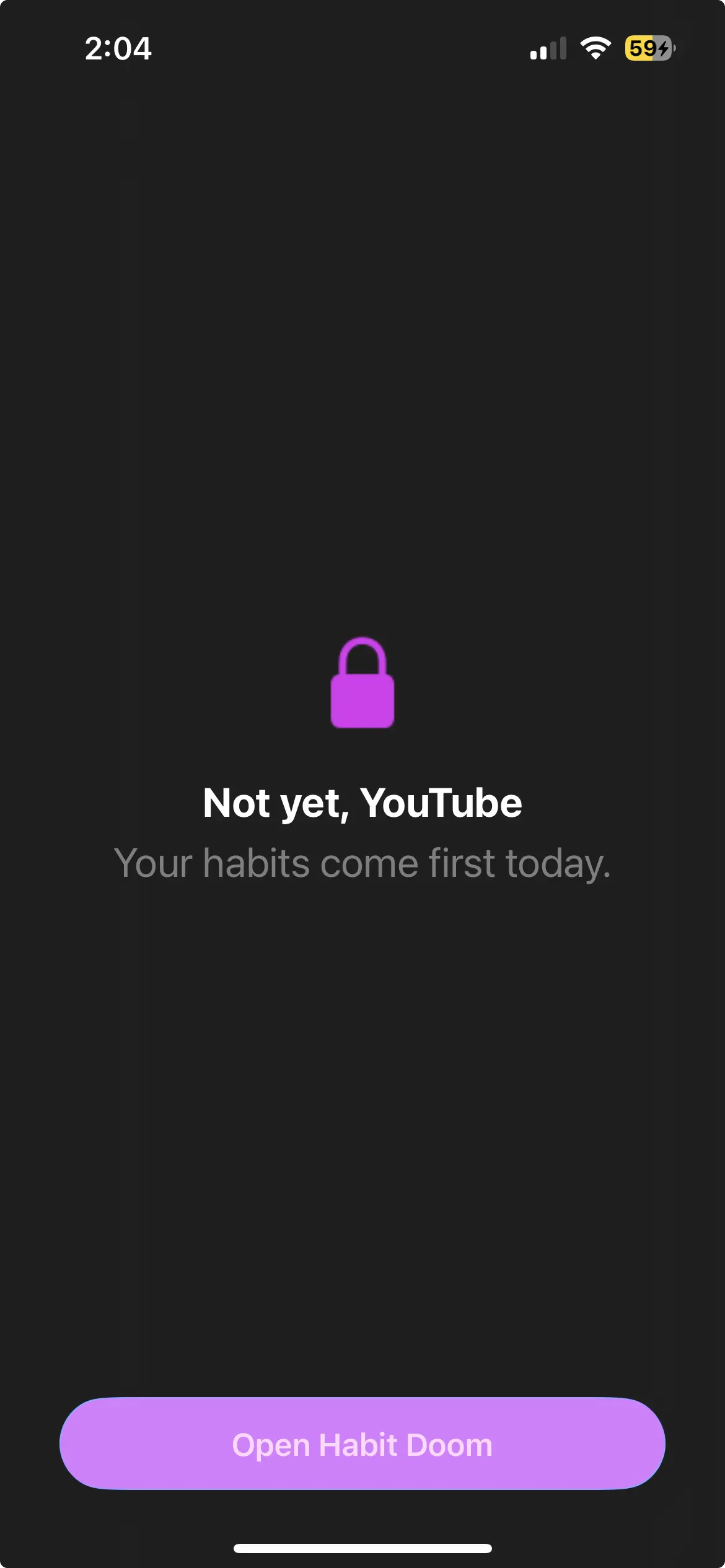
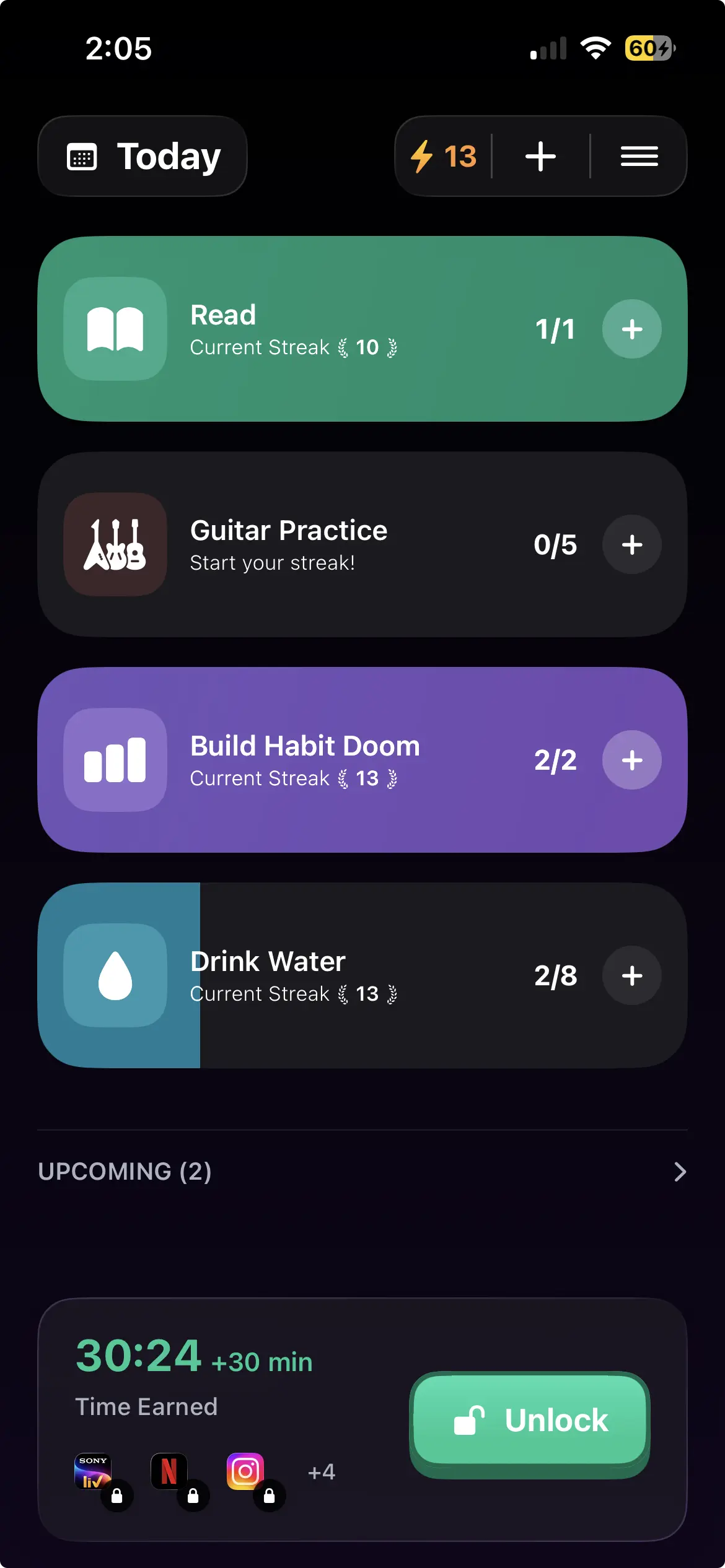
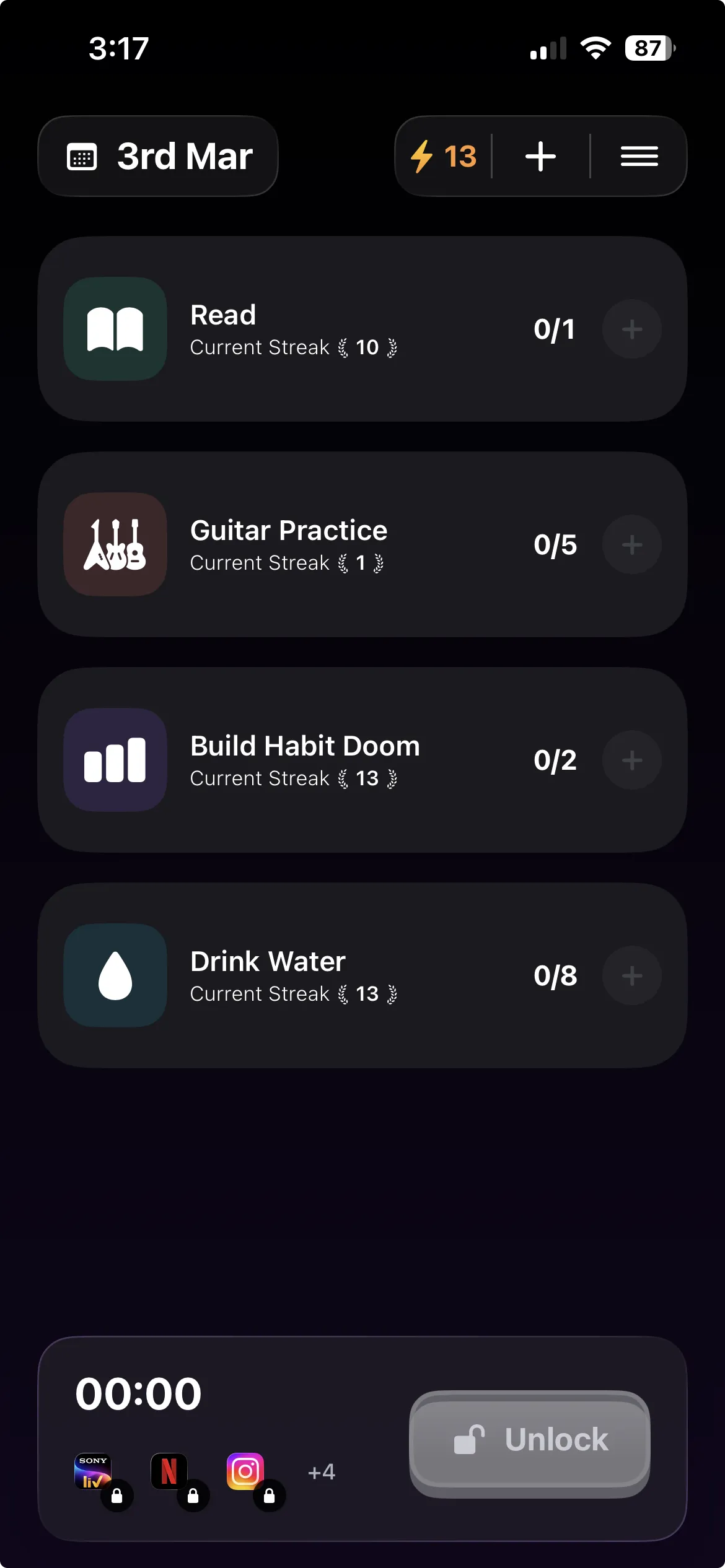
Habit Doom is built on this mechanic. You pick the apps that deliver the variable reward (TikTok, Instagram, X, Reddit, YouTube, whatever yours are) and they stay locked until you complete the daily habits you set. When the autopilot pickup happens, the lock screen appears. No feed. No dopamine. Nothing to reinforce.
This is the strongest fix because it does not require willpower at the moment of the pickup. It changes the environment so the pickup produces no reward, which is the only condition under which the brain demotes the loop.
Habit Doom uses Apple's Screen Time API with Anti-Cheat: force-quitting, uninstalling, or changing the system clock does not bypass the lock. For other apps using the same API, see our iOS Screen Time alternatives breakdown.
2. Remove the cues
Notifications are the most explicit cue, but they are not the only one. Habit loops use any cue that has been reliably paired with the reward. For phone checking, common cues include:
- The phone visible on the desk.
- Sitting down on the couch (if you have repeatedly scrolled there).
- The transition between tasks at work.
- Going to bed.
- Waking up.
You cannot eliminate all of them. You can eliminate the most automatic ones:
- All non-essential notifications off (the strongest single intervention).
- Phone face-down or in a drawer during work blocks.
- Phone in another room overnight (kills the wake-up and pre-sleep cues at once).
- Charging cable in the kitchen, not the bedroom.
3. Replace the routine with a micro-action
Habits are not eliminated in a vacuum. They are replaced. When the cue fires and the rewarding apps are locked, your brain still wants something to do.
Effective micro-replacements that take under 60 seconds:
- Open a reading app (Kindle, Pocket, Apple Books) and read one paragraph.
- Drink a glass of water.
- Do a 30-second stretch.
- Write one sentence in a journal app.
- Step outside for two minutes.
The replacement does not need to be profound. It needs to be easy enough that you will actually do it, and different enough that your brain stops pattern-matching it to the old loop. Over weeks, the new routine replaces the old one.
For more on the replacement strategy, see our guide to habits that replace doomscrolling.
4. Apply the 5-second rule before opening apps
When you do pick up the phone consciously, pause for 5 seconds before opening any social app. Ask: "What am I looking for here? Do I have a specific reason?"
If you have a real purpose (a message from a friend, an event time, a planned post), proceed. If the honest answer is "I am bored and looking for a hit," that is the cue to do something else.
This works because it inserts the prefrontal cortex into a decision the basal ganglia was about to make automatically. The brief gap between cue and routine is when the loop runs. A 5-second pause is more than enough to break it.
5. Track the number
iOS Screen Time's weekly report shows pickup count by day and by hour. Open it every Sunday for a month.
The number is the friction layer. When "Average daily pickups: 132" is in writing, the next time you reach for the phone in a meeting or during dinner, the number is in the back of your mind. Conscious awareness is exactly what an automatic loop cannot survive.
Tracking alone does not change behavior significantly. Tracking combined with the four interventions above does.
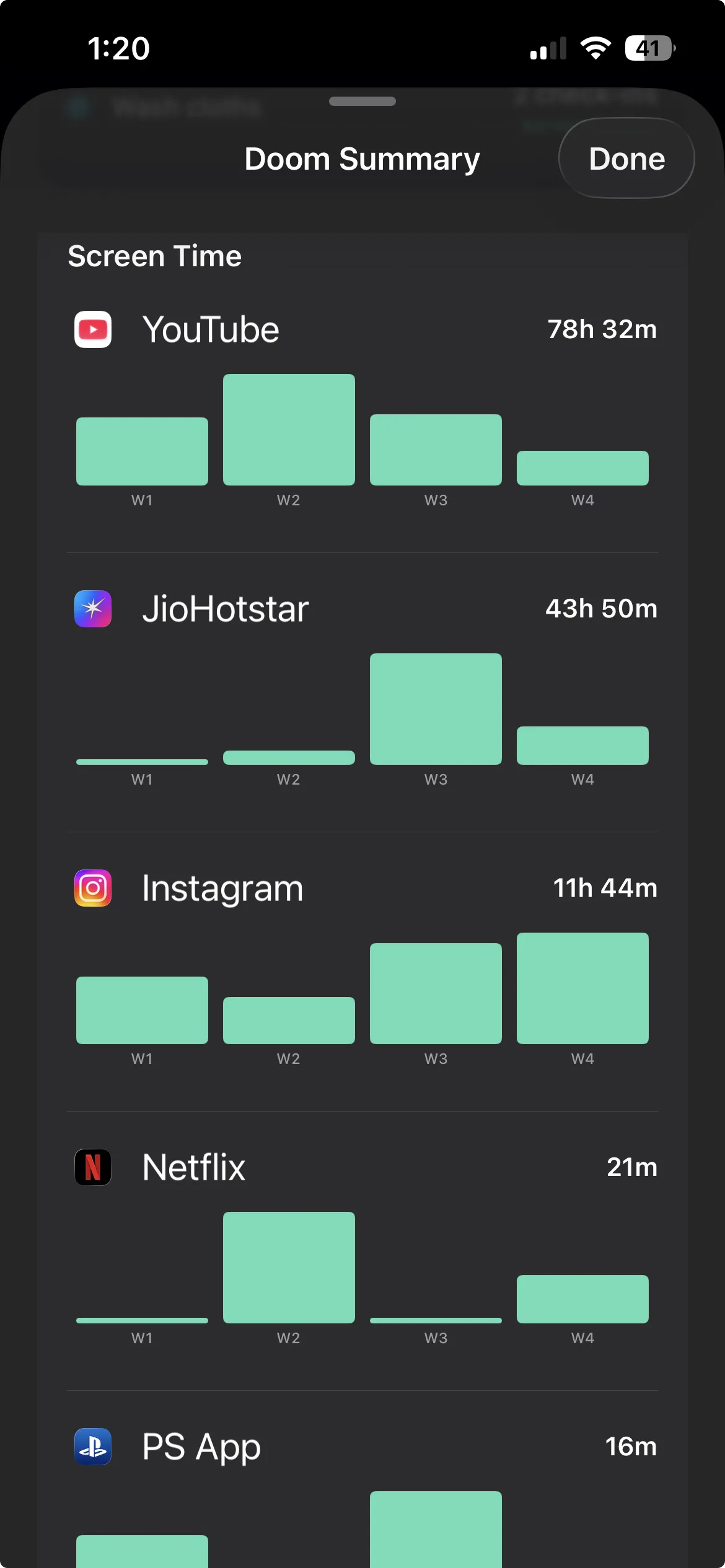
The 2-to-4-week decay curve
Here is what to expect when you combine the five fixes above.
Week 1: Phantom checking still high. The hand is still moving on autopilot. The lock screen appears more often than feels possible. This is the loop firing into emptiness for the first time.
Week 2: Phantom vibrations start to fade. You notice the urge before the pickup more often. Notification audit has already cut total pickups by 30 to 50 percent.
Week 3: The wake-up scroll is gone if the phone is out of the bedroom. Total pickups dropping noticeably. The automatic urge weakens because the loop has been producing nothing for two weeks.
Week 4: Average daily pickups typically drop from 100-150 down to 40-80 for most users. The unconscious urge has not vanished. It is much quieter. You notice it before it executes most of the time.
This is the decay curve researchers see in habit-reduction studies. It is not magic. It is the brain's own demotion of a loop that has stopped paying off.
The honest take
You keep picking up your phone because the design of the apps and the design of your brain are conspiring against you. The apps are engineered around variable rewards. Your brain is engineered to automate any loop that reliably produces dopamine. The combination is the most efficient compulsion-generation system in human history.
The fix is not to be ashamed. The fix is to stop fighting the loop with willpower and start changing the conditions under which the loop runs. Make the reward unavailable. Remove the cues. Replace the routine. Track the number. Give it 4 weeks. The brain will downgrade what stops paying off.
For the practical step-by-step on breaking the unconscious pickup, see our companion post on how to stop checking your phone unconsciously. When you are ready to make the rewarding apps unavailable, Habit Doom is free and uses Apple's Screen Time API without the Ignore Limit escape hatch.
Frequently Asked Questions
Keep Reading
Try Habit Doom
Lock your distracting apps. Complete your habits. Earn your screen time. It takes 30 seconds to set up.
Download Free