

Is ScreenZen Safe? What It Collects (2026)

 X
X LinkedIn
Is ScreenZen safe? The short answer
Yes, by the usual meaning of the word. ScreenZen is made by a real, established company. The core app needs no account, and its privacy policy says it collects no personally identifiable information, does not sell data and does not use ad networks.
The catch is smaller than most free apps have, but it exists. ScreenZen sends anonymous usage analytics to its own servers, and since September 2026 that includes a daily total of how long you spent in the apps you block.
Everything below comes from ScreenZen's own policies and its store listings, read on 10 October 2026. None of it comes from inspecting its servers or its network traffic.
Who makes ScreenZen
| Publisher | ScreenZen LLC |
| Based in | Sonoma, California (address published on Google Play) |
| On the App Store since | 16 July 2021 |
| US App Store | 4.9 stars from 51,312 ratings |
| Google Play | 4.8 stars from 33,911 reviews, 1M+ downloads |
| Terms | Governed by California law |
A free app with no ads invites the question of who is behind it. Here the answer is ordinary: a named company with a street address, five years of releases, and tens of thousands of ratings on both stores.
What ScreenZen collects
The privacy policy was last updated on 8 September 2026. In its own words:
We collect no Personally Identifiable Information using our core ScreenZen App.
It also says the settings and data for the blocking itself "are stored only on your device". So the list of apps you block and the limits you set are not uploaded.
What does leave the phone is analytics. The policy says ScreenZen "may use OpenPanel, which is an open source analytics software that we self-host", recording actions, device details and some in-app choices. Then the newer part:
we may also collect one simple daily total: the combined time spent in your blocked apps that day and how many times they were opened. We never collect per app usage or anything about apps you have not chosen to block.
Read that carefully, because it is narrower than it first sounds. It is one number a day for all your blocked apps together, not a log of which app you opened when.
Three more points from the same policy:
- No sale, no ad networks. "We do not sell your personal information, and we do not share it with third parties for their own commercial purposes. We do not use advertising or marketing networks, we do not work with data brokers."
- Research sharing. Usage analytics "may" be made available "to researchers at universities and non-commercial research institutions", after identifiers are removed.
- No deletion on request. "Our analytics are not linked to your identity, so we also cannot find your records from a request. Deleting the app stops further collection."
That last one is the honest consequence of anonymous data: they cannot delete what they cannot tie to you. The policy describes no way to switch the analytics off.
What changed in September 2026
The policy has become more detailed over the year, and the archived copies show how.
- In a copy archived on 16 January 2026, the policy said: "We do not collect, use, save, or have access to any of your personal data recorded in ScreenZen."
- A copy archived on 5 September 2026 was dated April 2026 and did not mention a daily total.
- The current policy is dated 8 September 2026, two days after version 4.0.0 of the app was released, and adds the daily total and the research clause.
None of that is alarming on its own. Apps add analytics as they grow, and ScreenZen wrote down what it added. But if you installed it a year ago because it collected nothing, the description you agreed to has changed.
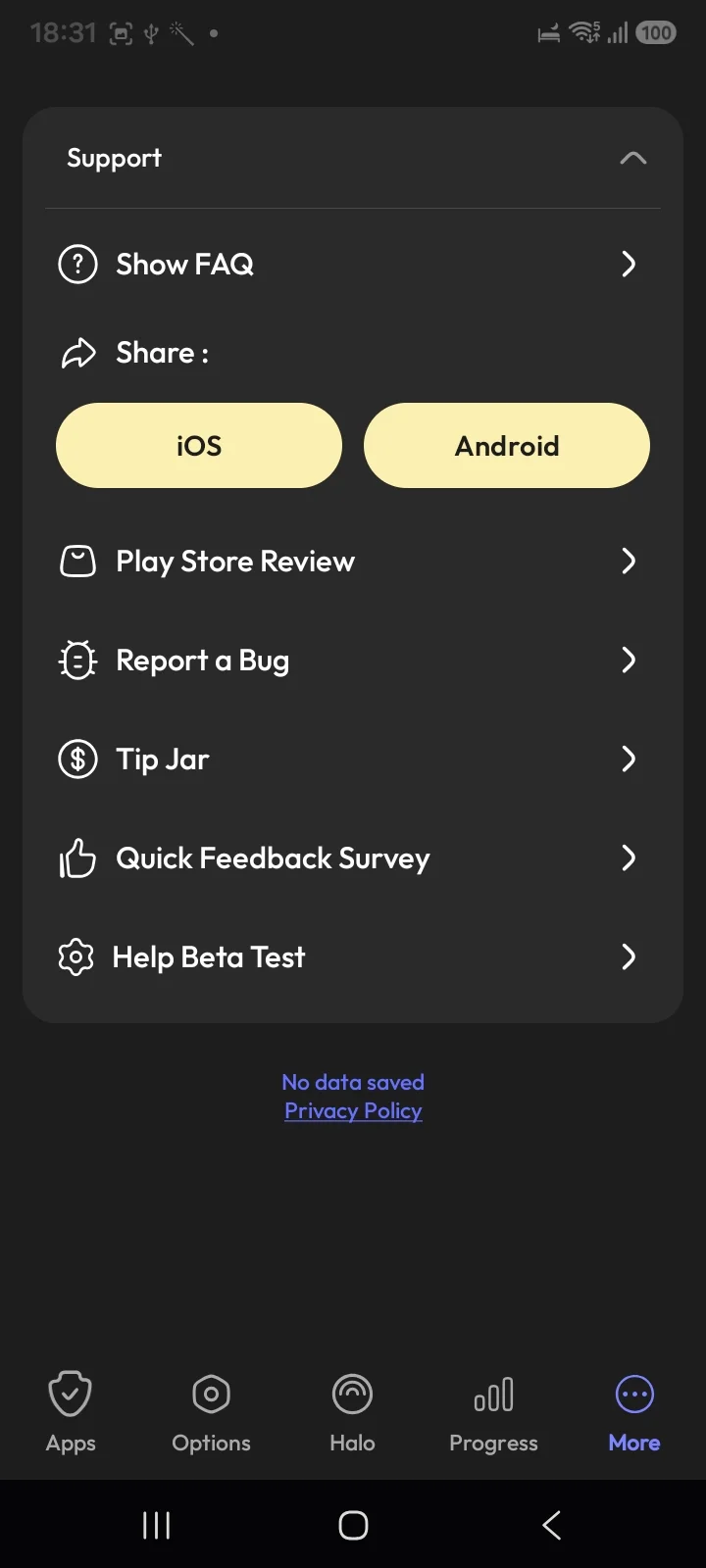
When we installed ScreenZen in August 2026, its support screen carried the line "No data saved". The September policy is the more precise statement of the two.
What the app stores say
Both stores make developers declare what they collect, and the declarations line up with the policy.
App Store. The privacy label lists one section, "Data Not Linked to You": usage data and diagnostics, used for analytics. There is no "Data Used to Track You" section and no "Data Linked to You" section. Apple notes that these labels are reported by the developer and not verified.
Google Play. The data safety section lists app interactions, device or other IDs and crash logs, collected for analytics, plus optional videos (the policy says a bug report can include a screen recording if you attach one). It states that data is encrypted in transit. It also states: "Data can't be deleted".
The permissions it asks for on Android
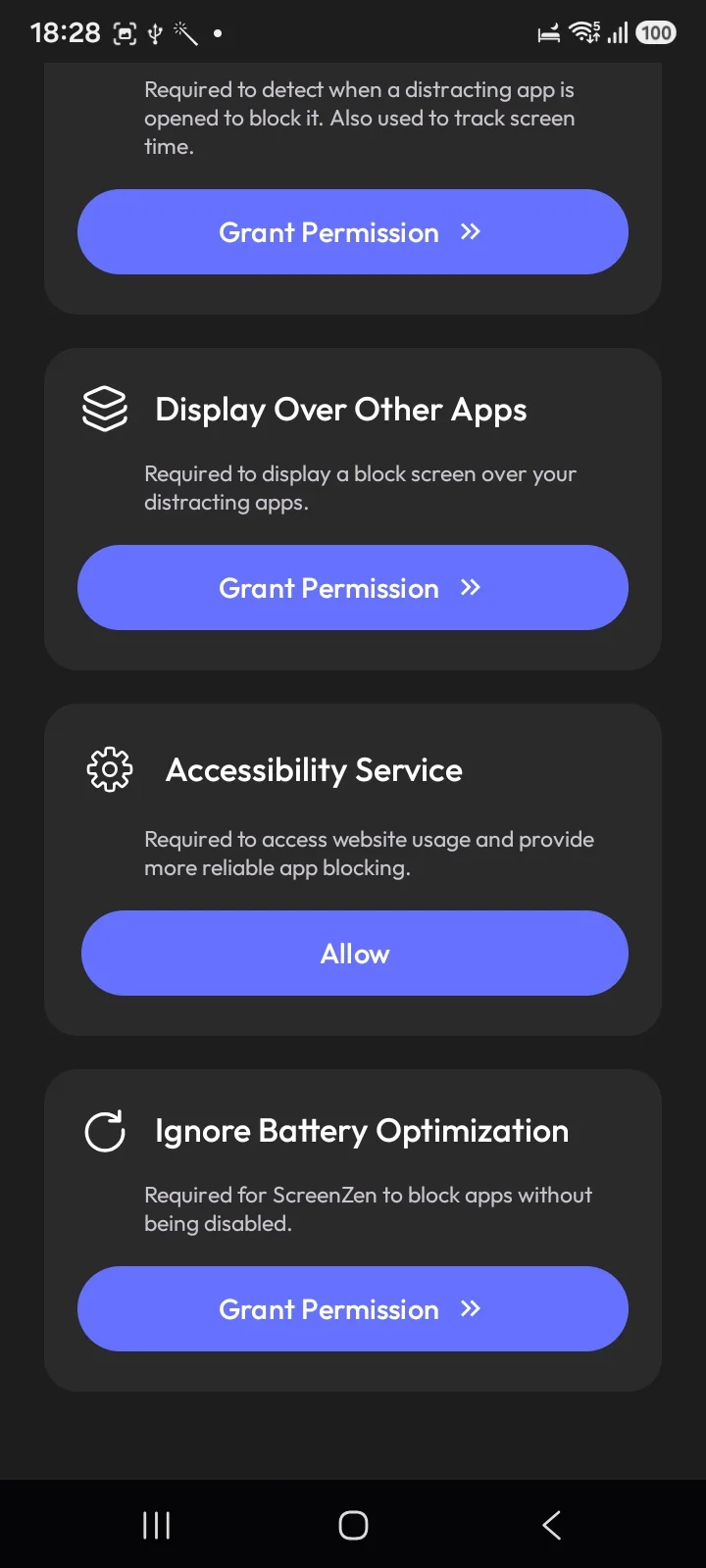
On Android, ScreenZen asked us for four permissions, including display over other apps, accessibility, and ignoring battery optimisation. Its Play description says "ScreenZen uses Accessibility permissions to block websites."
Accessibility access is powerful, and it is also how every Android app blocker works, ours included. There is no gentler permission that lets an app see which app is in front and cover it. So this is a reason to choose a blocker you trust, not a mark against ScreenZen specifically.
Is ScreenZen open source?
No. Its terms say the software is "owned by ScreenZen and our licensors", and there is no official source repository.
The confusion probably comes from the privacy policy, which describes its analytics tool as open source. That is true of the tool. It does not make the app open source, and it means nobody outside the company can check the app's code against its policy.
Is it really free, and will it stay that way?
It is free today, with no subscription and no paid tier. The developer funds it two ways: optional tips, sold as in-app purchases from $5 to $40, and a $49 hardware device called Halo.
We found no statement from ScreenZen promising that the app will stay free, and none announcing a paid plan. Its terms keep the usual right to change the service. The pricing side is covered in is ScreenZen free.
How that compares
Most apps in this category collect something, so the useful question is what and where it goes. We went through the policies of the main screen time apps in do screen time apps sell your data.
For a direct comparison with ours: Habit Doom keeps habit data on the device and uses anonymous analytics through PostHog, and there is currently no in-app analytics opt-out toggle. So on analytics the two apps are in a similar position, and neither should be described as collecting nothing.
So, should you use it?
If your worry was a scam app or an ad-funded data grab, ScreenZen is neither. It has a real company behind it and a policy that says plainly what it collects.
If your worry is any usage data leaving your phone at all, know that a daily total now does, with no switch to turn it off.
For most people that is a fair trade for a capable blocker that costs nothing. Whether the blocker itself is strong enough for you is a different question, and the comparison with Opal, Jomo and One Sec is the place to start.
Frequently Asked Questions
Keep Reading
Try Habit Doom
Lock your distracting apps. Complete your habits. Earn your screen time. It takes 30 seconds to set up.
Download Free