How to build a morning routine that actually sticks
 X
X LinkedIn
Why Morning Routines Matter More Than You Think
The first 60 to 90 minutes of your day set the cognitive and emotional tone for everything that follows. This is not motivational-poster wisdom. It is grounded in how your brain actually works during the transition from sleep to wakefulness and the neurochemical environment that exists in those early hours.
When you wake up, your body undergoes what researchers call the cortisol awakening response (CAR), a natural surge of the stress hormone cortisol that peaks roughly 30 to 45 minutes after opening your eyes. Far from being harmful, this spike is your brain's way of priming itself for alertness, focus, and disciplined action. The CAR is essentially a neurochemical head start, a window of time when your capacity for concentration and self-regulation is at its daily peak. What you do during this window disproportionately shapes the quality of your entire day.
Successful people are not morning people because of genetic luck. They are morning people because they have learned, either deliberately or through trial and error, to protect this window from chaos. They front-load their most important actions, whether that is exercise, deep work, creative output, or simply taking care of their mental health, into the hours when their brain is most capable of executing on intention rather than reacting to stimuli.
Yet the average person does something radically different. Studies consistently show that most smartphone users pick up their phone within three minutes of waking. Some estimates put it even sooner. The moment you open Instagram, TikTok, X, or your email inbox, you are handing the most neurochemically privileged hours of your day to algorithms designed to hijack your attention. You replace your own agenda with whatever the feed serves up, and the cortisol awakening response, instead of powering intentional action, gets burned on scrolling through content you never chose to consume.
A morning routine is not a rigid 5am wake-up-and-meditate prescription. It is simply a sequence of intentional actions that you complete before your day gets hijacked by external inputs. It can be 10 minutes or 90 minutes. It can include exercise or journaling or making your bed or all three. The specific activities matter less than the principle: you decide what happens in your morning before the world decides for you.
The compounding effect of this single shift is enormous. Over weeks and months, people who establish consistent morning routines report higher productivity, better emotional regulation, lower anxiety, improved physical health, and a stronger sense of personal agency. The morning routine does not just improve your morning. It restructures your relationship with your own time and attention.
The Science of Habit Formation
Understanding how habits form at a neurological level is the single most useful thing you can do before attempting to build a morning routine. Most people fail not because they lack motivation but because they do not understand the mechanics of what they are trying to build.
The Habit Loop: Cue, Routine, Reward
Charles Duhigg, in his influential book The Power of Habit, popularized the concept of the habit loop: every habit consists of three components. First, there is a cue, a trigger that tells your brain to initiate the behavior. Second, there is the routine, the behavior itself. Third, there is the reward, a positive outcome that reinforces the loop and makes your brain want to repeat it.
Morning habits have a distinct advantage over habits tied to other times of day: the cue is automatic and unavoidable. You wake up. Your alarm goes off. You get out of bed. These events happen every single day with near-perfect reliability, which means the cue side of the habit loop is already solved. You do not need to engineer a trigger or hope you remember. The morning itself is the trigger.
Why Mornings Are the Optimal Time to Build Habits
Beyond the reliable cue, mornings offer a second structural advantage: your willpower is at its highest. Research on decision fatigue, most notably the work of Roy Baumeister, demonstrates that self-control functions like a muscle that fatigues with use. Every decision you make throughout the day, from what to eat for lunch to how to respond to a difficult email, depletes your capacity for disciplined action. By evening, most people are running on fumes. Mornings, by contrast, represent a fresh reservoir of cognitive resources.
This is why people who try to exercise after work fail more often than people who exercise first thing. It is why journaling at night feels like a chore but journaling in the morning can feel natural. The same activity, performed at different times of day, meets a dramatically different level of internal resistance.
The 66-Day Reality
If you have heard that it takes 21 days to form a habit, discard that number. It comes from a misinterpretation of a 1960s observation by a plastic surgeon and has no basis in rigorous research. The most cited modern study on habit formation comes from Phillippa Lally and her colleagues at University College London, published in the European Journal of Social Psychology. Their finding: it takes an average of 66 days for a new behavior to become automatic, with a range spanning from 18 to 254 days depending on the person and the complexity of the habit.
The practical takeaway is not that you need to white-knuckle through 66 days of misery. It is that you should expect the routine to feel effortful for roughly two months before it starts to feel natural. Knowing this in advance prevents the common mistake of abandoning a routine after two weeks because "it should be a habit by now." It is not a habit yet. That is normal. Keep going.
Habit Stacking and Implementation Intentions
Two evidence-based techniques dramatically increase the odds that a new habit will stick. The first is habit stacking, a concept popularized by James Clear in Atomic Habits. The idea is simple: tie your new habit to an existing one. Instead of telling yourself "I will meditate in the morning," you say "After I brush my teeth, I will meditate for five minutes." The existing habit (brushing teeth) becomes the cue for the new habit (meditation), creating a chain of behaviors that flows naturally without requiring conscious planning each day.
The second technique is implementation intentions, which involve specifying the exact when, where, and how of a new behavior. Research by Peter Gollwitzer has shown that people who formulate their intentions in the structure "I will [behavior] at [time] in [location]" are significantly more likely to follow through than people who simply state a goal. "I will journal for five minutes at 7:15am at my kitchen table" outperforms "I want to start journaling" by a wide margin, because the specificity eliminates the need for in-the-moment decision-making.
The Role of Friction
One of the most powerful and underappreciated principles in habit science is the role of friction. Good habits are easier to maintain when the friction to perform them is low. Bad habits are easier to break when the friction to perform them is high. This is not about willpower. It is about environmental design.
If you want to work out in the morning, sleep in your workout clothes and put your shoes by the bed. If you want to journal, leave the journal open on your nightstand with a pen on top. If you want to stop doomscrolling first thing in the morning, charge your phone in another room. Every second of delay you add between yourself and a bad habit, and every second of delay you remove between yourself and a good habit, shifts the odds dramatically in your favor.
5 Steps to Build a Morning Routine That Sticks
Theory is useful, but execution is what matters. These five steps translate the science above into a practical framework you can implement starting tomorrow morning.
Step 1: Start Absurdly Small
The most common mistake people make when building a morning routine is starting too big. They read about someone's 90-minute routine involving meditation, cold plunges, journaling, exercise, and reading, then attempt to replicate it on day one. By day three, they have hit snooze through the entire routine and feel like a failure.
Start with a total routine time of five minutes. That is not a typo. Five minutes. A two-minute meditation beats a thirty-minute one you never do. Making your bed and drinking a glass of water beats a complex wellness protocol that you abandon after a week. The goal in the first two weeks is not transformation. It is consistency. You are building the neural pathway of "I wake up and I do my routine." The specific content of the routine can expand later, after the habit of having a routine is established.
Step 2: Anchor to an Existing Habit
Use habit stacking to connect your new morning actions to things you already do automatically. The chain should flow naturally: wake up, get out of bed, make bed, go to bathroom, brush teeth, drink water, meditate. Each action triggers the next. You are not creating new behaviors from scratch. You are inserting small additions between behaviors that are already wired into your morning autopilot.
Write the chain down. Put it somewhere you will see it first thing in the morning. After a few weeks, you will not need the list because the sequence will have become its own autopilot.
Step 3: Prepare the Night Before
Your morning routine actually starts the night before. Reduce morning friction to as close to zero as possible by making all decisions and preparations in advance. Set out workout clothes if you plan to exercise. Put your journal and pen on the table where you will sit. Prep your coffee maker. Charge your phone in another room so it is not the first thing you reach for.
The principle is simple: your morning self should not have to think, search for things, or make decisions. Everything should be ready to go so that the routine unfolds with minimal cognitive effort. The less thinking required, the more likely you are to follow through, especially on days when motivation is low.
Step 4: Track Completion, Not Perfection
Use a simple checklist to track whether you completed your routine each day. The format does not matter much, whether it is a physical calendar where you mark an X, a notes app, or a habit tracking app. What matters is that you can see your streak building over time.
The streak itself becomes a powerful motivator. After you have completed your morning routine for 14 consecutive days, the desire to not break the chain exerts a psychological pull that supplements your willpower. Jerry Seinfeld famously described this as his core productivity strategy: put an X on the calendar every day you write, and "don't break the chain." The visual record of consistency becomes its own reward.
Track completion, not quality. A day where you dragged yourself through a minimal version of your routine still counts. A day where you felt inspired and crushed an extended version also counts. They both get the same X. What matters is showing up.
Step 5: Protect the Routine from Your Phone
This is the step most people skip, and it is the reason most morning routines fail. You can have the perfect routine designed, the night-before preparation done, and the habit stack mapped out, but if your phone is the first thing you touch when you wake up, none of it matters. One glance at a notification leads to one quick check of your email, which leads to one scroll through your feed, and suddenly thirty minutes have vanished and your routine window is gone.
The phone is not a minor distraction. It is the single most reliable routine killer in modern life. Protecting your routine from your phone is not optional. It is structural. We will cover exactly how to do this in the sections below.
Sample Morning Routines by Goal
One of the barriers to starting a morning routine is not knowing what to include. Here are four template routines organized by primary goal. Each one has been designed to be practical, achievable, and grounded in the habit science discussed above.
For Fitness
- Wake up
- Glass of water (16 oz)
- 20-minute workout (bodyweight, run, or gym)
- Cold shower (even 30 seconds at the end of a regular shower counts)
- Healthy breakfast
- Phone
For Creativity
- Wake up
- 5-minute meditation or breathing exercise
- 30 minutes of writing, drawing, or other creative work
- Coffee or tea
- Short walk outside
- Phone
For Productivity
- Wake up
- Make bed
- Review daily goals and priorities (2 minutes)
- Deep work block (45 minutes of your most important task)
- Breakfast
- Phone
For Mental Health
- Wake up
- 10 minutes of journaling (stream of consciousness or prompted)
- 10-minute walk outside (sunlight exposure)
- Healthy breakfast
- Gratitude list (3 things)
- Phone
Notice the common thread across every single routine: the phone comes last. This is not incidental. It is the structural foundation that makes everything else possible. When your phone is the last item in the sequence, your morning belongs to you. When your phone is the first item, your morning belongs to whatever the algorithm decides to show you.
These are templates, not prescriptions. The best morning routine is one you will actually do. If a 90-minute creative practice sounds aspirational but a 10-minute walk and a glass of water sounds realistic, start with the walk and the water. You can always add complexity later. You cannot add it if you have already abandoned the routine.
Your Phone Is the #1 Morning Routine Killer
Research from Deloitte and other firms studying smartphone behavior consistently finds that approximately 80 percent of smartphone users check their phone within 15 minutes of waking, with a large subset checking within the first minute. For many people, the phone is literally the first object they interact with each day, before they have spoken to another person, before they have had a glass of water, before they have even fully opened their eyes.
This matters because of what happens neurologically when you open a social media app or infinite-scroll feed first thing in the morning. Your brain, fresh from sleep and riding the cortisol awakening response, encounters a firehose of novel, emotionally charged, algorithmically optimized content. The dopamine system activates. The reward circuits light up. And critically, your brain establishes a stimulation baseline for the day, a threshold of how much stimulation it expects from moment to moment.
When that baseline is set by TikTok, Instagram, or X, everything else in your day feels comparatively boring. Exercise feels tedious. Journaling feels pointless. Meditation feels impossible. Your brain has been calibrated to expect the rapid-fire novelty of an algorithmic feed, and the slow, deliberate activities that actually improve your life cannot compete. This is not a willpower failure. It is a neurochemical consequence of how you started your day.
Research published in the Journal of Behavioral Addictions has found that morning phone use is associated with increased anxiety in the afternoon and reduced productivity throughout the day. The mechanism is straightforward: starting your day in reactive mode, responding to other people's content, notifications, and demands, trains your brain to stay in reactive mode. You spend the rest of the day responding to inputs rather than generating outputs. The morning routine, which requires proactive, self-directed behavior, becomes nearly impossible to sustain.
The deeper problem is that simply deciding not to check your phone does not work for most people. The phone is right there on your nightstand. The habit of reaching for it is one you have reinforced thousands of times, possibly tens of thousands. You are not fighting a conscious decision. You are fighting an automated behavior loop with years of reinforcement behind it. Telling yourself "I just won't look at it" is like telling yourself "I just won't eat the cake" when the cake is sitting on your pillow. The friction is too low and the pull is too strong.
This is why the most effective strategies for protecting your morning routine involve removing the choice entirely, either by physically separating yourself from the phone or by using technology to make the distracting apps inaccessible until your routine is complete.

 Download
How to Lock Your Phone Until Your Routine Is Done
If your phone is the number one thing killing your morning routine, the logical solution is to make the phone a non-factor until your routine is complete. That is exactly what Habit Doom does, and it solves the problem at a structural level rather than relying on your willpower to resist the pull of your apps each morning.
How It Works
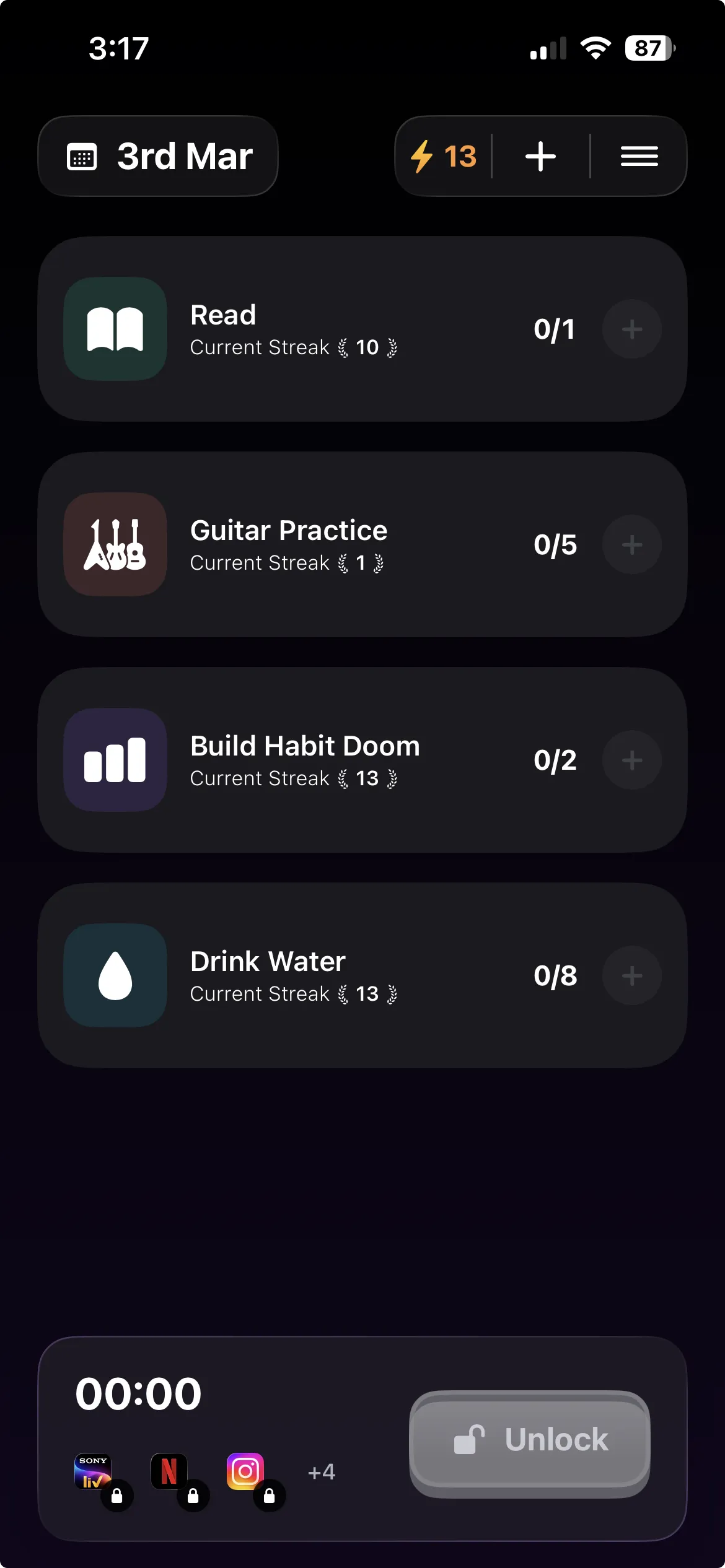
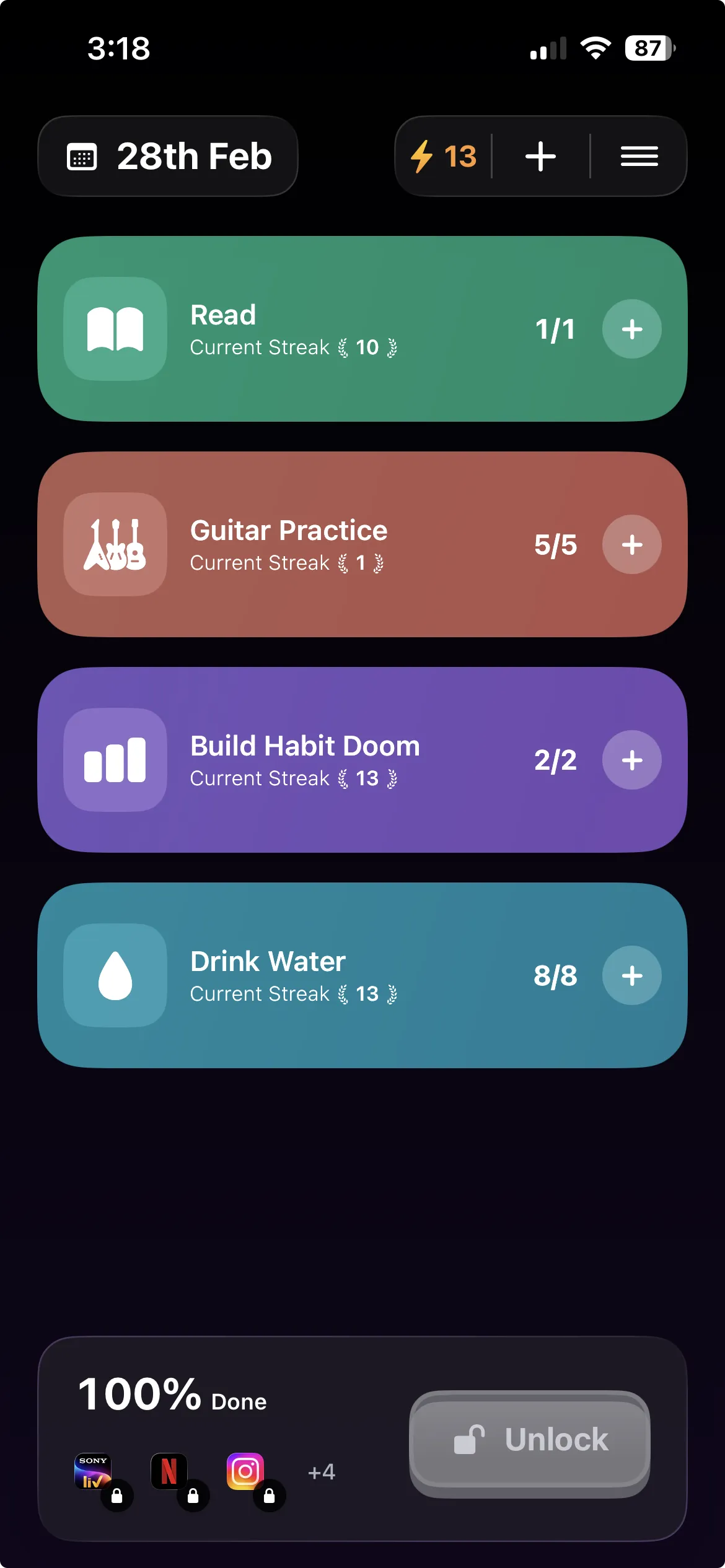
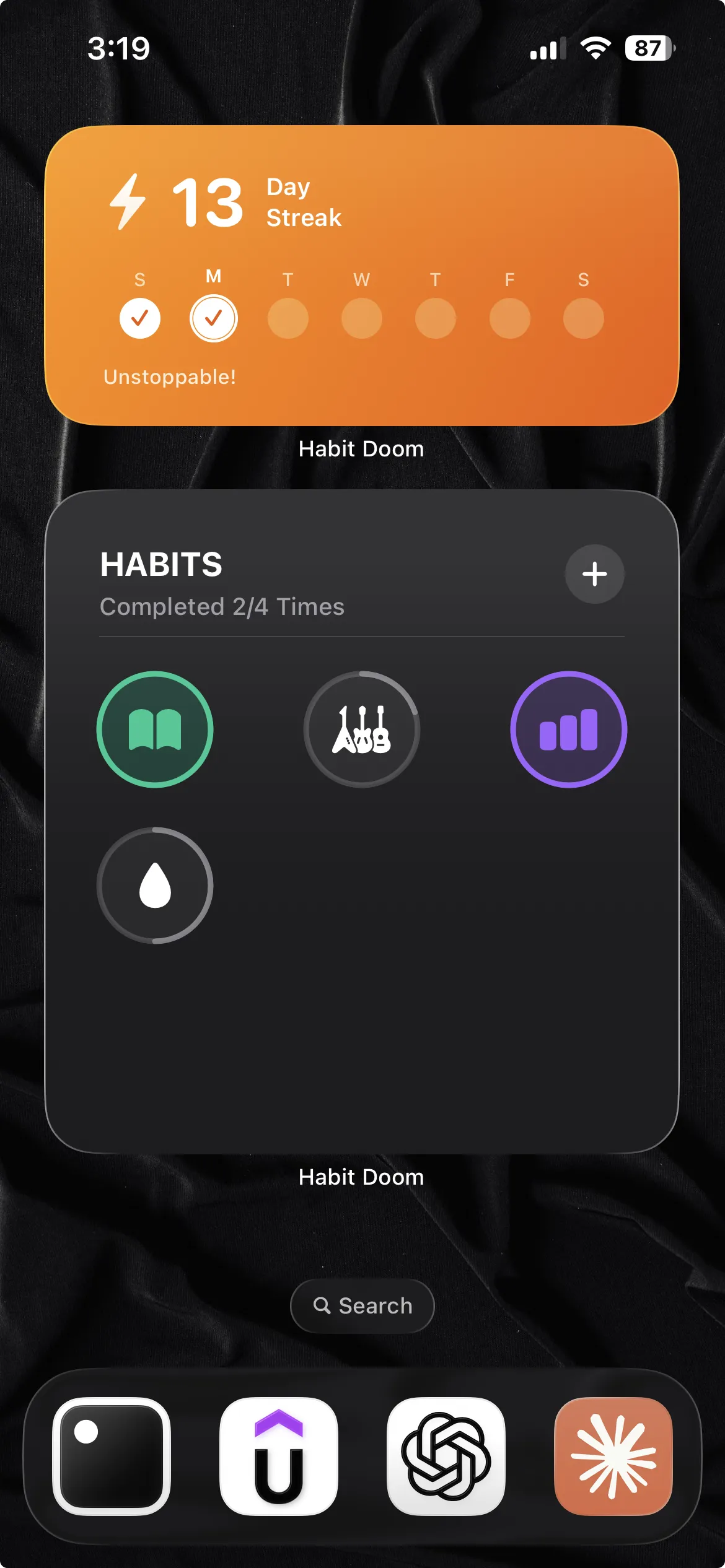
The setup takes about two minutes. You add the morning habits you want to complete each day, things like "meditate 5 minutes," "drink water," "exercise," "journal," or whatever your routine includes. Then you select the apps you want blocked until those habits are done. Instagram, TikTok, X, Reddit, YouTube, any app that tends to hijack your mornings goes on the block list.
When you wake up the next morning, those apps are locked. They stay locked until you check off every habit on your list. There is no "snooze" button. There is no "just five more minutes" bypass. You complete your habits, your apps unlock, and you go about your day. If you skip your habits, the apps stay locked. The system is simple, and that simplicity is what makes it effective. For a detailed walkthrough of every feature, read our full guide on how Habit Doom works.
Why This Solves the Morning Routine Problem
The psychological shift that Habit Doom creates is fundamental. Without it, your internal dialogue each morning is a negotiation: "Should I check my phone or do my routine? I'll just look for one second. Okay, maybe five minutes. Alright, I'll do my routine after this video." That negotiation is exhausting, and the phone wins more often than not because it offers an immediate dopamine reward while the routine offers a delayed one.
With Habit Doom, the negotiation disappears entirely. Your phone is locked. The distracting apps are not available. The only question left is what to do with your time, and the answer is already waiting for you: your habit list. The internal dialogue shifts from "Should I resist my phone?" to "Let me knock out my habits so I can unlock everything." It is the difference between deprivation and earning.
This approach aligns perfectly with the friction principle from habit science. Habit Doom adds massive friction to the bad habit (morning phone scrolling) while the good habits (your routine) remain friction-free. Your brain, which always seeks the path of least resistance, naturally gravitates toward completing the routine because that is now the easiest path to what it wants.
What It Costs
Habit Doom is free to download and use, with an optional $2.99/month subscription for all features. There are no ads, no data collection, and all data is stored on your device. There is no sign-in required and no social features harvesting your information. It is a tool, not a platform. You can see how it compares to alternatives like Opal and One Sec in our detailed comparison, or browse our roundup of the best app blockers for iPhone in 2026.
The Bigger Picture
Building a morning routine is ultimately about reclaiming ownership of your attention. Every morning that you complete your routine before touching your phone is a morning where you chose your priorities over an algorithm's priorities. Over weeks and months, that daily choice compounds into something much larger: a fundamentally different relationship with your time, your habits, and your sense of agency.
You are not restricting yourself. You are earning your screen time by investing in yourself first. The phone is not going anywhere. It will be there waiting for you after your meditation, after your workout, after your journaling, after your walk. The difference is that by the time you pick it up, you have already won the morning. And mornings that start with wins tend to produce days that end with them too.
The best morning routine is the one you actually do. Start small, protect it from your phone, and let consistency do the rest.
If you are ready to build a morning routine that survives contact with your smartphone, download Habit Doom from the App Store and set it up tonight. Tomorrow morning, your distracting apps will be locked and your habit list will be waiting. For more strategies on breaking free from phone habits, explore our guide on how to stop doomscrolling or browse the full Habit Doom blog.
Frequently Asked Questions
Keep Reading
Start Tomorrow Morning Right
Habit Doom locks your distracting apps until you complete your morning habits. Free on iOS, $2.99/mo for all features.
Download