


What Is a Dopamine Loop?

 X
X LinkedIn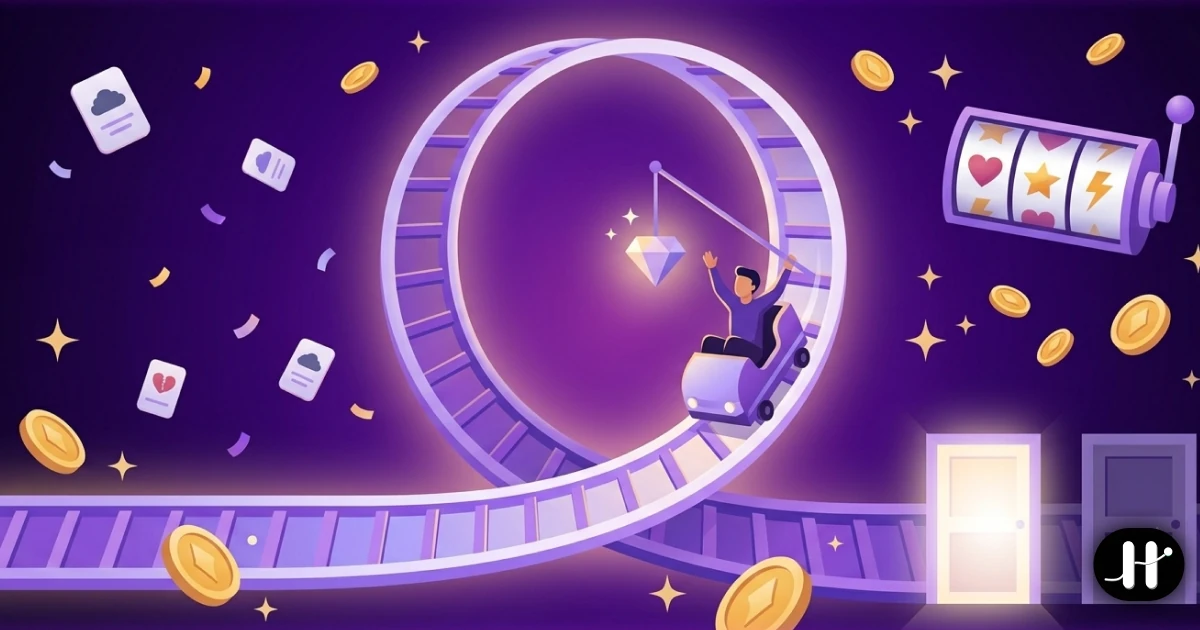
You have probably heard phone addiction explained like this: it is dopamine, your brain's feel-good chemical, and apps are built to trigger it.
That explanation is everywhere. It is also not quite right, and the accurate version is both more interesting and more useful if you are trying to change the pattern.
The definition
A dopamine loop is a repeating cycle where an action, like checking an app, leads to an uncertain reward, like a notification or an interesting post, which trains your brain to repeat the action even when the reward is small or inconsistent.
Loop is the load-bearing word. It is not one hit of pleasure and done. It is anticipation building before you check, a small payoff or nothing when you do, and then anticipation building again almost immediately. That cycle is what apps are built around.
Dopamine is not the "feel-good chemical"
This is the part nearly every article gets slightly wrong.
Neuroscientists Kent Berridge and Terry Robinson spent decades on this question. Their foundational review, What is the role of dopamine in reward: hedonic impact, reward learning, or incentive salience? (Brain Research Reviews, 1998), draws a sharp line between two things the brain does separately: wanting and liking.
Liking is the actual pleasure of a reward: the taste of good food, the warmth of a hug. Wanting is the pull toward pursuing it, the anticipation before you get it. Their conclusion was that dopamine tracks wanting far more closely than liking. Animals whose dopamine systems were chemically depleted stopped pursuing rewards almost entirely, yet still showed normal pleasure reactions when a reward was placed directly in front of them.
Dopamine is not what makes the reward feel good. It is what makes you want it again.
That distinction explains something "feel-good chemical" never could: why you keep opening an app that stopped being enjoyable some time ago. At that point you are not chasing pleasure. You are chasing the itch, not the scratch.
The slot machine your phone is running
The mechanism is older than the internet by decades.
B.F. Skinner's research on reinforcement schedules, set out with Charles Ferster in Schedules of Reinforcement (1957), found that unpredictable rewards produce far more persistent, repetitive behaviour than predictable ones. Skinner called it a variable-ratio schedule, and it is the reason slot machines work.
Your feed runs the same logic. You never know whether the next scroll brings something great, something upsetting, or nothing. The uncertainty is the engine.
Reward learning on these platforms has been measured directly. Lindström and colleagues, in Nature Communications (2021), analysed over a million posts from more than 4,000 users and found behaviour conforming closely to reward-learning principles: people post more when likes come in and less when they stop. One precision note, since this study gets stretched a lot: it modelled posting behaviour, not scrolling. It is solid evidence that these platforms run on reward-learning dynamics. The specific claim that each individual scroll is a bet rests on Skinner, not on this paper.
Why the distinction actually matters
Knowing the mechanism changes which fix makes sense.
If dopamine were about feeling good, the fix might be finding something that feels better. But because the loop runs on wanting rather than liking, the effective move is interrupting the cycle: removing the ability to act on the urge in the moment, rather than trying to out-willpower a craving that was never really about pleasure.
That is the entire logic behind friction-based tools. They do not try to make you want your phone less. They make the automatic loop harder to complete without a deliberate decision in the middle. It is also why habit-based approaches outlast pure willpower, a pattern covered in Why Most Habit Trackers Stop Working After Week 3 and in Marshmallow Test: Why You Can't Put Your Phone Down, which deals with the closely related question of delayed gratification.
The loop beyond phones
Phones are the most concentrated version most people meet daily, but the same loop drives plenty else: checking email compulsively, refreshing a delivery tracker, looking at a bank balance again. Recognising the pattern in your phone use makes it easier to spot elsewhere.
It also runs in the useful direction. The same reward-learning system can be pointed at something you actually want to build, which is the subject of Deliberate Practice: 10 Min/Day to Real Skill. And if you want the practical version of resetting your baseline, Dopamine Detox Apps: What Actually Works covers what holds up and what does not.
Frequently Asked Questions
Keep Reading
Try Habit Doom
Lock your distracting apps. Complete your habits. Earn your screen time. It takes 30 seconds to set up.
Download Free