


Why Deleting Apps Never Works

 X
X LinkedIn
You know the cycle. Sunday night, fed up, you delete Instagram. The home screen looks cleaner. The first three days feel genuinely good, lighter, like you got something back. Then something happens, a slow afternoon, a notification from a friend, a moment of boredom in a checkout line, and the app is back. You tell yourself this time you'll just use it less. You don't. Two weeks later you delete it again.
Deleting the app feels like the obvious move. It almost never works. Not because you lack discipline, but because deletion targets the wrong thing. It removes the app. It does nothing to the habit that wanted the app. Here is the mechanism, and what actually works instead.
A habit is a loop, and deletion only cuts one part
The cleanest way to understand a phone habit is the model popularized in Charles Duhigg's The Power of Habit: every habit runs as a loop of cue, routine, and reward. A cue triggers the behavior, the routine is the behavior itself, and the reward is what makes your brain file the loop away as worth repeating. Run that loop enough times in the same context and the brain stops deliberating. It just executes.
For an Instagram habit, the loop looks like this. The cue is an emotional or situational trigger: boredom, a transition between tasks, a flash of social anxiety, an idle minute. The routine is opening the app and scrolling. The reward is the small, unpredictable hit of novelty and connection that scrolling delivers. Decades of habit research, notably Wendy Wood and colleagues' work summarized in Habits in Everyday Life, show that once this kind of loop is established, it fires automatically off its context cues rather than off conscious choice.
Now look at what deleting the app does. It removes the routine, the middle link, and only temporarily. The cue is untouched: boredom and idle minutes and social anxiety all still happen. The craving the cue produces is untouched: your brain still expects the reward it learned to expect. So when the cue fires, you get the full pull toward the app with no app to open. That tension does not dissolve. It builds. And the fastest way to resolve it is the App Store. This is why most deletions reverse within days. You did not weaken the loop. You just removed its target and left everything that aims at the target fully loaded.
If you want the deeper version of why these urges feel involuntary, why you can't stop scrolling and why you keep picking up your phone both go into the neuroscience.
The app is gone but the web is not
Even if your willpower held against the loop, deletion has a plain technical hole. The app is not the only door.
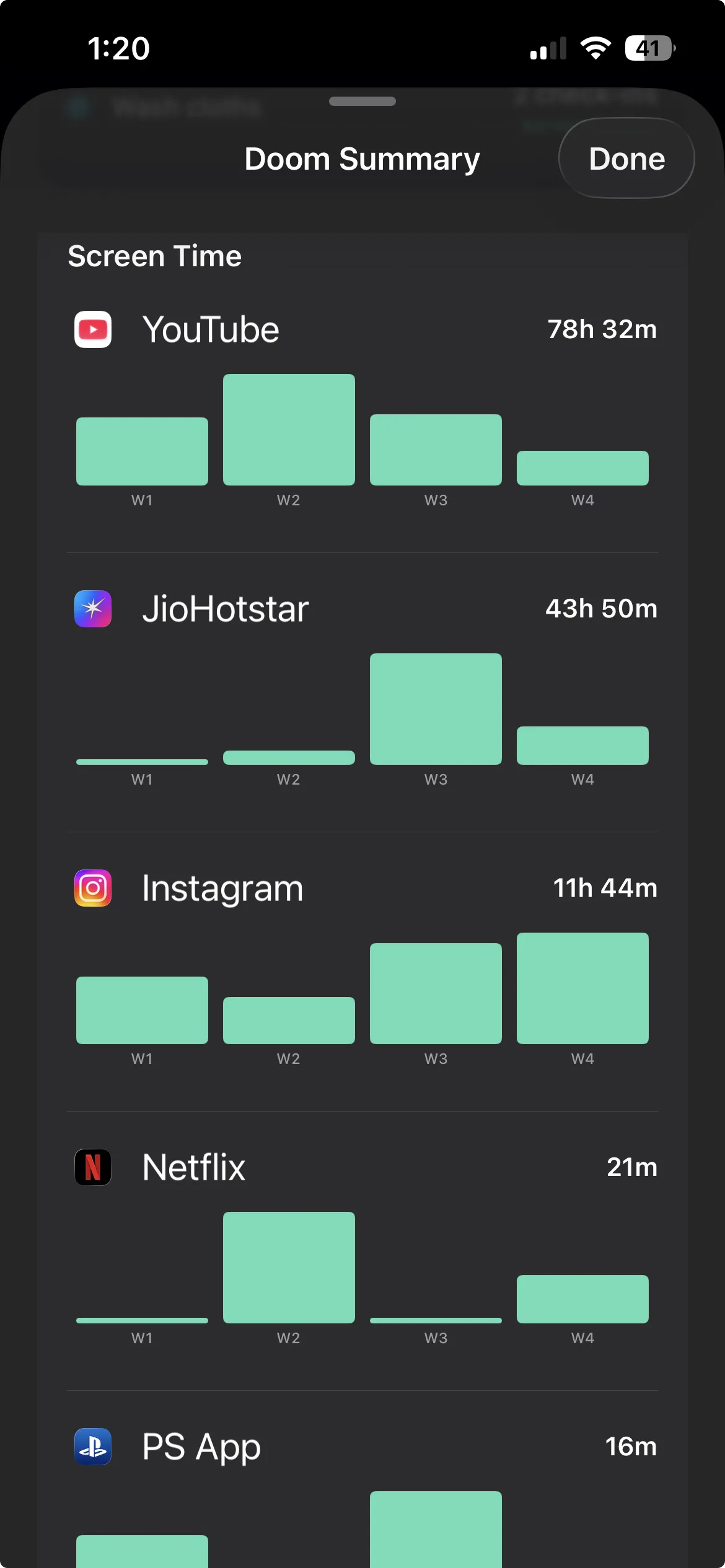
Delete Instagram and instagram.com is still right there in Safari. Delete the TikTok app and the mobile site loads fine. Delete X and the browser version works almost identically. The feed you were trying to escape is one tab away, and the habit loop is perfectly happy to use the browser as a substitute routine. Many people discover this within hours of deleting, and the browser version is often worse, because it has none of the (admittedly weak) usage nudges the native app might show.
This is the core weakness of deletion as a strategy. It attacks one specific instance of availability, the icon on your home screen, while leaving every other path to the same content wide open. Removing one door from a building with ten doors does not keep anyone out. It just makes them walk a little further.
Stories, group chats, and streaks pull you back
The hardest pull is not the algorithm. It is other people.
When you delete a social app, you do not just lose a time-sink. You lose a communication channel that other people are still using to reach you. The group chat lives in there. Your friends post stories you are now invisible to. Someone tags you and you never see it. On Snapchat, a streak you have kept for hundreds of days quietly dies. These are not cravings you can simply white-knuckle through, because they represent genuine social cost. The fear of missing out is doing real work here, and it is pointing at something real.
So deletion forces a brutal trade: either accept being cut off from people you care about, or reinstall. Most people, correctly, value the relationships more than the cleanse. They reinstall, fully intending to "just check the group chat," and the loop reactivates the moment the app is back. The social obligation is the wedge. The habit walks in right behind it.
One reinstall feels like total failure
There is a final reason the delete-reinstall cycle is so demoralizing, and it is psychological, not technical.
When you commit to "I am never using this app again," you have set an all-or-nothing rule. Addiction researchers have a name for what happens when an all-or-nothing rule gets broken: the abstinence-violation effect, described in Marlatt and Gordon's relapse-prevention model. The idea is that there is a meaningful difference between a single slip, called a lapse, and a full return to the old pattern, called a relapse, and that what turns one into the other is not the slip itself but how you interpret it.
Under a strict abstinence rule, reinstalling once gets read as proof: "I knew I couldn't do this, I have no willpower." That interpretation produces shame, and shame produces the thought that you have already failed, so you may as well scroll for an hour. The single reinstall, which is objectively minor, gets experienced as total collapse. The all-or-nothing framing manufactures the relapse. You did not have to fall off a cliff. The rule built the cliff and then pushed you off it.
This is the quiet tragedy of deletion as a tactic. It maximizes the abstinence-violation effect by design, because deletion is inherently binary. The app is either gone or it is back. There is no middle state, no graceful partial success, nothing between "perfect" and "failed."
Friction beats absence
Step back and the pattern across all four failure modes is the same. Deletion attacks availability. It does nothing to the habit.
The cue still fires. The craving still builds. The browser still works. The group chat still pulls. The all-or-nothing rule still primes you to treat any slip as a catastrophe. Deletion is a big dramatic gesture that changes the surface and leaves the machinery running.
What actually moves the needle is not absence, it is friction, and friction applied at the right moment. The research is consistent that the most reliable way to change a behavior is to change the environment around the cue rather than to fight the craving head-on with willpower. Make the routine slightly harder to execute, add a small barrier at the exact moment the loop tries to fire, and the loop weakens. You are not removing the app. You are inserting a beat of friction between the cue and the reward, which is the one place intervention actually lands.
And crucially, friction is not binary. It scales. It can let a genuine social obligation through while still stopping the mindless 11pm scroll. That single property fixes the abstinence-violation problem on its own, because there is no perfect-or-failed line to cross. There is just a barrier that is sometimes up.
Make access conditional, not impossible
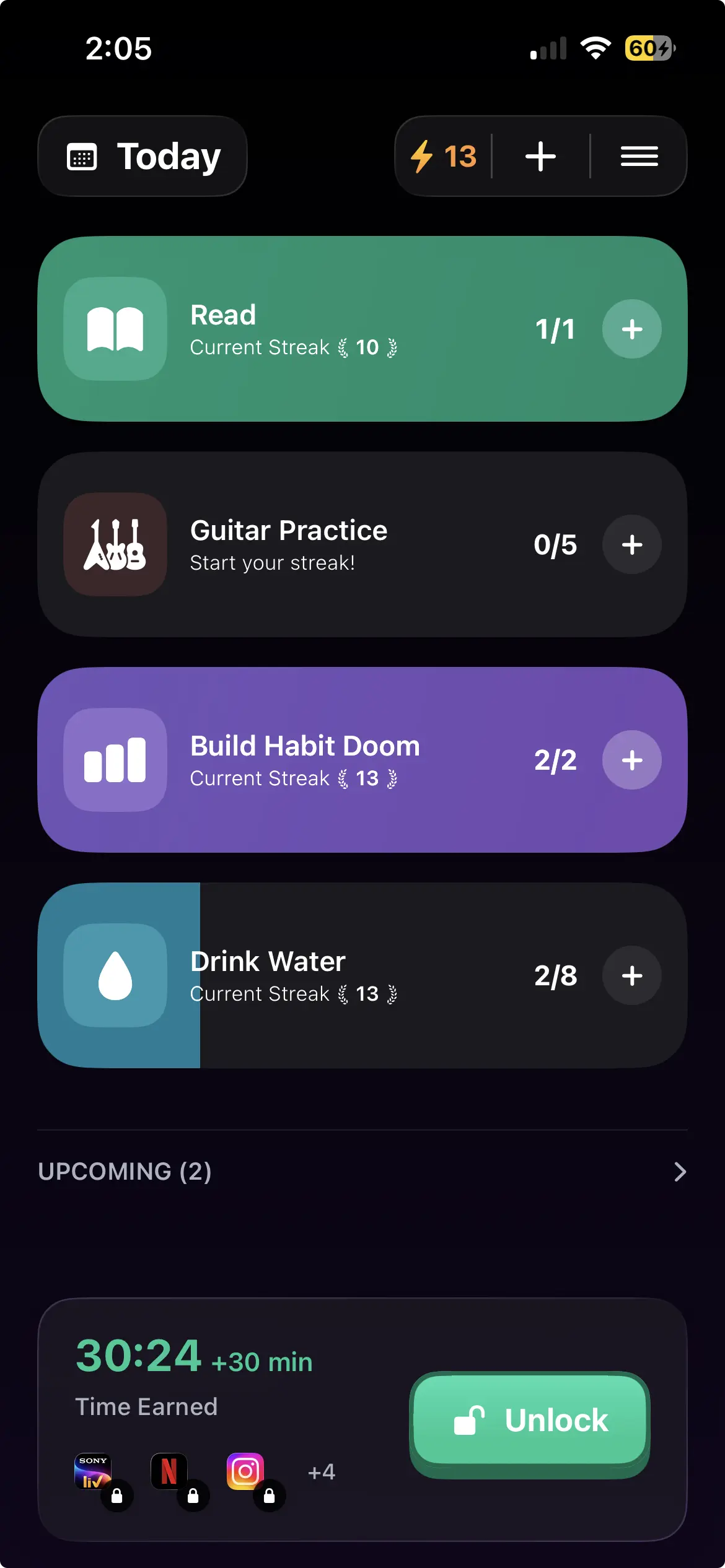
The strongest version of friction is conditional access: the app is available, but only after you do something first. You earn it.
This flips the entire frame. Instead of "this app is forbidden," it becomes "this app unlocks when my real priorities are handled." There is no abstinence rule to violate, so the relapse cliff disappears. The app is still installed, so the social cost of being cut off disappears too. The group chat is still reachable, just not at 7am before you have done anything. And because access is gated on completing something, the gate itself becomes the friction that interrupts the loop at the cue. This is the model behind the earn-your-screen-time approach, and it is structurally different from both deletion and from a dumb timer you can dismiss.
How Habit Doom does it
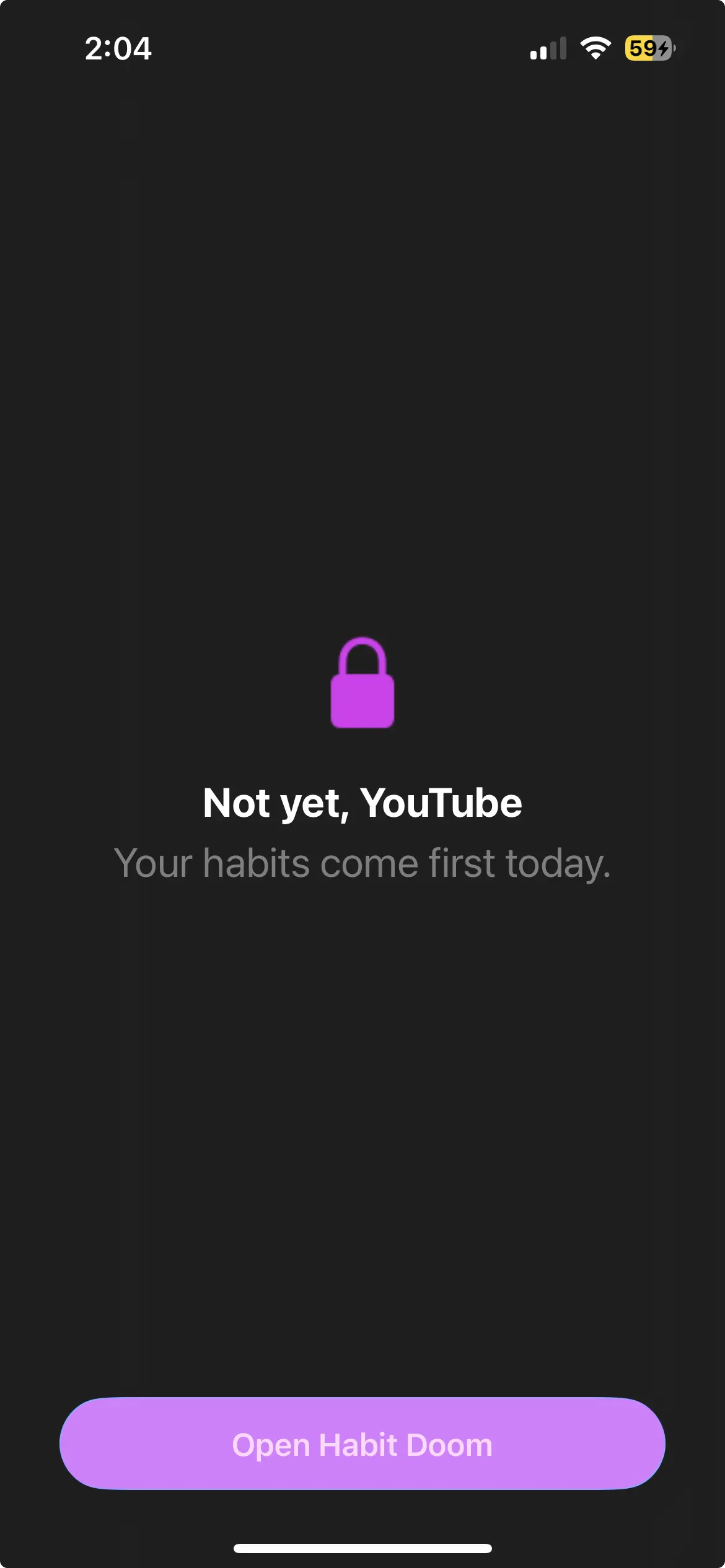
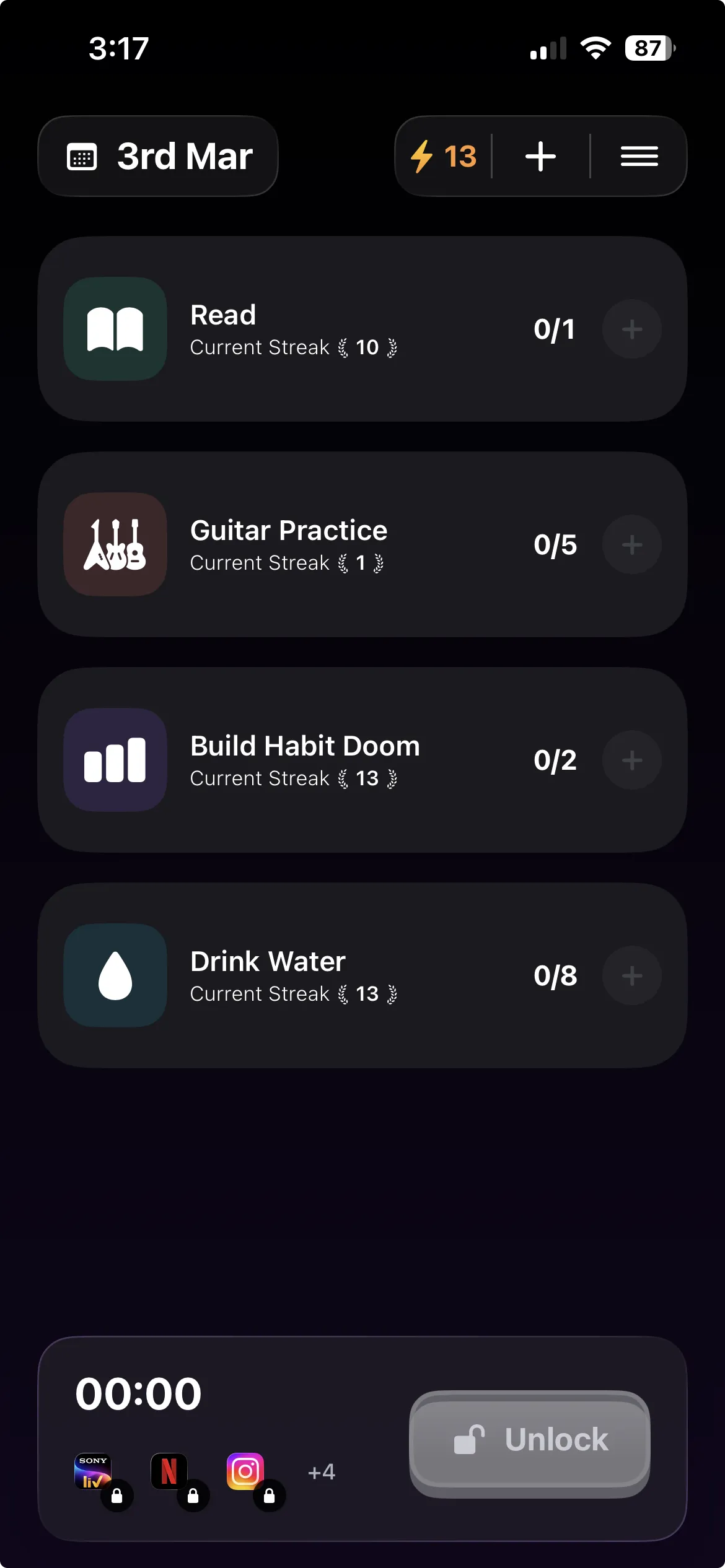
Habit Doom is built on conditional access. You do not delete anything. Your distraction apps, Instagram, TikTok, YouTube, X, whatever pulls you, stay installed but locked at the iOS system level until your daily habits are checked off.
Here is what that does to the loop. The cue still fires. You still reach for the phone out of boredom or habit. But the app the loop was reaching for is locked, so the automatic routine hits a wall and resolves into nothing instead of forty minutes of scrolling. The reward never arrives, the loop gets no reinforcement, and over time it fires less. You are interrupting the habit at the exact pressure point that deletion completely misses.
Because nothing is deleted, there is no abstinence rule and no relapse cliff. A locked screen is not a failure, it is just a locked screen, and it unlocks the moment your habits are done. The lock is also tamper-resistant: force-quitting the app does not release it, and neither does deleting Habit Doom itself, so you cannot loophole your way back the way you reinstall a deleted app. For users who want to be sure a habit was genuinely completed, on-device Anti-Cheat photo verification is free for everyone, where checking off a habit asks for a quick photo that an AI model confirms entirely on the phone.
The free tier covers three habits, app blocking, custom alarms, streaks, and Anti-Cheat, no payment needed. Pro lifts the habit cap at $4.99/month, $19.99/year (with a 7-day free trial), or $29.99 lifetime. It is on iPhone and Android. If you want the full picture of how habit tracking and app blocking combine, habit tracker with app blocking covers the category.
The takeaway
Deleting an app feels decisive, which is exactly why it keeps failing. It is a loud move against the symptom while the disease keeps running. The cue still fires, the browser still works, the group chat still pulls, and the all-or-nothing rule guarantees that the inevitable reinstall feels like total collapse.
The fix is not a bigger act of willpower or a more dramatic deletion. It is friction in the right place: making the app conditional instead of forbidden, so the loop gets interrupted at the cue and a slip never becomes a cliff. Stop trying to make the app impossible to reach. Make it something you unlock once your day is handled.
Frequently Asked Questions
Keep Reading
Try Habit Doom
Lock your distracting apps. Complete your habits. Earn your screen time. It takes 30 seconds to set up.
Download Free