


341 Downloads. $59 Revenue. 90 Days In.

 X
X LinkedIn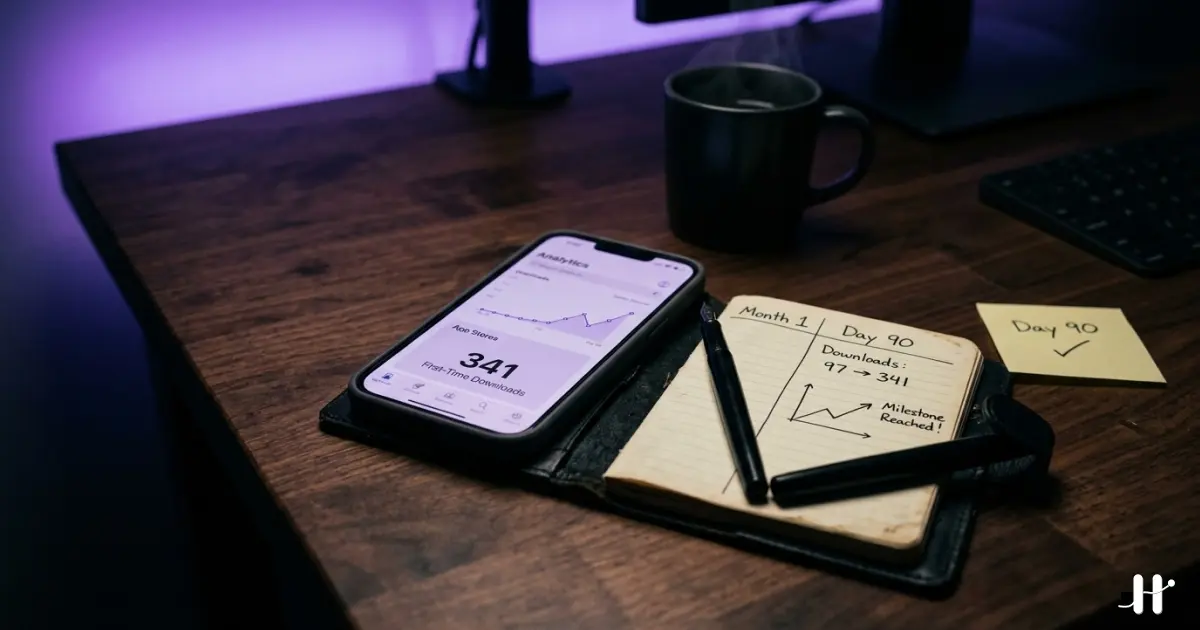
Two months ago, every number from Habit Doom's first month on the App Store landed in a blog post. 97 downloads. $0 revenue. 90% onboarding completion. A retention problem.
This is the follow-up. Same rules: every number, no spin, none of the "we are seeing great traction" corporate speak. The headline App Store metrics (downloads, conversion rate, revenue, ratings) come from App Store Connect, which is the source of truth. The engagement data comes from PostHog and is windowed to the last 60 days (March 11 to May 11), because earlier weeks were polluted by my own test devices during launch. Any figures that would have been inflated by that early noise have been excluded.
Habit Doom is the same iOS app it was at month one. It locks distracting apps (Instagram, TikTok, YouTube) until you complete your daily habits. No timer-only nudge. No gentle reminder. A real lock at the operating system level, gated by real habit completion.
Here is what 90 days look like.
The Top-Line Numbers
| Metric | Month 1 (Mar 19) | Day 90 (May 10) | Change |
|---|---|---|---|
| First-time downloads | 97 | 341 | 3.5x |
| Redownloads | n/a | 77 | new |
| Conversion rate | 7.94% | 9.84% | +1.9pp |
| Impressions | 1,910 | 6,450 | 3.4x |
| Product page views | 319 | 1,160 | 3.6x |
| App Store rating | 0 ratings | 5★ (17 ratings) | new |
| Proceeds (after Apple cut) | $0 | $59 | new |
| In-app purchases | 0 | 14 | new |
| Active subscription plans | 0 | 7 | new |
| Paid plans | 0 | 4 | new |
| Monthly recurring revenue | $0 | $4 | new |
Where Downloads Came From
The App Store funnel for the first 90 days, straight from Apple:
Three things stand out from this funnel:
- Impressions tripled (1,910 → 6,450). The blog footprint and AI-citation work are visibly broadening top-of-funnel reach.
- Conversion rate climbed nearly 2 percentage points (7.94% → 9.84%). The App Store listing iterations (subtitle, screenshots, copy passes) are paying off. Apple's category benchmark for productivity apps sits around 4-6%, so we are now solidly above that.
- The IAP step is the smallest cliff. 4.1% of downloads become a paying purchase, which roughly matches indie productivity app benchmarks. The bigger blocker is feeding more humans into the top of the funnel, not converting the ones who arrive.
The Revenue Reality Check
At month one, the answer to "how much revenue?" was zero. Three months in, the honest answer is small but real.
The breakdown according to App Store Connect:
- $59 in proceeds to date. This is after Apple's 30% cut, after refunds, after trial-period mechanics. The number that actually hits the bank.
- 14 in-app purchases processed across all tiers.
- 7 active subscription plans as of May 10.
- 4 paid plans (the rest are inside the 3-day free trial window).
- $4 monthly recurring revenue. Small enough to round to zero in a spreadsheet, large enough to confirm the payments rail works end-to-end.
- Day 1 / Day 7 / Day 35 download-to-paid rates: 1.21% / 1.33% / 1.14%. Users who pay tend to pay early. Conversion does not meaningfully climb between day 7 and day 35.
The honest read: payment infrastructure works, the price ladder makes sense, but there is not enough top-of-funnel volume yet for revenue numbers to be impressive. $59 in three months is not a business. It is a signal that the rails are clean and ready to scale.
What the Engagement Data Says (Last 60 Days)
Headline metrics come from Apple, but the in-app behavioral signal lives in PostHog. The window below is March 11 to May 11, after the early test-device noise was excluded.
A few signals from the last 60 days worth highlighting:
- Weekly active users grew from 38 to a peak of 103. A 2.7x climb in 9 weeks, entirely organic, no paid acquisition. The dip in mid-April reflects a small dip in app launches that recovered the week after.
- 17.4 sessions per active user. People who use the app open it about 17 times across a single use period. The app is not a "download and forget" experience for retained users.
- 9,368 in-app actions tracked. 8,669 app unlock events, plus 3,901 manual app locks (users choosing to lock distractions early) and 1,684 timer-expired locks (apps locking automatically when earned time ran out).
- Manual lock ratio: 69.8%. That is the most behaviorally interesting number on this page. Users are voluntarily locking their distracting apps before their earned screen time runs out, more than two out of every three lock events. At month one this ratio was 55%. The behavior change strengthened over time rather than fading.
- Onboarding completion: 80.7% (368 of 456 unique users who started the flow finished it). Well above the 60-70% benchmark for habit and productivity apps.
- Screen Time permission grant rate: 76.9%. A better permission-UX prompt (5-second demo of locking before the system popup fires) materially improved this from the month-one rate of roughly 67%.
- 739 habits created by 314 unique users in the window. Most popular habits: Read, Workout, Drink Water, Meditate, Go on a Walk. The same list as month one, in roughly the same order.
ChatGPT has started calling Habit Doom's mechanic "behaviorally sound" when asked about the category. Perplexity calls it "operant conditioning meets reward substitution." The 69.8% voluntary-lock ratio is the data point that supports both framings.
The 1.2 Percent Question
The Day-1 download-to-paid rate of 1.21% is the number that decides whether paid acquisition makes financial sense. The math:
- If Apple Search Ads averages $3-5 cost per install in the US, and 1.21% of installs become paying users, the cost per paying user is $250-414.
- If those paying users tilt toward Lifetime ($29.99) or Yearly ($19.99), the immediate payback is negative.
- If they tilt toward Lifetime and stick around 24+ months, the unit economics tighten.
This is the central tension paid acquisition was meant to resolve. Update: Apple Search Ads ran from May 12 to May 31 at roughly $20-35/day, then I stopped it. The CPA landed near $8.85 per install against a lifetime value well under $1 per install at current monetization, so the math never came close to working. The hypothesis being tested was that paid acquisition reaches people who would never search "habit tracker" or "app blocker" on their own, but who self-select once they see the mechanic. What the cohort data showed: ASA installers retained at roughly 21% D7 versus about 32% for organic. Real users, but markedly less sticky, and far too expensive. It was buying ranking and learning data, not revenue. So I cut it.
What Changed Since Month 1
A non-exhaustive list of things that happened between March 19 and May 11:
- All three IAPs are live and working. Monthly ($4.99/mo), Yearly ($19.99/yr with 7-day trial), and Lifetime ($29.99). The two-week App Store Connect bug saga is documented here.
- 5-star App Store rating across 17 ratings, up from 0 reviews at month one.
- 41 blog posts published, each engineered for a specific AI search surface (ChatGPT, Perplexity, Google AI Overview, Gemini).
- Doomscroll Calculator shipped at habitdoom.com/doomscroll-calculator. A free interactive tool that translates daily screen time into 60 concrete lost activities (50 marathons unrun, 800 books unread, 12 novels unwritten), each cited to primary sources. Product Hunt #12 placement on May 4.
- First press placement attempts. Editorial pitches sent to The Sweet Setup, Lifehacker, ADDitude, MacStories, 9to5Mac, Six Colors.
- AI citations growing. Bing AI Performance dashboard shows citation rate up 5-8x from late-March baseline. ChatGPT and Perplexity both started flagging Habit Doom's "earn screen time through habits" mechanic as behaviorally distinct from incumbent app blockers.
- Anti-cheat mode shipped, preventing the usual workarounds (deleting and reinstalling, settings hacks, restore-from-backup tricks).
- Conversion rate improved 1.9 percentage points (7.94% to 9.84%), purely from App Store listing iterations.
What's Next
Update on what actually happened. This section was written looking forward. Here is the honest after-the-fact version.
- Apple Search Ads ran, then stopped. It launched May 12 across four campaigns at roughly $20/day and ran through May 31. CPA came in around $8.85 per install against sub-$1 LTV, so I shut it off. An expensive lesson, but a clean one: paid search does not pay for itself at this monetization level.
- Higgsfield, ElevenLabs, and DaVinci Resolve for the UGC and ad-creative pipeline are still on the list, not yet stood up.
- Meta Ads are still ahead, not yet live.
What did land was a quietly excellent organic month. May 2026 set all-time highs: D7 retention reached 26.5% and the app logged 10,762 check-ins for the month, the strongest engagement on record.
The strategic pivot is still the direction: performance marketing as the primary acquisition lever, once the unit economics support it. ASA showed they do not yet. Reddit organic is paused after a platform-filter event in early May. Blog and AI-citation work continues passively in the background. The first 90 days established the rails: a working product, a verified payment flow, a 5-star rating, and a conversion rate above category benchmark. The next 90 days will measure whether $20-50/day in paid spend can break through the organic ceiling.
The Honest Version
341 first-time downloads in 90 days is still small. 14 in-app purchases is still small. And $59 in proceeds is, let's be honest, tiny.
But the trajectory is real, and so are the structural improvements underneath it:
- From 97 to 341 first-time downloads is 3.5x. Driven almost entirely by organic search and listing strength, not marketing spend.
- Conversion rate improved from 7.94% to 9.84%. This is the highest-leverage internal metric on the page. Each percentage point compounds as impressions grow.
- 5 stars across 17 ratings. Small sample, but the trajectory is up rather than down.
- The payment flow works. $4 MRR is symbolic, not material, but it confirms the entire monetization rail is sound and ready to scale.
What did not change is also the point. The App Store rating, the conversion rate, the structural shape of the funnel all say the same thing. The product works. The mechanic works. The bottleneck is not the loop. It is the size of the funnel feeding into the loop.
Performance marketing is the test of whether paid acquisition can reach more of the right people without dropping the quality signals that make those people stay. The first run at that test, a three-week Apple Search Ads burst in late May, came back with a clear answer: not at this CPA, not yet. So the funnel-size problem is still open, and organic is still doing the heavy lifting.
Next milestone update in another 90 days. Numbers will be higher, or this post will explain exactly why they are not.
Habit Doom is free on the App Store. If you read this far, you might as well be download number 342.
Frequently Asked Questions
Keep Reading
Try Habit Doom
Lock your distracting apps. Complete your habits. Earn your screen time. It takes 30 seconds to set up.
Download Free