


The First Social Media Addiction Verdict, Explained

 X
X LinkedIn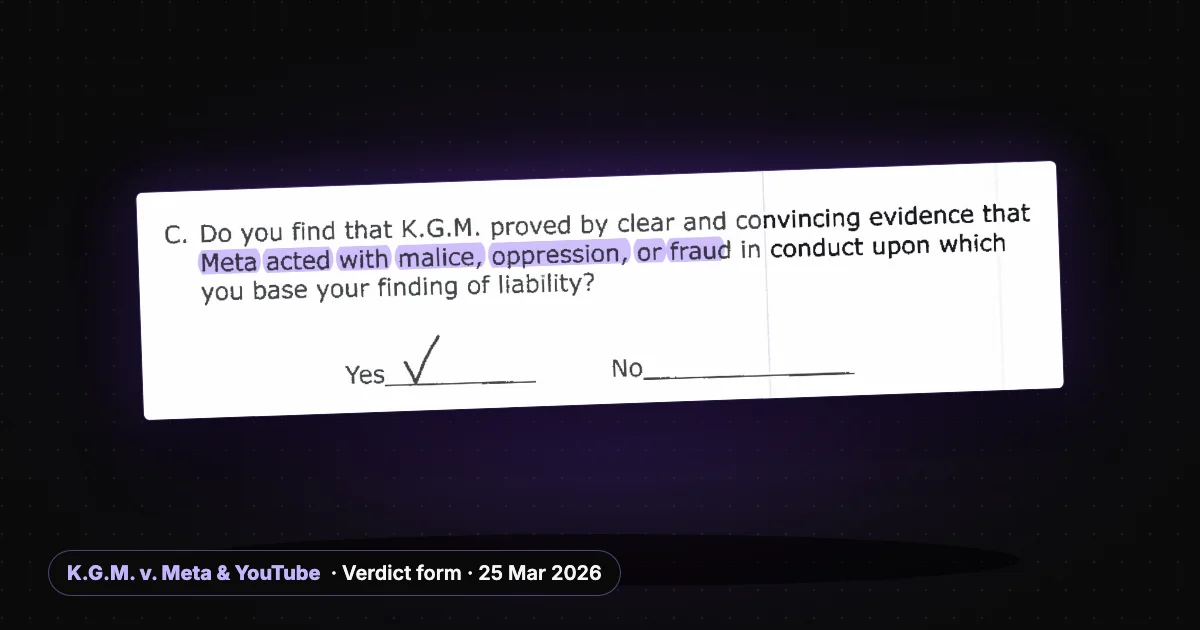
The short answer
On 25 March 2026, a jury in Los Angeles Superior Court found Meta negligent in the design or operation of Instagram, and YouTube negligent in the design or operation of YouTube. It found both failed to warn, awarded $3 million in compensatory damages, and found both acted with "malice, oppression, or fraud."
It is widely described as the first jury verdict in a social media addiction case. The case, K.G.M. v. Meta Platforms and YouTube, was tried within JCCP 5255, California's coordinated proceeding for these suits, before Judge Carolyn Kuhl. It runs in parallel with the federal case, MDL 3047.
What the verdict forms say
There are three two-page verdict forms, and they are short enough to summarise in full.
| Question | Meta (Instagram) | YouTube |
|---|---|---|
| Negligent in the design or operation of the app? | Yes | Yes |
| Failure to warn? | Yes | Yes |
| Acted with malice, oppression or fraud? | Yes | Yes |
| Share of $3,000,000 compensatory damages | 70% | 30% |
What the forms do not say
A lot of coverage summarised the verdict as "infinite scroll and autoplay found addictive". The forms never mention infinite scroll or autoplay, and never use the phrase "designed to be addictive." They ask general questions about negligent design, warnings and conduct.
The feature-level language comes from the plaintiff's side. Written testimony from the plaintiff's counsel to the US Senate Judiciary Committee on 13 May 2026 described the case in those terms, including "infinite scroll: removing natural stopping points", and quoted trial exhibits such as a 2012 YouTube email, "not viewership, it's viewer addiction." That is counsel's account of the evidence, not the jury's wording.
The parts to treat carefully
- Punitive damages. Press reports put them at $3 million ($2.1 million Meta, $0.9 million YouTube), for $6 million in total: $4.2 million from Meta and $1.8 million from YouTube. The punitive-phase form was not publicly located, so treat those as reported figures.
- An appeal has been reported. Say "a jury found", not "the courts have ruled".
- The plaintiff. The court identifies her by initials. She is a young woman who described mental health harms beginning in childhood. This guide sticks to the design question the jury answered.
Why it matters
Before this, the evidence about social media design came mostly from complaints and unsealed filings, which are one side's argument. A verdict is different: twelve people heard both sides and answered Yes. Combined with New Mexico's trial win in August 2026 (New Mexico v. Meta), 2026 is the year these claims moved from allegation to finding.
The full sequence of cases is in the social media lawsuits timeline.
Frequently Asked Questions
Keep Reading
Try Habit Doom
Lock your distracting apps. Complete your habits. Earn your screen time. It takes 30 seconds to set up.
Download Free