


Social Media Lawsuits: The Complete Timeline

 X
X LinkedIn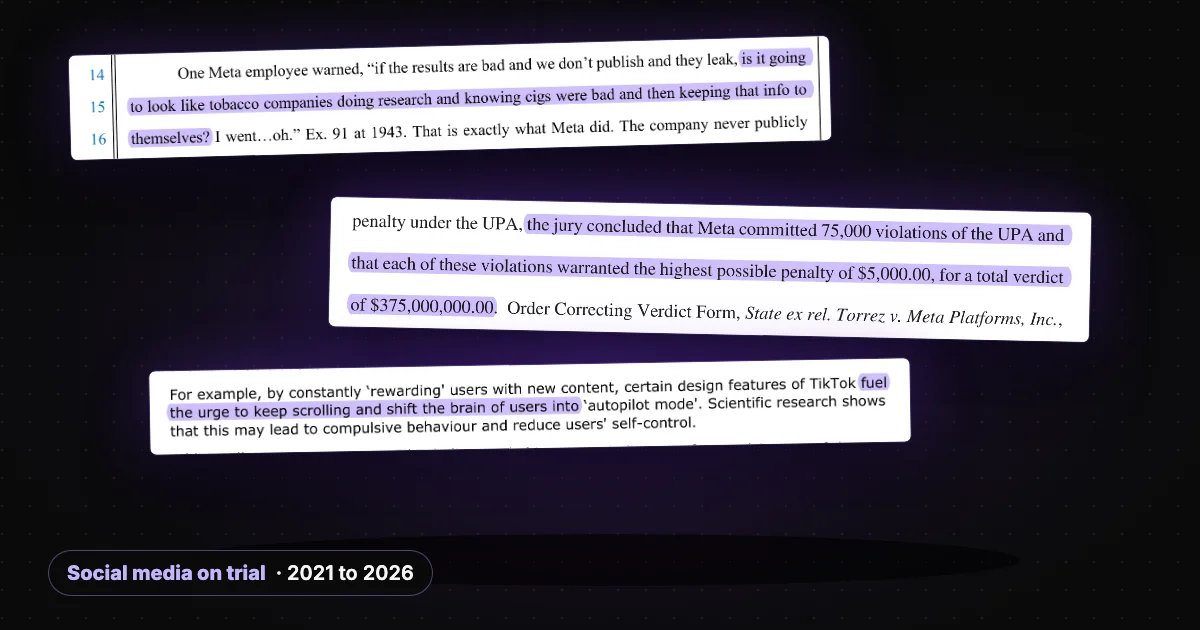
How to read this timeline
Five years ago, the case against social media design rested on leaked documents. Today it rests on jury verdicts, a court judgment, regulator findings and a settlement worth up to $17.1 billion. This page follows that shift in order, with an official source for every entry.
Each entry carries a label, because the labels matter:
- Lawsuit and Court filing: one side's allegations. Strong documents, but not findings.
- Verdict and Judgment: what a jury or judge actually found. The strongest evidence there is.
- Settlement: an agreement. Settlements here state they are not an admission of wrongdoing.
- Regulator finding, Law, Fine, Hearing and Report: what governments did and said.
Use the buttons to show only US or international entries. The newest entries are at the bottom.
- 2021
The Facebook Files: Instagram and teen girls
The Wall Street Journal publishes Meta's internal research on Instagram and teenage girls as part of its Facebook Files series, later entered into the congressional record.
Frances Haugen testifies to the Senate
The former Facebook product manager behind the leaked documents testifies to a Senate Commerce subcommittee in 'Protecting Kids Online: Testimony from a Facebook Whistleblower'.
- 2022
Federal addiction cases consolidated as MDL 3047
The Judicial Panel on Multidistrict Litigation centralises the social media adolescent addiction cases against Meta, TikTok, Snap and YouTube in the Northern District of California before Judge Yvonne Gonzalez Rogers.
- 2023
Seattle Public Schools sues the platforms
The first school district to sue alleges the operators of TikTok, Instagram, Facebook, Snapchat and YouTube created a youth mental health crisis that schools are paying for, a public nuisance theory hundreds of districts later adopted.
US Surgeon General's advisory
The Surgeon General issues an advisory on social media and youth mental health, warning there is not enough evidence to say social media is sufficiently safe for children and adolescents. New Mexico's court later adopted its findings into the record.
Ireland fines TikTok €345 million
Ireland's Data Protection Commission fines TikTok €345 million under the GDPR over how it processed children's data in 2020, including public-by-default settings for child accounts.
42 attorneys general sue Meta
33 attorneys general file a joint federal complaint in California alleging Meta designed Instagram and Facebook features to keep young users hooked while misleading the public; others file in their own courts, 42 in all.
UK Online Safety Act becomes law
The Online Safety Act receives Royal Assent, giving Ofcom powers to require platforms to protect children from harmful content.
Less-redacted Meta complaint made public
A less-redacted version of the states' complaint reveals internal Meta material, including Project Daisy: hiding Like counts reduced negative social comparison, and Meta estimated the cost at about 1% of ad revenue.
New Mexico sues Meta
New Mexico's attorney general files suit in state court, focused on child sexual exploitation on Meta's platforms and seeking abatement of a public nuisance.
- 2024
Tech CEOs before the Senate Judiciary Committee
The CEOs of Meta, TikTok, Snap, X and Discord testify at 'Big Tech and the Online Child Sexual Exploitation Crisis'.
EU opens proceedings against TikTok
The European Commission opens formal Digital Services Act proceedings against TikTok covering minors' protection, addictive design and the 'rabbit hole' effect, among other issues.
Italy fines TikTok €10 million
Italy's competition authority fines three TikTok companies €10 million for an unfair commercial practice, citing the 'French scar' challenge and how TikTok's recommendations spread harmful content.
EU opens proceedings against Meta
The Commission opens Digital Services Act proceedings into Facebook and Instagram over behavioural addiction in children, 'rabbit hole' effects and age assurance.
FTC: 'A Look Behind the Screens'
An FTC staff report on nine social media and video streaming companies finds vast data collection, engagement-optimised design and weak protections for teens.
14 attorneys general sue TikTok
Thirteen states and DC sue TikTok, each in its own court. Kentucky's complaint was redacted badly: three days later Kentucky Public Radio revealed the hidden internal documents, including that habit formation took 260 videos.
Australia passes an under-16 social media law
Parliament passes the Online Safety Amendment (Social Media Minimum Age) Act, requiring platforms to take reasonable steps to stop under-16s having accounts. Royal Assent follows on 10 December 2024.
- 2025
FTC orders seven companies to explain AI companion chatbots
The FTC issues 6(b) orders to Alphabet, Character Technologies, Instagram, Meta, OpenAI, Snap and xAI on how their chatbots affect children and how they monetise engagement.
Project Mercury and the unsealed internal documents
School districts' 235-page brief in MDL 3047 quotes internal documents from all four companies, including Meta's halted Project Mercury deactivation study and a YouTube deck aiming for an app that is 'Addictive'.
Australia's minimum age of 16 takes effect
Age-restricted social media platforms must now take reasonable steps to prevent Australians under 16 from having accounts.
- 2026
EU: TikTok's addictive design breaches the DSA
The Commission preliminarily finds infinite scroll, autoplay, push notifications and TikTok's recommender shift users into 'autopilot mode', and says TikTok needs to change the basic design of its service.
New Mexico jury: 75,000 violations, $375 million
After a seven-week trial, a Santa Fe jury finds Meta violated New Mexico's Unfair Practices Act 75,000 times and assigns the $5,000 maximum to every violation.
First social media addiction jury verdict
In K.G.M. v. Meta and YouTube, a Los Angeles jury finds both negligent in the design of Instagram and YouTube, finds malice, oppression or fraud, and awards $3 million in compensatory damages, split 70/30.
EU: Instagram and Facebook's addictive design breaches the DSA
The Commission preliminarily finds Meta's time-management tools, including teen defaults, are easily dismissed, and says autoplay and infinite scroll should be off by default.
New Mexico judgment: $567 million fund and teen limits
The judge finds Meta created a public nuisance, orders a $567 million abatement fund, and for under-18s in New Mexico orders quiet hours for notifications, hidden likes and a 90-hour monthly cap. No changes to the algorithm.
Meta settles with 51 states and territories
A consent judgment sets teen defaults (a 12am to 6am lockout, a 2-hour daily cap, no like counts) and payments the attorneys general put at up to $17.1 billion. Meta admits no wrongdoing.
What the pattern shows
Three things stand out once the cases are in one place.
The evidence moved from allegation to finding. Until 2025, almost everything was a complaint or a leak. In 2026, a Los Angeles jury, a New Mexico jury and judge, and the European Commission each reached their own conclusions, independently and on different legal grounds.
The remedies keep converging. New Mexico's judge and Meta's settlement with the states, three weeks apart, both landed on hidden like counts and quiet notification hours for teens. The European Commission asked for screen time breaks and for infinite scroll and autoplay to be off by default.
The core features are still standing. New Mexico's court agreed that autoplay, infinite scroll, like counts and algorithmic recommendations combine to drive problematic use, and still declined to order them changed, citing the First Amendment, Section 230 and the absence of Meta's competitors from the case. Meta's strictest settlement limits only switch on if Snap, TikTok and YouTube adopt the same rules. Europe, where neither of those constraints applies, is the first to go after the features directly.
About this page
We update this timeline as cases move. Dates are when a document was filed or a decision was announced. Where a case has several stages, each gets its own entry.
Frequently Asked Questions
Keep Reading
Try Habit Doom
Lock your distracting apps. Complete your habits. Earn your screen time. It takes 30 seconds to set up.
Download Free