


Meta's Settlement With the States: What Changes for Teens

 X
X LinkedIn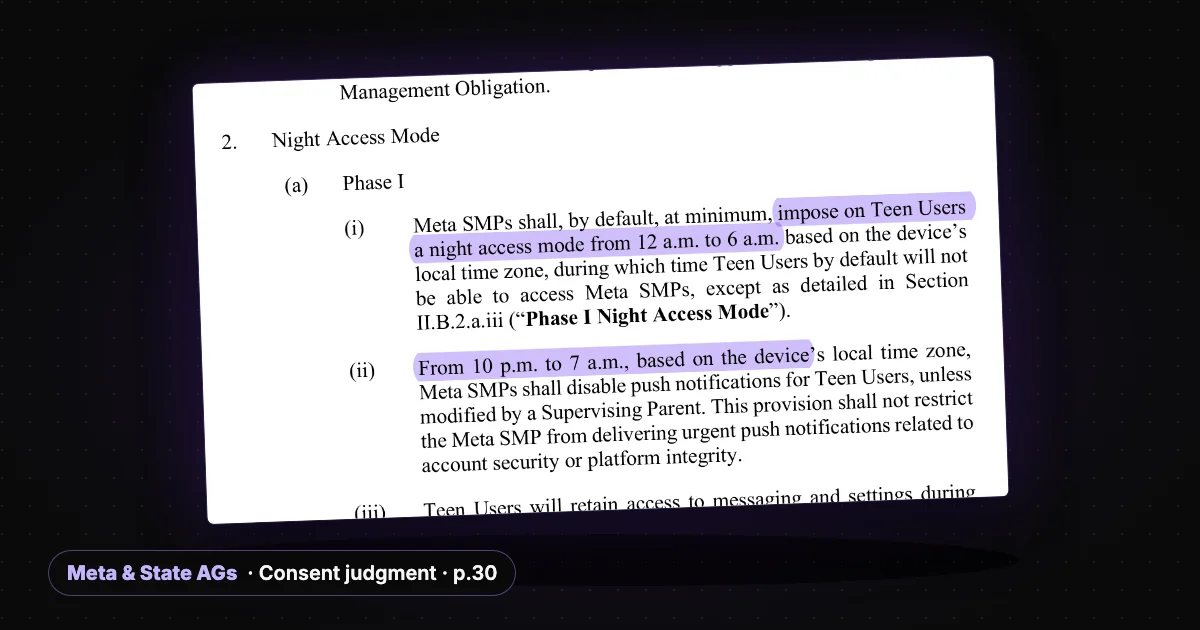
The short answer
On 26 August 2026, Meta and a coalition of state attorneys general filed a consent judgment to settle the case the states brought in October 2023, and the federal docket shows the court entered it the same day. Meta's apps now owe teens default limits that look a lot like a parental-control app built in:
- Locked out from 12am to 6am
- No notifications from 10pm to 7am, or during school hours
- 2 hours a day, across Instagram, Facebook and Meta's other social apps
- No like or reaction counts
The attorneys general put the money at up to $17.1 billion. Meta admits no wrongdoing.
The filing is People of the State of California, et al. v. Meta Platforms, Inc., Case No. 4:23-cv-05448-YGR, Document 572-1, part of the federal social media case, MDL 3047. Page numbers below are pages of that filing.
Who signed
The payment table lists 51 jurisdictions: 47 states, the District of Columbia, Puerto Rico, American Samoa and the Northern Mariana Islands. Florida, New Mexico and Texas are not on it. New Mexico had already taken Meta to trial and won.
What changes for teens now: Phase I
These are defaults. A teen can make them stricter; only a supervising parent can loosen them.
| Rule | Phase I default | Page |
|---|---|---|
| Night access mode | Locked out 12am to 6am (messaging and settings stay) | p.30 |
| Night notifications | Off 10pm to 7am, except urgent security alerts | p.30 |
| Daily limit | 2 hours cumulative across Meta's social apps | p.31-32 |
| School Mode | Notifications off during school hours | p.33 |
| Pauses | At 60 and 90 minutes of daily use, plus a notice after any 15-minute continuous session | p.33 |
| Likes | Teens see no like or reaction counts | p.35 |
| Filters | Cosmetic-procedure filters disabled for teens | p.35 |
| Feed | An option to make a non-personalized feed the default | p.35 |
The daily limit excludes long-form video, messaging and settings. Once it is hit, Meta's apps are not allowed to nudge the teen toward another Meta app or toward messaging instead. Exhibit G (p.130) even includes drawings of how prominent the pause screens have to be.
The stricter limits come later, maybe: Phase II
The rules that made headlines, 60 minutes per app and 120 minutes in total, plus a night mode from 10pm to 7am, are Phase II. They switch on only on "Industry-Wide Adoption": when every core industry competitor is bound by substantively equivalent obligations, through its own settlement, a law, or by volunteering them.
In practice that means Meta's tighter limits depend on Snap, TikTok and YouTube doing the same. Until then, Phase I applies.
The money
The attorneys general announced up to $17.1 billion over ten years, $12.1 billion guaranteed. Here is how that maps onto the filing:
| Payment | Amount | Where |
|---|---|---|
| Guaranteed installments to states | $11.66 billion | Exhibit B, p.110 |
| Contingent installments | $5.02 billion | Exhibit B, p.110 |
| Cambridge Analytica payment (a separate, older dispute folded in) | $459 million | Exhibit E, p.127 |
| State costs | $75 million | p.48 |
The contingent $5 billion is forfeited back to Meta for any state whose trigger is never met (p.49), so "Meta pays $17 billion" overstates what is certain.
What it is not
- Not an admission. The judgment says it is "for settlement purposes only" and does "not constitute an admission… of any liability, wrongdoing, or violation" (p.7).
- Entered, per the docket. The document filed on 26 August is marked [proposed]; the federal docket shows the judge entering it the same day as Document 576.
- Ten years. Unless the agreement says otherwise, the obligations expire 10 years from the effective date.
Where it fits
Notice how much of this mirrors what New Mexico's judge ordered three weeks earlier: hidden likes and quiet notification hours for teens. And notice what is missing from both: no court or settlement has yet removed infinite scroll or autoplay. The full sequence is in the social media lawsuits timeline.
Frequently Asked Questions
Keep Reading
Try Habit Doom
Lock your distracting apps. Complete your habits. Earn your screen time. It takes 30 seconds to set up.
Download Free