


The EU Says TikTok and Meta's Design Is Addictive

 X
X LinkedIn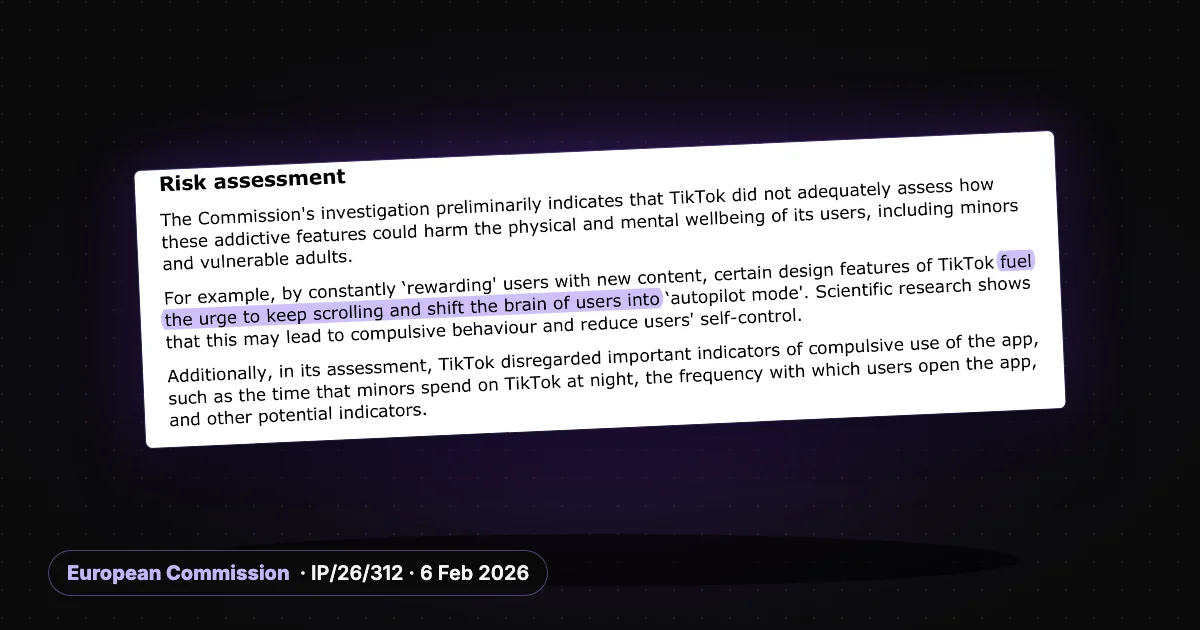
The short answer
In 2026 the European Commission told two of the biggest social media companies that their design itself breaks EU law:
| TikTok | Instagram and Facebook | |
|---|---|---|
| Preliminary findings | 6 February 2026 (IP/26/312) | 10 July 2026 (IP/26/1579) |
| Formal proceedings opened | 19 February 2024 | 16 May 2024 |
| Features named | Infinite scroll, autoplay, push notifications, personalised recommender | The same four |
| Suggested fix | "Change the basic design of its service" | Disable autoplay and infinite scroll by default |
Both are preliminary findings under the Digital Services Act, the EU law that makes very large platforms assess and reduce the risks their services create. Neither is a final decision.
"Autopilot mode"
The most quoted line appears, in nearly the same words, in both releases. For TikTok, the Commission wrote that by "constantly 'rewarding' users with new content, certain design features of TikTok fuel the urge to keep scrolling and shift the brain of users into 'autopilot mode'." For Meta, that personalised recommendations, autoplay and infinite scroll "fuel the user's urge to keep scrolling and shift the brain into 'autopilot mode', contributing to unhealthy habits and compulsive use."
It is unusual language for a regulator, and it is backed by what the Commission says was an in-depth investigation: the companies' risk assessments, internal data and documents, answers to repeated information requests, scientific research, and interviews with experts including in behavioural addiction.
What the Commission found
The companies did not assess the risk properly. TikTok, it said, disregarded indicators of compulsive use such as how long minors spend on the app at night and how often users open it. Meta disregarded what it knew about minors' night-time use and how formats like Reels and Stories could drive compulsive use.
The safety tools do not work well enough. This is the finding that matters most to anyone who has tried an app's built-in limits:
- TikTok's time-management tools "are easy to dismiss and introduce limited friction", and its parental controls require extra time and skill from parents.
- Instagram and Facebook's time-management tools, "including those activated by default for teens, can be easily dismissed and do not lead to a meaningful reduction" in use. Their parental controls only work if parents have the technical expertise and time to understand them.
What the Commission wants changed
For TikTok, it said the company "needs to change the basic design of its service", for example by disabling infinite scroll over time, adding effective screen time breaks including at night, and adapting its recommender.
For Meta, design changes to both apps: disabling autoplay and infinite scroll by default, effective screen time breaks, and a recommender that is "less engagement-oriented."
What happens next
Each company can examine the Commission's file and reply in writing. The European Board for Digital Services is consulted. If the Commission confirms its view in a non-compliance decision, it can fine the company up to 6% of its total worldwide annual turnover.
Both investigations are wider than design. TikTok's covers the "rabbit hole" effect, age assurance and minors' privacy and safety; Meta's covers age assurance for under-13s (preliminary findings on 29 April 2026) and rabbit-hole effects.
Where it fits
The US cases have mostly been fought over disclosure, negligence and money. The EU is the first regulator to aim directly at the features themselves. Compare it with the New Mexico judgment, where a US court agreed the same features drive problematic use but said the First Amendment and Section 230 stopped it ordering them removed. The full sequence is in the social media lawsuits timeline.
Frequently Asked Questions
Keep Reading
Try Habit Doom
Lock your distracting apps. Complete your habits. Earn your screen time. It takes 30 seconds to set up.
Download Free