


New Mexico v. Meta: The $942 Million Judgment

 X
X LinkedIn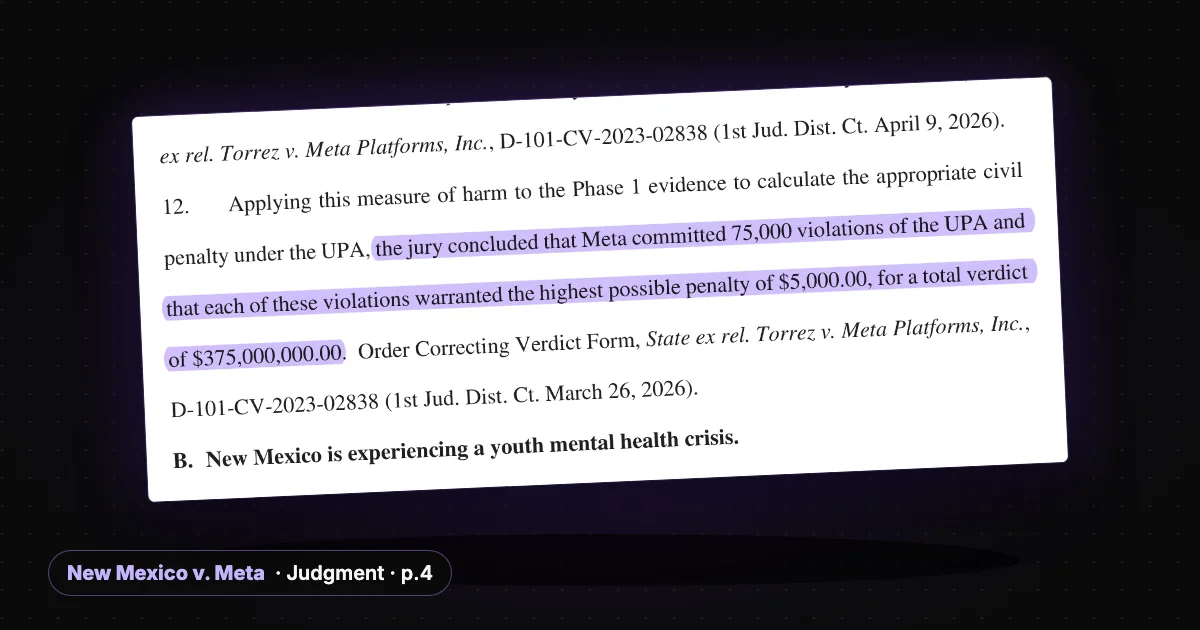
The short answer
New Mexico sued Meta on 5 December 2023, took the case to trial in 2026, and won. A jury found 75,000 violations of the state's Unfair Practices Act and gave every one the maximum $5,000 penalty: $375 million. The judge then found Meta had created a public nuisance, ordered it to pay $567 million into an abatement fund, and ordered changes to how Facebook and Instagram work for teenagers in the state. In total: $942 million.
The case began as a suit focused on child sexual exploitation on Meta's platforms, with a public nuisance claim; the trial covered both that and adolescent mental health.
This is a verdict and a judgment, not a complaint. It is the strongest kind of evidence in this whole area.
The case is State of New Mexico ex rel. Raúl Torrez v. Meta Platforms, Inc., No. D-101-CV-2023-02838, First Judicial District Court, Santa Fe County. The judgment was filed on 6 August 2026.
How the trial worked
The court split the case in two.
| Phase | When | Who decided | Question |
|---|---|---|---|
| 1 | 2 Feb to 24 Mar 2026 | Jury | Did Meta violate the Unfair Practices Act, and what penalty? |
| 2 | 4 to 22 May 2026 | Judge | Did Meta create a public nuisance, and what must it do to abate it? |
The jury question was about disclosure. The instruction asked how many people under 18 in New Mexico used the platforms because they were not properly informed of the risks, or would not have used them if they had been. The jury's answer was 75,000, at the top penalty each.
What the court heard about design
The findings record testimony from Dr. Damon McCoy, admitted as an expert in social media integrity systems. On autoplay, endless scroll and low-value notifications, he testified that inside Meta "they were considered dark patterns and addictive-like designs." Elsewhere: "Meta had knowledge that… their products were… basically Attention-Capture Damaging Patterns." That is expert testimony the court recorded, not the court's own words.
The court's own conclusion on design is notable. It agreed with the State that autoplay, infinite scroll, like counts and algorithmic recommendations "combine to facilitate addictive or problematic behaviors in adolescent users."
The $567 million abatement fund
On top of the jury's penalties, the court ordered Meta to pay $567,000,000 into a fund the State draws down over five years to address the harm:
| Category | Amount |
|---|---|
| Treatment | $420,000,000 |
| Screening and assessment | $90,000,000 |
| Awareness and prevention | $33,000,000 |
| Referral, linkage and coordination | $15,000,000 |
| Implementation, quality improvement and evaluation | $9,000,000 |
The court reduced the State's estimate partly because, in its words, other social media companies share responsibility for the harm to New Mexico teenagers. Meta's compliance obligations run for a five-year abatement period, paused during any appeal if Meta posts a bond.
What Meta was ordered to do
For accounts belonging to under-18s in New Mexico:
- Notifications off from 10pm to 7am every day, and 8am to 3pm on school days. Messages from connected users and urgent alerts are exempt.
- Like counts hidden by default. Only a parent or guardian can switch them back on.
- A usage cap of 90 hours a month, cumulative across Facebook and Instagram.
Beyond that, Meta must show safety banners (monthly for adults, weekly for teens), show new teen users a daily information screen for their first 30 days covering things like "rabbit holing" and tools against problematic use, fund a state-approved education campaign with materials for schools, keep its researcher data access running, and change how it reports child sexual abuse material, including human review of new reports from New Mexico before they go to NCMEC.
What the court refused
The court granted no relief on Meta's algorithm, and did not restrict infinite scroll or autoplay. Its reasons: those features are closely tied to how content is presented, which raises First Amendment and Section 230 problems, and they are used across the industry, so restricting only Meta, whose competitors were not in the case, could harm Meta unfairly. It also declined to appoint a child safety monitor, preferring specific, checkable requirements.
That is the most interesting tension in the judgment. The court found the features contribute to addictive use, and found it could not order them removed.
Where it fits
New Mexico ran in parallel with two other big 2026 moments: the first social media addiction jury verdict in Los Angeles in March, and Meta's separate settlement with a coalition of states in August. The full sequence is in the social media lawsuits timeline.
Frequently Asked Questions
Keep Reading
Try Habit Doom
Lock your distracting apps. Complete your habits. Earn your screen time. It takes 30 seconds to set up.
Download Free