


Project Mercury: What the Unsealed Social Media Files Show

 X
X LinkedIn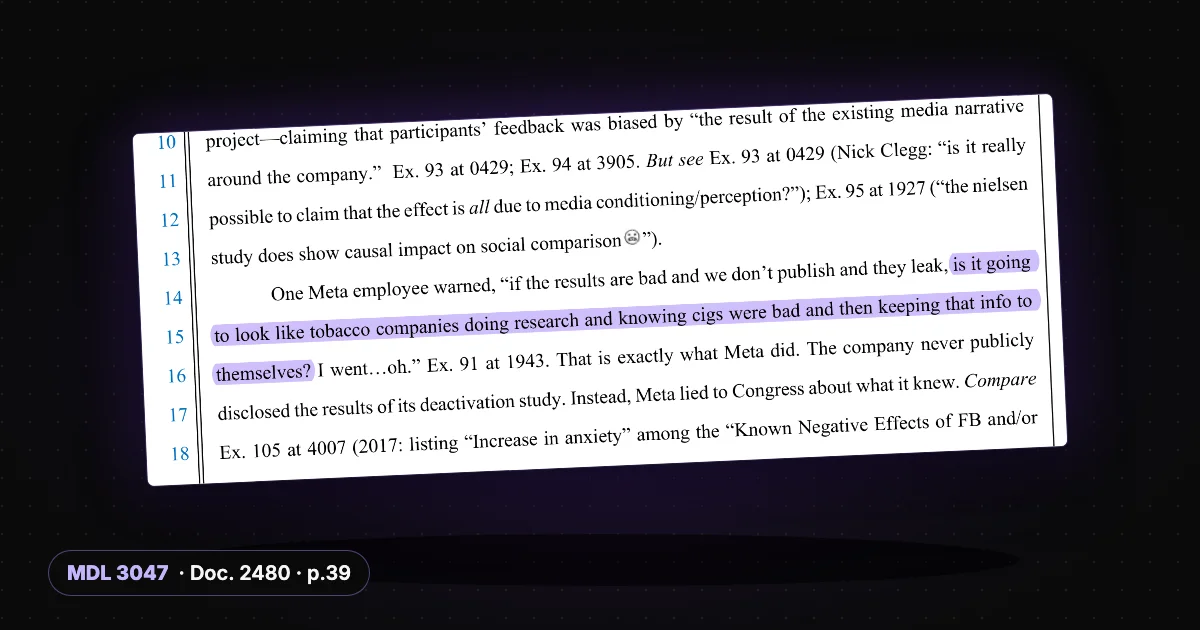
What was unsealed
On 21 November 2025, school districts suing Meta, TikTok, Snap and YouTube filed a 235-page brief in the federal social media addiction case, MDL 3047 (Case No. 4:22-md-03047-YGR, N.D. Cal., Document 2480). It opposes the companies' motions for summary judgment in six bellwether school district cases, including Tucson Unified, Charleston County and DeKalb County, and was filed in a less-redacted form that made the quotes public.
What makes it unusual is how much of it is the companies' own words. The brief quotes internal emails, chats, decks and research by exhibit number, company by company. Page numbers below are PDF pages of that filing.
One rule before reading on: this is the plaintiffs' brief. The quoted lines are internal documents, but which lines were chosen, and the argument around them, belong to the school districts. The companies dispute the claims.
Meta: Project Mercury
The passage that gave the filing its nickname is on p.39. Project Mercury was a Meta research project run with Nielsen on what happens when people deactivate Facebook. According to the brief, it found that people who stopped using Facebook reported lower depression, anxiety and loneliness, and Meta halted it.
The brief quotes a staff member: "the nielsen study does show causal impact on social comparison." And another, asking whether it would "look like tobacco companies doing research and knowing cigs were bad and then keeping that info to themselves?"
The rest of the Meta section is in the same register:
- p.40: an in-house scientist who had taught a course on addiction wrote that "some of our users are addicted to our products… driving sessions incentivizes us to make our product more addictive… Intermittent rewards are most effective (think slot machines)."
- p.56-57, Take a Break: a default-on test was blocked, Meta projected more than 99% of teens would never use the opt-in version, and actual adoption was 0.45%.
- p.62, Project Daisy: hiding Like counts was estimated at an "ad revenue impact of minus 1%", and one employee called it "such a rare case where a product intervention can improve well-being for almost everyone."
- p.80-81: "No one wakes up thinking they want to maximize the number of times they open Instagram that day. But that's exactly what our product teams are trying to do."
TikTok: "a few minutes fewer means fewer ads"
- p.110: "[e]ven a few minutes fewer means fewer ads and the impact on revenue at scale is significant."
- p.112-113: "Our goal is not to reduce time spent." The screen-time reminder videos were first named "Addiction" and renamed "Take a Break". Trust and Safety wanted a hard cap; Government Relations wanted one teens could turn off.
- p.113-114: the brief contrasts TikTok's sister app in China, Douyin, which caps under-14s at 40 minutes a day and blocks use from 10pm to 6am. Internally: "Douyin's focus on addiction, while ours is on agency."
Snap: the Streaks spread
p.137-138 tells the Streaks story on two pages. Internally, Streaks were described as "Daily Habit Training" and as an "accidentally addictive, somewhat unhealthy feature that gamifies friendship in a weird way." The brief says Snap's CEO asked for a plan "to kill streaks" because "it's the right thing to do", and that they were never killed because they were "a main driver of . . . engagement."
On p.132, a line about the Discover feed reads "I think we wish it was more addictive compelling", with "addictive" struck through in the original document.
YouTube: "an app that is…Addictive"
- p.174: a 2016 deck to executives set the aspiration to "create an app that is…Addictive[:] Our app experience should compel users to come back more and more often."
- p.177-178: "More autoplay = more WT, and that was an explicit goal of the project" and "Autoplay's share of watch time doubles at night."
What to be careful about
Three passages are often misquoted, and the brief itself is careful about them:
- p.55, on "stopping cues", is deposition testimony from Aza Raskin, who invented infinite scroll. It is not a Meta document.
- p.101, comparing TikTok to gambling, is the lawyers' paraphrase of a deposition. The internal words on that page are "compulsive usage", "habit moment" and "slot-machine effect".
- p.176, comparing YouTube to a slot machine, is YouTube's own wellbeing deck reporting what outside experts say.
Redacted numbers stay redacted. Where the filing blacks something out, nobody outside the case knows the figure.
Where it fits
This filing is one entry in a much longer story that includes a jury verdict, a state trial and a settlement. See the full social media lawsuits timeline, the first addiction verdict, and what Meta agreed to in its settlement with the states.
Frequently Asked Questions
Keep Reading
Try Habit Doom
Lock your distracting apps. Complete your habits. Earn your screen time. It takes 30 seconds to set up.
Download Free